





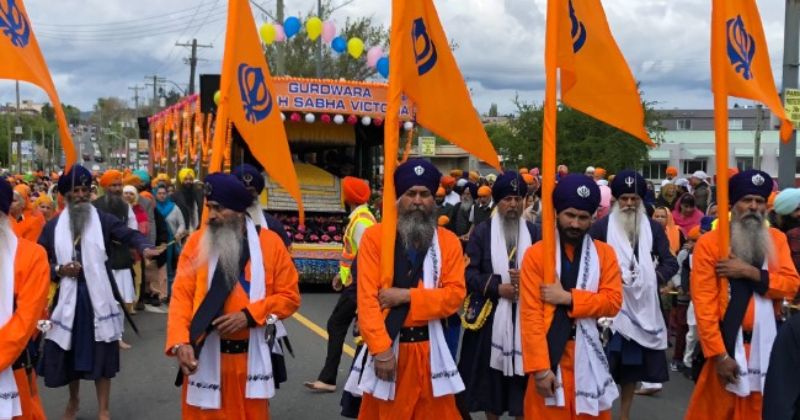
The Sikhs world over celebrate Baisakhi every year on April 13 or 14 which is the day when a new faith the Sikh religion was born. The birth of the Khalsa was done in the grandest of ceremonies on the first of Vaisakh 1756 BK (March 29, 1699 CE) 325 years back. Sikh religion is the latest evolved by human beings after Hinduism, Buddhism, Jainism, Christianity, Islam, Judaism and Zoroastrianism.
The emergence of Sikh religion was the logical outcome of the blueprint given by Guru Nanak Dev the first of Sikh Gurus. The unique event of Baisakhi in 1699 was the culmination of the political and social scenario prevalent in those times. The Mughal state had assumed the form of a purely Islamic state under Aurangzeb. Earlier, especially in the times of early Mughal rulers Babar, Humayun and Akbar, the rule was largely Islamic but not totally Islamic. However, in Aurangzeb’s time, the state became entirely Islamic as orthodoxy was adopted as an “imperial policy”. He began with puritanic measures. In the second year of his reign, he discontinued the celebration of Nauroz (first day of the lunar year). A few years later music and dancing were prohibited. “Zharoka Darshan” was discontinued on the ground that it smacked of human worship. Severe punishments were given for anything that was construed by the theologians as violating the spirit of Islam. Non- Muslims were singled out for discriminatory treatment in the fields of public services, construction and repair of temples, conversion and taxation.
Islam being a missionary religion and the ruling Muslim community being in a minority, great importance was attached to conversions. In March 1695 CE, all the Hindus, except Rajputs, were ordered not to ride elephants, fine horses or palanquins or to carry arms. Aurangzeb was equally bigoted towards Shias, Sufi saints and liberal minded Muslims. In 1661 CE Mansur-e-Sani Sufi Muhammad Sarmad was beheaded for believing in Sufi principles. In 1699 CE even celebration of Moharram was banned. The 9th Sikh Guru, father of Guru Gobind Singh, Guru Teg Bahadur was beheaded in 1675 in Delhi at Sisganj near the Red Fort on the orders of Aurangzeb. His crime being saving the Kashmiri Brahmins from being converted to Islam. Such were the suffocating circumstances which led to the birth of Khalsa, the Sikh religion on the day of Baisakhi in 1699.
The tenth Guru for the protection of religion and justice decided to put his plan into operation on the first of Vaisakh 1756 BK (March 29, 1699CE). He sent hukamnama to his large number of followers inviting them to visit Anandpur Sahib, a city in Punjab founded by his father, in full strength on the Vaisakhi festival. The Sikhs responded by gathering in very large numbers, on day of the festival. Some historians put the number at 80,000. In those times, when means of communication were very less, this number of gathering speaks of the influence Guru Gobind Singh was having on the minds of people. The people had come from far of places as Jagannath Puri in the east, to Bidur in the south, to Lahore and Delhi in the north, to Dwarka in the West.
The Guru rose early on that day and sat in meditation. He then appeared before the sangat who hailed him with shouts of greetings. Bhai Mani Singh gave exposition of a shabad from the Adi Granth. The Guru then with his sword unsheathed spoke “Is there anyone here who would lay down his life for his Guru and Dhararm” It was an amazing call and his words created confusion and silence among the gathering. They could not understand what the Guru meant and gazed in awed silence until he spoke again. Now confusion turned into fear. For the third time, Sri Guru Gobind Singh repeated his call. Now Daya Ram, a Khatri (carpenter) from Lahore stood up and said in humility “My head is at thy disposal, my true Lord. There would be no greater gain than dying under thy sword”.
The Guru took him to a specially improvised enclosure close by. The Guru returned with his sword dripping blood, and wavering it to the multitude asked for another head. This was more than any one could endure. People started leaving the place. But another person from Delhi Dharam Das, a jat (OBC) came forward to offer himself for sacrifice to the Guru. He too was taken to the enclosure. In the same way the Guru made three more calls. Mokham Chand a chibba from Dwarka in Gujrat, Himmat a jhinwar from Jagannath Puri in Orissa and Sahib Chand, a barber (again a so called low caste) from Bidar in Karnatka cheerfully responded one after another and advanced to offer their heads. After few minutes, the Guru led the five Sikhs back from the enclosure in which he had taken them one by one. In the enclosure confidentially guarded he had kept sets of apparel specially designed for the occasion. Decked in saffron coloured gorgeous outfits topped over with neatly tied turbans of the same colour, the glorious five (the panj piyaras-the five beloved) walked deferentially behind the Master, overwhelmed with gratitude. The Guru was himself attired in the same manner as his chosen five disciples.
The gathering considerably thinned and silence struck was further puzzled to see those whom they had thought to have been sacrificed to the Guru’s whim reappear in flesh and blood and gloriously dressed. The Guru took water in an iron bowl, stirred it with a khanda (double edged sword-a dagger) to the recitation of hymns. A plate full of patasas (a sweet) brought by Mata Jito, the Guru’s wife was put in the water. Amrit, the nectar of immortality was now ready and was administered to the five beloved to signify their initiation into the casteless fraternity of the Khalsa (a new Sikh faith). Their names were changed and they were given one family name “Singh” which is derived from Sanskrit “simha” meaning lion — it was and is commonly used as a surname by the Rajputs, Gurkhas and many others belonging to Hindu martial classes. A sikh woman takes the surname “Kaur” on baptism. Kaur is also a common surname derived from the word “Kanwar” used for Rajput women and means both a princess and lioness. This moment on, that Baisakhi of 1699 marked their complete break with the past and it required the initiated to live a virtuous life of morally responsible action under the discipline and code especially prescribed for him. For outward symbols, the Guru asked them to always wear unshorn hair (kesh), a comb (kangha) in the hair knot, an iron bangle (kara) on the right wrist, a sword (kirpan) on his person, a kachha (a pair of short breeches). These five K’s (kesh, kanga, kara, kirpan, kachh) are the marks of investiture on the personality of an initiated Sikh. The five symbols taken together signify that a Sikh, both as an individual and a corporate body should be strong in body, mind and soul and develop an integrated personality. The distinctive appearance of a Sikh imparts a semblance of unity, close brother hood, equality, group consciousness and above all an ethical and morally right conduct.
In addition to the five above emblems, a Sikh is prohibited to smoke, chew tobacco or take alcoholic drinks. He is also directed never ever to violate the modesty of women of even the enemy. The first Guru of Sikh faith Guru Nanak, in whose times woman folk was considered to be inferior and girl infanticide on birth of a girl child was common in society. Guru Nanak declared in his hymm ‘so kyon mandaa aakheye jit jame raajaan” i.e. “how can you call a woman inferior who gives birth to kings, saints and great men. The existence of this world is only possible through women only”. The tenth Sikh Guru who founded the faith on Baisakhi, suffered enormously at the hands of the ruler of those days still proclaimed in his hymn that “maanas ki jaat sabhe eko pahachanbo” i.e. consider all men of all castes and creeds as same”. He was master in four languages Saskrit, Punjabi, Persian and Brijbhasha. He edited Sri Guru Granth Sahib (the Holy Book of the Sikhs) and directed all Sikhs to consider this Holy Book as their Guru (Master). The Holy Granth contains hymns of six Sikh Gurus and thirty saints, the greatest ever till those times. The saints like Kabir Ji, Ravidas Ji, Namdev Ji, Farid Ji, Dhanna Ji, Peepaa Ji, Trilochan Ji included are of different castes, many of them were considered to be of so called low castes.
Baisakhi celebrated on April 13 or 14 of every year is also marked as a day of festivities as the crop of wheat and other food grains is ready to be cut and the farmer earns money for the crops grown in his agricultural farms. Thus various programmes are conducted by the Punjabis and Sikhs not only in India but all around the world as the Sikhs are living in large numbers now a days in all corners of the world. Large number of Sikhs are living in U.S., U.K., Canada, Europe and virtually in all Continents. The Sikhs as initiated and instructed by their Master on the Baisakhi of 1699 are patriots by their hearts and serve the country of their birth and living with a sense of pride, duty and devotion.
The very purpose of all ten sikh gurus was to underline and strengthen the social, cultural, religious and spiritual unity of the Indian nation and society. It was to underline, re-narrate, retell and reemphasize this unity that Guru Gobind Singh ji when editing the Holy Guru Granth Sahib included the Vani (hymns) of thirty great saints of various castes, and religions and places of India apart from the hymns of six sikh Gurus. Also the Panj Piyaras who were administered Amrit on the Baisakhi of 1699 were of different regions of India. like Lahore, Bidar, Jagannath Puri, Dwarka and Hastinapur. Guru Gobind Singh Ji was born in Patna Sahib (Bihar), created Khalsa in Anandpur Sahib (Punjab), edited and prepared Guru Granth Sahib in Paonta Sahib Yamunanagar (Haryana) and left for heavenly abode in Nanded (Maharashtra). All Sikh Gurus considered whole of India as their motherland and never hesitated to sacrifice everything including their lives for it. It is the duty of every sikh to serve the very purposes enshrined by all sikh Gurus including Guru Gobind Singh Ji and stand by them strongly and tell loudly and clearly that patriotic blood runs in the veins of every sikh. The sikhs in India are well placed and they have occupied all the top positions in India right from the President, Prime Minister, Chiefs in Army and Air force. Every Indian of any caste, creed or religion keeps and sees the sikhs in high estimation. On this auspicious day of themselves Vaisakhi, sikhs should re-dedicate themselves to the great ideals of our great Gurus.
















Comments