





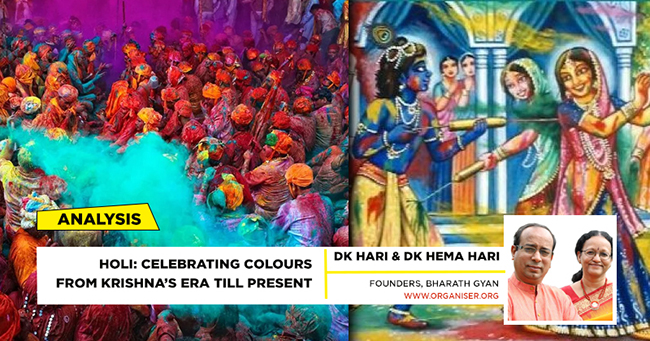
Holi is today celebrated as the festival of colours in every nook and corner of this land, because it signifies the arrival of spring when nature is in full bloom. People spray colours, dance together and prepare various delicacies on this day. Besides, it is the day to end and rid oneself of past errors, to end conflicts by meeting others, a day to forget and forgive. Holi also marks the start of the New Year for many.
Where did this festival originate from?
Holi finds a mention in numerous scriptures like Jaimini Purvamimamsa-Sutras and Kathaka-Grhya-Sutras which have detailed descriptions of the celebration of the festival.
The word “Holi” can be traced back to Holika, the sister of the Asura King, Hiranyakashyapu and the aunt of Prahalada. The story of Holi is a part of the legend of Narasimha Avatar, which has great significance and many lessons.
The story of Prahlada and Narasimha King Hiranyakashipu was a mighty Asura king who was blinded by ego and greed for power. He was a tyrant king, who had a son called Prahlada, who was pure at heart, a believer in good and the divine.
Holi, with such antiquity and continuity, in tune with the cycle of seasons, has been and continues to be celebrated all across the land to revel in the acts of Krishna, knowledge of Krishna, the values that Krishna gave forth
Prahlada believed in Narayana, the ultimate source of the entire Creation and hence earned the wrath of his father Hiranyakashipu for not regarding him as the ultimate master. Hiranyakashipu therefore tried various means to kill Prahlada, his own son, but Prahlada always emerged unscathed.
Finally, Hiranyakashipu challenges Prahlada to prove that Narayana is indeed real, supreme and resides in everything including the inanimate. He then breaks a pillar with his mace to disprove Prahlada.
Lo and behold, the pillar splits and from within, emerges a ferocious being, half man-half lion, the avatara, incarnation of Vishnu, who lays Hiranyakashipu on His lap and slays him. This form was Narasimha meaning half man, half lion – Nara, “man” and Simha, “lion”. Narasimha slaying Hiranyakashipu – a sculpture, a painting
Symbolic meaning
There is a symbolic message relevant for our present times, from the legend of Hiranyakashipu and Prahlada. The name Hiranyakashipu means, “one who has a golden bed”. Hiranya means gold or golden hued and Kashipu denotes a bed. Hiranyakashipu was a King who rolled in absolute wealth, wealth that led to ego and arrogance, which in turn demanded submission and recognition as the supreme power.
Hiranyakashipu symbolises the greed for wealth, power and recognition in the society today which has eventually now led us to a corrupt society.
Prahlada means, “one who naturally evokes a feeling of happiness and peace”. It comes from the word “ahlada” which means, “reviving, refreshing, cheerfulness, joy, delight, gladness”. It denotes the gladness that leads to peace and happiness which can arise only from the possession of true knowledge. Pra means “special”, “natural”. It is akin to how the vision of a full moon inherently gives rise to a feeling of peace, comfort and happiness.
Holi from Holika, the Aunt of Prahlada
The slaying of Hiranyakashipu by Narasimha is a moral lesson on how one should not cultivate ego, not be blinded by uncontrolled greed and desire for power, as it can finally lead to unprincipled ways of living and a violent end.
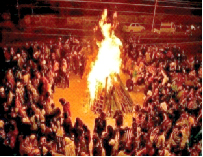
As part of his many unsuccessful attempts to kill Prahlada, Hiranyakashipu requests his sister, Prahlada’s aunt Holika for help. Holika had a special power of being able to withstand fire. So she chose to kill Prahlada by fire and sat on a pyre holding him tightly in her lap. However, the power of Prahlada’s faith in Vishnu / Narayana was so great that she got burnt instead and Prahalada escaped unscathed.
This event is also referred to as Holika Dahan and the festivities that arose therefrom are also referred to as ‘Dhulandi’, one of the high points in Holi celebrations in present times too, where a bon fire is raised, in which everyone participates.
While the bon fire idea, dahan may have started with Holika being burnt in it, later, through the ages, the dahan came to symbolize the collective burning of ill will on this occasion of Holi.
In today’s celebrations, Holika Dahan or the lighting of bonfire takes place on the eve of Holi. The day is also popularly called ‘Chhoti Holi’ or the ‘Small Holi’. The bigger event – play with the colour, takes place on the next ‘big’ day.
One should burn one’s ego. Only then does our life becomes multifaceted and colourful. Holi brings forth this important lesson.
Holi – A Reminder Of The Remains In Multan
Multan which is in Pakistan today, has been widely held to be the place where King Hiranyakashipu met his end at the hands and on the lap of Narasimha. Multan has thus been revered as the place of incarnation of Bhagwan Narasimha. Sculptures showing a pillar splitting into two have been identified from here as also the ruins of the temple here called Prahladapuri in honour of Prahlada for whom the Bhagwan incarnated.
The present day ruins of Prahladapuri temple are believed to stand where Prahlada had built a temple originally to Bhagwan Narasimha. Successive generations have ensured the presence of a temple here through the flow of time.
Holi is a festival that, along with Holika and Prahlada, brings to mind Hiranyakashipu and his end at the hands of Sri Narasimha who emerged at Multan.
Holi Celebrated During Krishna’s times
We thus see the cause for Holi going back to the times of Narasimha Avatar, much before the times of Shri Krishna. Though Holi celebrations started from the times of Narasimha, this festival appears to have taken on a colourful and festive hue from the times of Krishna.
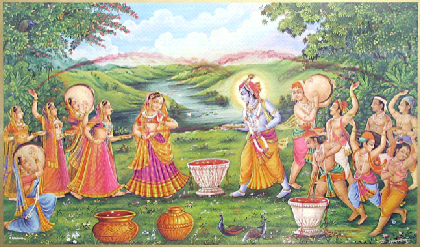
Krishna, who came much after the incarnation of Narasimha, in His youth, along with the other lads of the village, has also celebrated the festival of Holi with the Gopika stree, milkmaids.
This celebration of Holi then, started on Phalgun Poornima, the Full Moon day in the lunar month of Phalgun and continued upto Ranga Panchami, the fifth phase of the moon when colours were splashed on each other, symbolic of the colour in Nature springing forth with the forthcoming spring season or Vasant Ritu.
Krishna playing Holi
Holi in Barsana
In the birth place of Radha, the village of Barsana in Braj, Holi is celebrated even today, in a distinct style where the women chase the men with sticks and the men dodge getting caught and beaten. It is called Lathmar Holi. This is a symbolic representation of the times of Krishna, when the Gopika, women of the village would chase away the cowherd boys who had come to steal butter along with Krishna.
Through the last 5000 years, this unique tradition of celebrating this period as Braj Holi and Lathmar Holi, has continued in this land of Braj Bhumi.
Holi: A Historic Festival
Holi, with such antiquity and continuity, in tune with the cycle of seasons, has been and continues to be celebrated all across the land to revel in the acts of Krishna, knowledge of Krishna, the values that Krishna gave forth. These historic festivals transport people back in time to the historical pastimes of Krishna in the historical land bound by the geography of Braj. More on Krishna, His times and Braj in our book, Historical Krishna .












Comments