
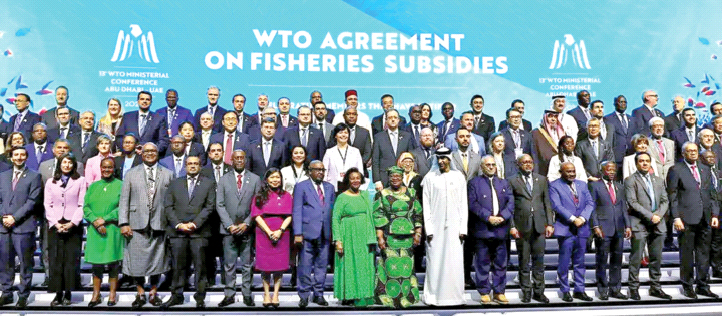
The 13th Ministerial Conference of the World Trade Organisation was scheduled in Abu Dhabi, United Arab Emirates, from February 26 to 29. Since consensus could not be reached among the members of different countries on different issues, this conference was extended for two more days till March 2, 2024. But it’s significant that despite extension, a consensus could not be reached and the conference ended without conclusion regarding various issues. Only one issue, where agreement could be reached, despite intense opposition from majority member countries, was tariff moratorium on e products. This also could happen, due to an appeal by the Trade Minister of UAE. But what this decision means is that this tariff moratorium will supposedly be the last one. Final document notes, “Members also agreed to maintain the current practice of not imposing customs duties on electronic transmissions until the 14th Session of the Ministerial Conference (MC14) or March 31, 2026, whichever is earlier. The moratorium and the Work Programme will expire on that date.” It may be noted that since 1998, this moratorium has been continued, as the same keeps on extending periodically, by the member countries.
There were several other issues in this conference on which there was lack of convergence, since the beginning of the conference. These issues were fisheries subsidies, permanent solutions for public stock holdings of food, investment facilitation for development agreement (IFDA), spearheaded by China. Apart from this, another important issue, which the developed countries had been pushing forward was the issue of so-called reforms in the World Trade Organisation.
Subsidies On Fisheries
The topic of disciplining fisheries subsidies first came up at the Doha Ministerial Conference in 2001. Some members demanded that subsidies that contribute to overfishing and overcapacity in the oceans should be banned. It also called for the elimination of subsidies that contribute to illegal, unreported and unregulated (IUU) fishing. Members adopted the Fisheries Subsidy Agreement at the 2022 ministerial conference in Geneva, but it could be adopted formally, only if ratified by two-thirds of WTO members. Although it was ratified by some members at the 2024 Abu Dhabi conference, there were wide differences among WTO members on several key issues, including the definition of harmful subsidies, especially distant waters by vessels of developed countries. Due to differences on limiting the subsidy being given, a consensus could not be reached in MC13.
Our Indian delegation raised the issue of protecting the interests of 50 crore fishermen of the world, including Bharat and placed a condition that this agreement should not be taken forward until a decision is taken on subsidies for fishing in distant waters, impacting the catch by traditional fishermen. It was also pleaded that countries should be allowed to subsidise fishing in their Exclusive Economic Zones (EEZs), for the next 25 years. Since developed countries were not ready for either of these demands, this agreement did not move forward.
When some developed countries, including USA, objected to the subsidy given by Bharat for public food stockholding, saying that the same is trade distorting, in the 9th Ministerial Conference held in Bali, Bharat argued that this subsidy is for public stockholding for ensuring food security for the poor. At the same time, it was also argued that the method of calculation of subsidy is also not justified, because the reference year for making this calculation is 1986-88. It is noteworthy that after 1986, there has been a significant increase in the market price of food products, hence there is a need to replace this reference year with the latest one. In view of all these things, a peace clause was agreed to give relief to India and other developing countries from this objection, that the developed countries will not raise any objection to food subsidy, till there is a permanent solution is reached to this issue.
In this conference, the issue of a permanent solution to the quest of subsidies for public stock holding was on agenda. Developed countries were adamant that a permanent solution to food subsidy issues should be linked with a limit on subsidies beyond ten per cent of total production. India was firm on its just demand that this subsidy be given for ensuring food security to the poor and there cannot be any compromise regarding this, under any circumstances; rather the reference year needs to be changed. India had the support of 80 countries of the world on this issue, saying that developed countries give 200 times more subsidies than developing countries, hence protection is necessary for resource poor farmers in developing countries. It is worth noting that Indian farmers have also been criticising the WTO on this issue. When a proposal came from the developed countries and food grain exporting countries, known as cairn countries, to set a time limit for ending subsidies for public stockholding of food, given by developing countries was tabled at the Abu Dhabi conference, India rejected it outright saying that this time limit, cannot be accepted, saying that subsidy for public stockholding is key to food security. Thus, no consensus could be reached on this issue as well.
China Led IFDA Also Blocked
MC13 was also marred by huge concerns from many countries, including India, over the potential adoption of China led Investment Facilitation for Development Agreement, or IFDA. Finally, the anxiety around the agreement ended after India and South Africa took a firm stand against it, and rightly so, at the conference, which concluded on March 2.
IFDA aimed to create legally binding rules for facilitating investment inflows and was supported by more than 120 nations, representing over 70 per cent of WTO membership. This was a plurilateral rather than multilateral agreement—meaning that it was between a select group of WTO members, but not all of them. In response, India and South Africa submitted a paper at the conference about the inadmissibility of this plurilateral agreement in WTO’s fold. With strong and formidable arguments, put forth by the joint statement by India and South Africa, IFDA couldn’t find a place in the final outcome.
There seem to be sinister designs in the intent, content, and structure of the proposed agreement. It appears that in the garb of creating global standards for investment facilitation measures, the agreement sought to deprive sovereign nations of their right to regulate and monitor FDI in their respective territories.
Post Doklam, India had put certain conditions on FDI from all border-sharing countries, mandating government approval in place of the ‘automatic route’. This measure allowed India to restrict investments from a country with which it was in conflict. If IFDA were implemented, countries party to it might be deprived of their freedom to safeguard their respective interests.
It is being observed that the IFDA had been pushed by China and more and more signatures consenting the proposal have been obtained by influencing the small nations, especially those participating in Belt Road Initiative (BRI). If we see the list of nearly 120 signatories to IFDA, around 80 are BRI countries. It’s significant that Pak and Sri Lanka didn’t sign the proposed IFDA, as they were the major victims of BRI. In the meanwhile, South Africa, and India both opposed IFDA vehemently, initially. Majority of WTO members rejected the China-backed investment facilitation plan. However, in the final document we find mention of only India, as opposer of the agreement. There is no doubt that IFDA needed to be blocked to safeguard sovereignty and global peace, which India was able to do.
WTO Reforms
There is a push from the developed countries to include new issues in WTO negotiation, what they call WTO Reforms. Inclusion of these issues is nothing but repackaged Singapore issues, which were tried to be introduced in early ministerial meetings of WTO, and were outright rejected by the majority of member countries. Now in the name of “empowering women, expanding opportunities for micro, small, and medium – sized enterprises (MSMEs) and achieving sustainable development in its three dimensions – economic, social and environmental”, the developed country members are trying to snatch away the rights of developing countries, which they have achieved over a period in WTO. For instance, they want equal treatment for underprivileged women in developed and developing countries, similarly they are also trying equal treatment for MSME of developed and developing countries both. In the name of environment they have a whole Pandora Box of promoting their business of environment products and limiting exports from developing countries in the name of environmental protection.
It is heartening to note that, there were only talks, and there was hardly any convergence on these issues. Finally, a word about the Director General of WTO, Ms. Okonjo-Iweala. There was a general feeling in the conference that DG has been crossing limits of her constitutional role. Constitutionally, Director General is an international civil servant and her role is only to facilitate the negotiations, without bias. However, DG had been pushing, sometimes even pressurising the member countries to sign the agreements, for which they were not inclined. Her actions earned her a lot of criticism from different quarters, and more explicitly from the civil society organisations.