


Cauvery and the Unfinished Agenda
December 5, 2025
  • Read Ecopy
  • Circulation
  • Advertise
  • Careers
  • About Us
  • Contact Us
Android AppiPhone AppArattai
Organiser
  • ‌
  • Bharat
    • Assam
    • Bihar
    • Chhattisgarh
    • Jharkhand
    • Maharashtra
    • View All States
  • World
    • Asia
    • Europe
    • North America
    • South America
    • Africa
    • Australia
  • Editorial
  • International
  • Opinion
  • RSS @ 100
  • More
    • Op Sindoor
    • Analysis
    • Sports
    • Defence
    • Politics
    • Business
    • Economy
    • Culture
    • Special Report
    • Sci & Tech
    • Entertainment
    • G20
    • Azadi Ka Amrit Mahotsav
    • Vocal4Local
    • Web Stories
    • Education
    • Employment
    • Books
    • Interviews
    • Travel
    • Law
    • Health
    • Obituary
  • Subscribe
    • Subscribe Print Edition
    • Subscribe Ecopy
    • Read Ecopy
  • ‌
  • Bharat
    • Assam
    • Bihar
    • Chhattisgarh
    • Jharkhand
    • Maharashtra
    • View All States
  • World
    • Asia
    • Europe
    • North America
    • South America
    • Africa
    • Australia
  • Editorial
  • International
  • Opinion
  • RSS @ 100
  • More
    • Op Sindoor
    • Analysis
    • Sports
    • Defence
    • Politics
    • Business
    • Economy
    • Culture
    • Special Report
    • Sci & Tech
    • Entertainment
    • G20
    • Azadi Ka Amrit Mahotsav
    • Vocal4Local
    • Web Stories
    • Education
    • Employment
    • Books
    • Interviews
    • Travel
    • Law
    • Health
    • Obituary
  • Subscribe
    • Subscribe Print Edition
    • Subscribe Ecopy
    • Read Ecopy
Organiser
  • Home
  • Bharat
  • World
  • Operation Sindoor
  • Editorial
  • Analysis
  • Opinion
  • Culture
  • Defence
  • International Edition
  • RSS @ 100
  • Magazine
  • Read Ecopy
Home Bharat

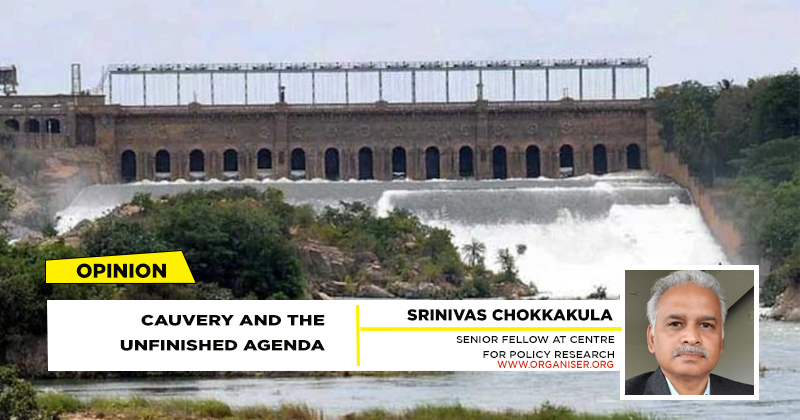
Cauvery and the Unfinished Agenda

The Cauvery water dispute involves competing claims by states over the sharing of its waters, and the recent escalation underscores the challenges in achieving a lasting resolution

Srinivas ChokkakulaSrinivas Chokkakula
Feb 4, 2024, 09:20 pm IST
in Bharat, Opinion
Follow on Google News
FacebookTwitterWhatsAppTelegramEmail

The Cauvery dispute over sharing its waters escalated again in 2023 even though the Supreme Court readjudicated it in 2018 by modifying the Cauvery Water Disputes Tribunal’s (CWDT) award of 2007. The apex court’s modification of a tribunal award is the first in the history of interstate river water disputes resolution in India. The court might have hoped that its decision would yield better compliance by states. The flare-up of the dispute, in the very first distress year after the 2018 decision raises questions about that assumption. What are the takeaways from the 2023 episode for a more enduring resolution of interstate river water disputes?

The unprecedented

The CWDT was constituted in 1990 to adjudicate the dispute, primarily between the states of Karnataka and Tamil Nadu. Pondicherry and Kerala were also the parties to the dispute. The CWDT gave its decision in 2007, but its notification was delayed; the states challenged it before the Supreme Court. The court had always carefully avoided exercising its jurisdiction in accordance with the Article 262 of the Constitution which bars courts’ jurisdiction over interstate river water disputes. Giving effect to this article, the Interstate River Water Disputes Act 1956 (IRWDA) bars the jurisdiction of the courts, including that of the Supreme Court. Yet, this time, before readjudicating the Cauvery dispute, the Court decided in 2016 that it had an appellate jurisdiction over the disputes, though it contradicts its own position in the past. It then readjudicated the dispute and gave a decision in 2018 modifying the CWDT award.

This 2018 decision the Court constituted another first. The Court ordered creating a Cauvery Water Management Authority (CWMA) to implement its decision. This is the first time an interstate institution of the nature was created. The only other instance was the creation of the Narmada Control Authority (NCA), recommended by the Narmada Water Disputes Tribunal (NWDT). The NWDT had the consensus of the disputing states to create the NCA. The CWMA did not have such consensus but was created through the fiat of the Supreme Court.

The unfinished

We must understand this episode of recurrence, escalation and mitigation of the Cauvery dispute in the interest of a resilient and robust response to the challenge of interstate river water disputes. The episode offers useful insights about the two interventions that preceded it: one, the Supreme Court’s exercising of its jurisdiction; and two, the creation of the CWMA.

A cursory perusal of the events that unfolded since the beginning of the episode in August 2023 till its de-escalation suggests the following. The 2023 episode of recurrence is no different from the earlier ones. The upstream and downstream states of Karnataka and Tamil Nādu took the usual extreme positions on the releases of allocations during distress years. The two states approached the Supreme Court as usual, and the nation witnessed the spectacle of haggling about the extent of releases. As it had always been the case, the Court was at a loss in the absence of a consensus about the yields and availability of water – causing delays in decision making. The failure to make timely decisions in distress times has had the usual costs: apparent crop losses to downstream farmers, and an exacerbated sense of injustice in both the states in the larger scheme of disputes resolution.

The moot point here is about the utility of Supreme Court exercising its appellate jurisdiction. The states remained noncompliant, if not defiant, and the Court ended up playing a similar role – interpreter or mediatory – even when it was about giving effect to tribunals’ decisions. On top of it, the decision to declare its appellate jurisdiction opened a pandora box, by availing the competitive states an additional layer of litigation for yet another round of politics to play out while incurring additional costs. These were some apprehensions that mattered when the Constitutional framers decided to provide for the bar on the courts’ jurisdictions under Article 262, and the parliamentarians barred the jurisdiction of courts under IRWDA. On the other hand, when the intractable positions of the states that kept escalating the episode of dispute, the Court had to lean on the CWMA for the decision-making about the releases. The Court relied on the CWMA’s technical expertise to mediate the extreme positions of the states to mediate and mitigate further escalation of the dispute.

This poses a valid question, what should be the focus of future policy interventions? It is clearly not the radical legal responses, as in expanding the Court’s jurisdiction. But to focus on strengthening CWMA to manage the recurring disputes. Thus the 2023 episode of Cauvery dispute presents the following unfinished agenda towards a more resilient interstate river water disputes resolution. First, review the decision of expanding the Supreme Court’s appellate jurisdiction to interstate river water disputes. Second, look into ways of strengthening CWMA and invest in a policy ecosystem for strengthening interstate institutions.


Topics: Supreme CourtCWMACauveryCauvery Water Disputes Tribunal’
ShareTweetSendShareSend
✮ Subscribe Organiser YouTube Channel. ✮
✮ Join Organiser's WhatsApp channel for Nationalist views beyond the news. ✮
Previous News

Ram Mandir: When Ram Lalla binds devotees in North East

Next News

Record crowd of 24 lakhs visit Ayodhya in last 12 days; Modi slams past regimes for being ashamed of their culture 

Related News

The Supreme Court of India

Supreme Court allows extra support for overburdened BLOs, says SIR duties are mandatory for government staff

West Bengal Chief Minister Mamata Banerjee

West Bengal: NCBC delists 35 Muslim castes wrongly included in OBC category; Mamata govt’s appeasement politics exposed

Representation image of a Muslim woman (Tribune)

Supreme Court secures property rights of divorced Muslim women in landmark verdict

Supreme Court tears into Rohingya plea, says ‘Illegal entrants cannot claim rights meant for Indian citizens’

Supreme Court questions extending rights to illegal Rohingya entrants amid rising security fears

Supreme Court flags security concerns as Rohingya Habeas plea triggers sharp remarks

SC to Waqf Boards: Fix your own mess; UMEED portal deadline remains December 6

Load More

Comments

The comments posted here/below/in the given space are not on behalf of Organiser. The person posting the comment will be in sole ownership of its responsibility. According to the central government's IT rules, obscene or offensive statement made against a person, religion, community or nation is a punishable offense, and legal action would be taken against people who indulge in such activities.

Latest News

PM Modi presents Putin with Bhagavad Gita, chess set, and silver horse

Cultural ties strengthened: PM Modi presents Putin with Bhagavad Gita, chess set, and silver horse

Image for representational purpose only, Courtesy Vocal Media

Bihar to get ‘Special Economic Zones’ in Buxar and West Champaran

Thirupparankundram Karthigai Deepam utsav

Andhra Pradesh: AP Dy CM Pawan Kalyan reacts to Thirupparankundram row, flags concern over religious rights of Hindus

23rd India-Russia Annual Summit

India-Russia Summit heralds new chapter in time-tested ties: Inks MoUs in economic, defence, tourism & education

DGCA orders probe into IndiGo flight disruptions; Committee to report in 15 days

BJYM leader Shyamraj with Janaki

Kerala: Widow of BJP worker murdered in 1995 steps into electoral battle after three decades at Valancherry

Russian Sber bank has unveiled access to its retail investors to the Indian stock market by etching its mutual fund to Nifty50

Scripting economic bonhomie: Russian investors gain access to Indian stocks, Sber unveils Nifty50 pegged mutual funds

Petitioner S Vignesh Shishir speaking to the reporters about the Rahul Gandhi UK citizenship case outside the Raebareli court

Rahul Gandhi UK Citizenship Case: Congress supporters create ruckus in court; Foreign visit details shared with judge

(L) Kerala High Court (R) Bouncers in Trippoonithura temple

Kerala: HC slams CPM-controlled Kochi Devaswom Board for deploying bouncers for crowd management during festival

Fact Check: Rahul Gandhi false claim about govt blocking his meet with Russian President Putin exposed; MEA clears air

Load More
  • Privacy
  • Terms
  • Cookie Policy
  • Refund and Cancellation
  • Delivery and Shipping

© Bharat Prakashan (Delhi) Limited.
Tech-enabled by Ananthapuri Technologies

  • Home
  • Search Organiser
  • Bharat
    • Assam
    • Bihar
    • Chhattisgarh
    • Jharkhand
    • Maharashtra
    • View All States
  • World
    • Asia
    • Africa
    • North America
    • South America
    • Europe
    • Australia
  • Editorial
  • Operation Sindoor
  • Opinion
  • Analysis
  • Defence
  • Culture
  • Sports
  • Business
  • RSS @ 100
  • Entertainment
  • More ..
    • Sci & Tech
    • Vocal4Local
    • Special Report
    • Education
    • Employment
    • Books
    • Interviews
    • Travel
    • Health
    • Politics
    • Law
    • Economy
    • Obituary
  • Subscribe Magazine
  • Read Ecopy
  • Advertise
  • Circulation
  • Careers
  • About Us
  • Contact Us
  • Policies & Terms
    • Privacy Policy
    • Cookie Policy
    • Refund and Cancellation
    • Terms of Use

© Bharat Prakashan (Delhi) Limited.
Tech-enabled by Ananthapuri Technologies