





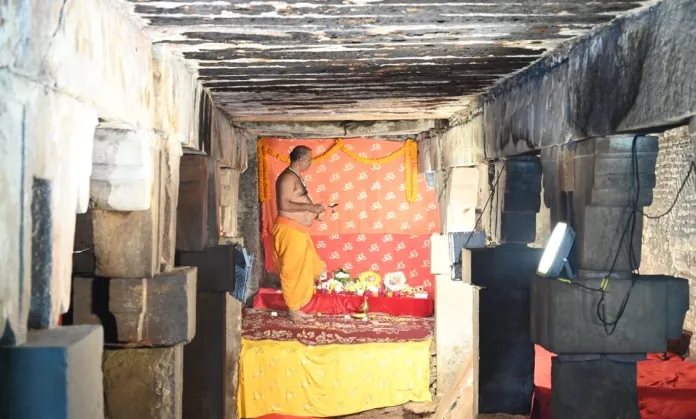
In a significant development in the Gyanvapi case, the Varanasi district court’s decision to permit Hindus to worship in the Vyas Cellar within the mosque complex has met with resistance from the Muslim side. The Supreme Court of India declined to entertain the petition filed by the Muslim Committee of Management, Anjuman Intezamia Masajid, Varanasi, against the district court’s ruling.
The Varanasi court’s verdict allowing Hindu devotees to perform worship of Hindu deities in the Vyas Ji Ka Tehkhana, the basement cellar of the Vyas family, prompted an urgent application from the mosque committee on January 31, seeking to maintain the status quo at the mosque site.
According to reports, the lawyers representing the mosque committee rushed to the residence of a Supreme Court registrar the previous night, requesting an immediate hearing due to concerns that Hindu rituals would be conducted inside the mosque during the night. However, the registrar informed them that he would await instructions from the Chief Justice of India.
The masjid committee alleged in its application that the administration was hastily implementing the court order, allowing Hindu pujas within the mosque premises even during the night. They argued that this preemptive action aimed to prevent any legal challenge from the Muslim side against the court order.
The Muslim side wrote, “There is no reason for the administration to undertake this task in hot haste in the dead of the night, as the order passed by the Trial Court had already given them one week to make the necessary arrangements. The obvious reason for such unseemly haste is that the administration, in collusion with the plaintiffs, is trying to foreclose any attempt by the Mosque Managing Committee to avail of their remedies against the said order by presenting them with a fait accompli.”
The Supreme Court, however, rejected the plea and advised the Masjid Committee to approach the Allahabad High Court instead. The registrar conveyed this decision to the Muslim side in the morning, informing them that Chief Justice DY Chandrachud had directed them to seek recourse in the High Court against the Varanasi court order.
Following the district court’s ruling, members of the Vyas family conducted puja rituals in the Vyas Ji Ka Tehkhana, as the administration facilitated access to the cellar just after midnight, adhering to the court’s directive. The administration arranged for the placement of idols of deities recovered in the cellar, as detailed in the recently published ASI report, for the puja rituals.
The first rituals, conducted after 31 years, commenced around midnight and concluded by 3.30 AM. Subsequently, women from the Vyas family entered the cellar for prayers.
Varanasi Divisional Commissioner Kaushal Raj Sharma announced that regular puja of the deities inside the cellar would begin from Thursday onwards in compliance with the district court’s order. Advocate Vishnu Shankar Jain outlined the schedule for daily aartis at the Vyas cellar, starting with Mangala Aarti at 3.30 AM and concluding with Shayan Aarti at 10.30 PM.
On January 24, the Varanasi court granted permission for the Archaeological Survey of India (ASI) to release its scientific survey report on the Gyanvapi Mosque. The court addressed requests from concerned parties seeking access to the report and ruled that all relevant parties should receive the findings.
The ASI’s report, now publicly available, reveals significant findings. It indicates the existence of a large Hindu temple predating the construction of the Gyanvapi Mosque. The report highlights the reuse of various parts, including pillars, from the pre-existing temple in the construction of the mosque.
During the survey, 34 inscriptions were uncovered, with a notable number originating from stones used in the earlier Hindu temple. Additionally, the report details the discovery of sculptures depicting Hindu deities and buried architectural structures found in one of the cellars.
Based on these findings, the ASI concludes that the reuse of inscriptions suggests the demolition of previous structures, with their components repurposed in the construction or renovation of the existing Gyanvapi mosque.
















Comments