





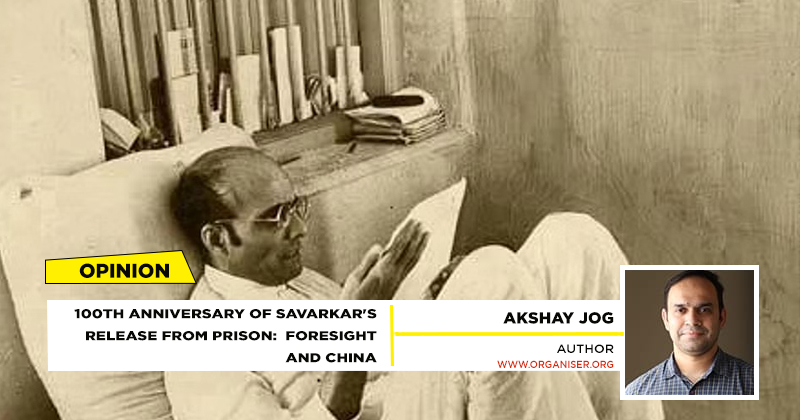
Veer Savarkar had predicted the unpleasant fate that ‘Quit India would result in partition of India’. He had warned of Pakistan’s attack on Jammu & Kashmir and China-Pakistan invasions. Unfortunately, later on, it all came true. His views on national security policies are still relevant. Let us look in detail at his prophetic words regarding China’s invasion of Bharat.
In 1954, the representative of the Kesari newspaper of Pune requested Veer Savarkar to write an article on India’s defence and strategic policy. In the article, which was published on January 26, 1954, Savarkar wrote: “When China, without even consulting India, invaded the buffer state of Tibet. India should at once have protested and demanded the fulfillment of rights and privileges as per her agreements and pacts entered into with Tibet. But our Indian Government was not able to do any such thing. We closed our eyes in the name of world peace and co-existence and did not even raise a finger against this invasion of Tibet. Neither did we help this buffer state of Tibet when her very existence was at stake. Why? The only reason that I visualise is our unpreparedness for such an eventuality and/or war..…… That is the reason why after swallowing the whole of Tibet the strong armies of China and Russia are now standing right on our borders in a state of complete preparedness and on the strength of the above, China is today openly playing the game of liquidating the remaining buffer states of Nepal and Bhutan.…… We have not been able to put before her an army that can match the strength of her armies on these borders of ours even today. This is precisely the reason why China dares come forward with such an unabashed claim on our territories.”
Savarkar criticised the policy of Panchsheel because India made this agreement with China when Tibet had already been completely digested by Mao. Savarkar always advocated militarisation policy and expounded its importance, utility, and necessity. In the aforesaid article, he drew attention to India’s lack of defence policy and unpreparedness, which proved him right when China invaded India in 1962.
Here Savarkar also stated the importance of Tibet, Nepal, and Bhutan for India as buffer states. A buffer state is a usually small neutral country lying between two larger rival countries, serving to prevent the outbreak of regional conflict. Like a strategic and diplomatic expert Savarkar continues: “China…. had completely overrun Tibet and destroyed the only buffer state so as to strengthen her vast borders. By this act of hers, China had with one stroke came right on our borders by force and prepared the way for an open aggression against India whenever she felt like it.”
It turned out to be true because the Chinese frontier advanced all across that territory by about thousands of kilometres towards the Himalayas by occupying Tibet, so the Indian border became vulnerable. Britain that ruled over us till 1947, was aware of the importance of buffer state. Therefore, they maintained and preserved the status of Tibet, Nepal, and Bhutan as buffer states. But our government after the Independence, was completely ignorant and inattentive towards this strategy and was under the influence of the dreamy principle of Panchsheel.
Nehru welcomed Chou En-lai, the Prime Minister of China, at Delhi on June 26, 1954, and coined the slogan ‘Hindi-Chini bhai bhai’ (Indians and Chinese are brothers). Kesari newspaper asked Savarkar to give his opinion on this pact, which was published on July 4 1954. Savarkar said: “In politics, the enemy of our enemy is our best friend. Enlightened self-interest is the only touchstone on which friendship in political dealings could be tested, since there is no such thing as real and selfless friendship in the political arena. If the meeting between Chou En-lai and Nehru, he said, angered the U.S.A., Indians should not mind it as the U.S.A. did not care to pause and think that India would -be dissatisfied or would feel insulted if America entered into a military pact with Pakistan. All the policies of India must be dependent on what was good or bad for India herself. If it was advantageous to India she should not in the least worry or care whether anyone felt enraged, insulted, or irritated.”
Savarkar further said, “While crying from the house top about these principles, it was worth noting that China, by swallowing Tibet, had ruthlessly trampled those very principles of world peace, brotherhood, and peaceful co-existence. That was the most funniest part of the whole deal, and it at once raised doubts in the Indian mind about the bona fides of China and Chou En-lai. There was at that time a political party in Tibet aiming at independence. It was curious and in a way most astonishing that after preying on and swallowing the mouse of Tibet the Chinese cat was talking of going on a pilgrimage. That was exactly the role that the Chinese Premier Chou En-lai and President Mao Tse-tung were playing.” (Keer, Dhananjay. Veer Savarkar, Popular Publication, 2nd edition, 1966, page 489-490)
Savarkar was a rare combination of a poet’s heart and a rational intellectual. While welcoming Nehru and Chou En-lai meeting, he pointed his fingers at China’s tactics of swallowing Tibet which possessed a threat to India. As Savarkar always stressed, in international politics and diplomacy, borders can’t be demarcated by principles but by the sword. So principles have significance only if they are backed by military strength or power. India should not blindly rely on anybody and shouldn’t be reckless. No country will come to our rescue without their own interest, so we must be always watchful, vigilant, and well prepared, and these should be our principles in foreign policy.
Savarkar said a naked truth that preaching sermons of high principles is pleasant to ears, with which one can claim moral high ground, but practically if we alone follow it and other nations preach it only orally, then it may prove disastrous to the interests of India. So Savarkar was hoping that this should not happen in the case of Panchsheel, but no one paid attention to Savarkar’s warnings of 1954, which followed the unfortunately betrayal of 1962.
In 1954, Savarkar demanded the modernisation of the armed forces of India. He suggested that we must develop nuclear bombs and adopt advanced technology, and use modern warfare to hold the upper hand in superpowers.
It was not to become a superpower, but to become India an idol of high principles. We must build our nation on high principles, but we must be up-to-date in all fields to protect those high principles. As Savarkar said, “High principles must have sound armed strength behind them to see that they are brought into practice by those who talk eloquently about it.”
During the recent conflict between India and China, we were well prepared, vigilant, and equipped with advanced arms and weapons, modern warfare, and almost all superpowers were in favour of us due to our effective diplomacy. Indirectly, we followed and implemented what Savarkar told in 1954. Our historical experiences bear testament to Veer Savarkar’s greatness and foresight.












Comments