





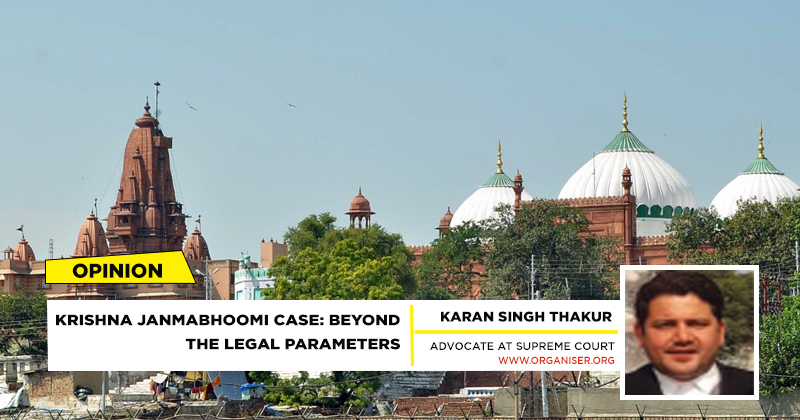
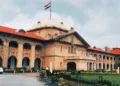
In a significant order likely to affect the fate of the prayers in the pending suits before the Allahabad High Court concerning Mathura’s Krishna Janmabhoomi-Shahi Eidgah Mosque dispute, the HC has allowed a plea seeking the appointment of a court commissioner to inspect the Idgah Mosque. A bench of Justice Mayank Kumar Jain passed this order.
The Krishna Janmabhoomi at Mathura case is a long-standing dispute between the Hindu and Muslim communities in Bharat. The dispute revolves around a site in Mathura, Uttar Pradesh, which is the birthplace of Bhagwan Krishna and hence a sacred place for Hindus. At present, there is a mosque known as the Shahi Masjid at the site, which was built in the 17th century by Mughal ruler Aurangzeb. The question at hand is whether the mosque was built on the site of a pre-existing temple, and whether the mosque can be converted back into a temple. In this article, we will examine the applicable statutes, archaeological findings, and relevant opinions that have been invoked in the Krishna Janmabhoomi at Mathura case. The issue of the temple-mosque dispute in Mathura came into focus following the Ram Janmabhoomi-Babri structure dispute in Ayodhya, which was finally resolved in 2019 with the Supreme Court of India giving the disputed land to Hindus for the construction of a temple.
THE KRISHNA JANMABHOOMI CASE
On September 24, 2020, Lucknow resident and advocate Ranjana Agnihotri and six others originally filed a plea in the lower court to remove the 17th century Shahi Idgah mosque from the complex it shares with the Katra Keshav Dev Temple, close to the spot known as ‘Krishna Janmabhoomi’. The petitioners filed the pleas under “next friend of Bhagwan Sri Krishna Virajman”. They had claimed in the plea that Shahi Idgah Masjid is constructed on a part of 13.37-acre land belonging to the Sri Krishna Janmabhoomi Trust. They had demanded the mosque be removed and the land returned to the Trust. However, the civil judge senior division rejected the suit on September 30, 2020 as non-admissible.
Why was the plea dismissed?
At the time, the civil judge hearing the case had dismissed the plea stating that none of the petitioners was from Mathura and therefore had no valid stake in the matter. Undeterred, the petitioners then moved the court of the district judge, seeking a revision of the order.
After hearing the arguments, District and Sessions Judge Rajeev Bharti allowed the revision – meaning the original suit will have to be heard by the lower court. This time, the Trust and temple authorities have been made party to the suit. “The court has allowed revision of the lower court order and had directed the lower court to register the suit as a regular suit,” District Government Counsel (Civil) Sanjai Gaur said. Advocate Hari Shankar Jain, who is representing the petitioners of the suit, said, “The court has said they (the petitioners) have the right to sue.” The case is currently pending before the Mathura district court. The petitioner has argued that the mosque was built by destroying a Hindu temple, and that the mosque should be removed and the temple restored. The defendant, the Shahi Masjid Committee, has argued that the mosque has been in existence for over 350 years, and that the suit is time-barred under the Limitation Act.
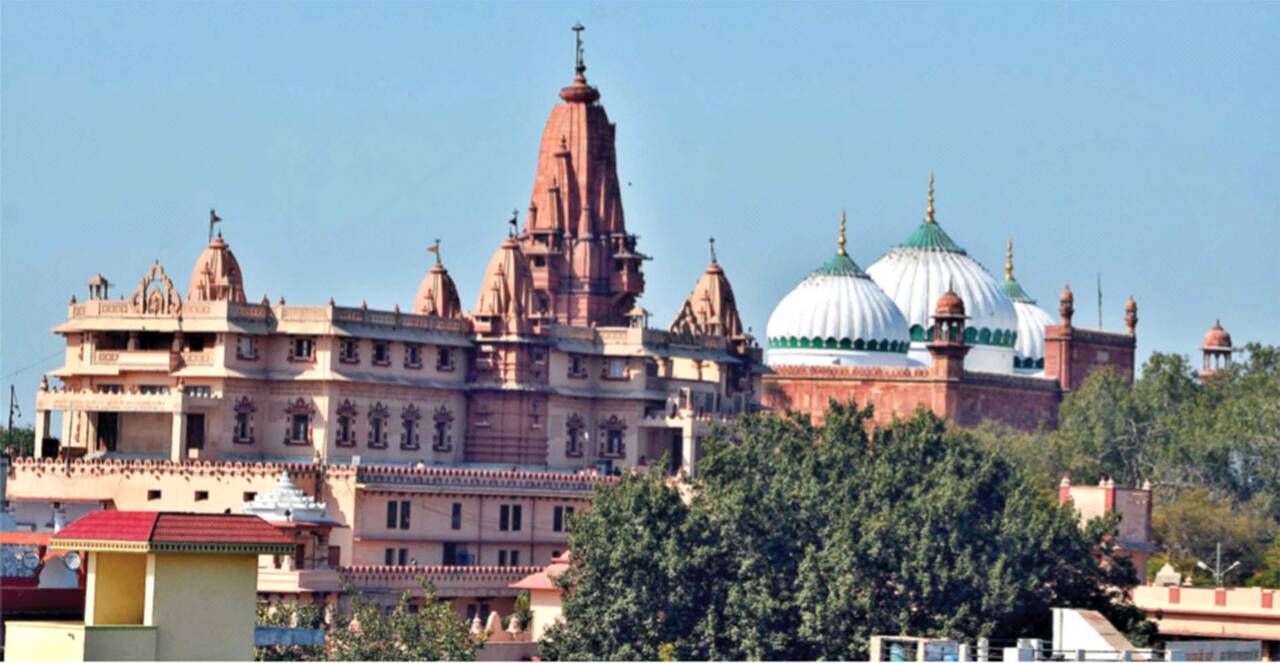
The issue of whether the temple may be converted to a mosque has been a subject of much debate and controversy. The Archaeological Survey of India (ASI) conducted excavations at the site in 1974-75, and found evidence of a pre-existing Hindu structure beneath the mosque. However, the findings of the ASI report continue to be a subject of dispute, with some historians and archaeologists disputing the findings. The matter of the Mathura temple-mosque dispute is a complex one, involving issues of history, religion, and legal interpretation. The case is currently sub-judice before the Mathura district court, and it remains to be seen what the final outcome will be. The Allahabad High Court has allowed the primary survey of the Idgah complex by a court-monitored three-member team of advocate commissioners. The Supreme Court has also refused to stay the Allahabad High Court order allowing the survey.
The applicable statutes that are relevant to the dispute at the Krishna Janmabhoomi site include the Places of Worship (Special Provisions) Act, 1991, the Constitution of India, the Ancient Monuments and Archaeological Sites and Remains Act, 1958, and the Indian Penal Code, 1860. These statutes provide the legal framework for resolving the dispute and maintaining the religious character of the site. However, the interpretation of these statutes is likely to be the subject of further litigation.
ARCHAEOLOGICAL FINDINGS
In 2021, the Archaeological Survey of India (ASI) conducted excavations at the Krishna Janmabhoomi site in Mathura. The ASI’s findings revealed the existence of a temple beneath the Shahi Masjid. The ASI’s report stated that the temple was built in the 6th century AD and was destroyed in the 12th century. The report also stated that the mosque was built on the ruins of the temple.
The archaeological findings in the Krishna Janmbhoomi case have been a subject of much controversy. The excavations carried out by the Archaeological Survey of India (ASI) in 1974-75 revealed the presence of a pre-existing Hindu structure beneath the Babri Masjid. The ASI report stated that the remains of a temple-like structure with features resembling a Hindu temple, including a ‘Makara Pranali’ (a spout-like fixture used for ablution purposes in Hindu temples), were found below the mosque. The report also stated that the mosque was built on a raised platform over the pre-existing structure. However, some historians and archaeologists have disputed the findings of the ASI report, arguing that the structure found could have been a secular building, and that there was no conclusive evidence to suggest that a temple was demolished to build the mosque.
The Allahabad High Court, in its 2010 judgment on the Ayodhya dispute, took note of the ASI report and held that there was evidence of a pre-existing Hindu structure at the disputed site, and that the mosque was built over it. The court also stated that there was evidence of the mosque being built after the demolition of the pre-existing structure, but did not conclusively state whether the pre-existing structure was a temple.
The findings of the ASI report continue to be a subject of debate and controversy, with both sides presenting their own interpretations and arguments. The matter is currently sub-judice before the Supreme Court of India.
AYODHYA LAND DISPUTE CASE
The Ayodhya Land Dispute Case is another landmark case that is relevant to the Krishna Janmabhoomi at Mathura dispute. In this case, the Supreme Court was called upon to resolve a long-standing dispute over a site in Ayodhya, the birthplace of Lord Rama. The dispute had arisen between the Hindu and Muslim communities over the ownership of the site, which had been the subject of several legal battles for over a century. In its verdict, the Supreme Court held that the site belonged to the Hindus, and ordered the construction of a temple at the site. The court also ordered that an alternative site be provided to the Muslim community for the construction of a mosque. The verdict has been seen as a precedent for the Krishna Janmabhoomi case.
RELEVANT OPINIONS
The Hindu community has argued that the Krishna Janmabhoomi site is a sacred site and that it was the location of a temple that was destroyed by Muslim invaders. The Hindu community has also argued that the site should be restored to its original form as a temple. On the other hand, the Muslim community has argued that the mosque has been in existence for centuries and that it should be allowed to remain as a mosque.
The issue of whether the temple at the Krishna Janmbhoomi site in Mathura can be converted to a mosque has been a subject of much debate and controversy. The matter is not just a legal one, but also has religious and emotional implications for both Hindus and Muslims.
There are also those who argue for a compromise solution, such as the construction of a temple and mosque side-by-side at the site, or the relocation of the mosque to a nearby location. Legal experts have also weighed in on the matter. Some argue that the legal principle of adverse possession should be applied to the case, which would mean that the mosque should be allowed to remain at the site as it has been in existence for a long period of time. Others argue that the fact that the mosque was built on the site of a pre-existing temple renders it illegal, and that the temple should be restored at the site.
Overall, the issue of whether the temple may be converted to a mosque remains a contentious one, with differing opinions from various experts and groups. The final decision rests with the courts and the government, and any resolution will have to take into account the concerns of all stakeholders involved. In conclusion, the Krishna Janmabhoomi at Mathura case is a complex and sensitive issue that has been the subject of several legal battles over the years. However, the legal resolution of the dispute will depend on the interpretation of the law and the evidence presented in court.













Comments