





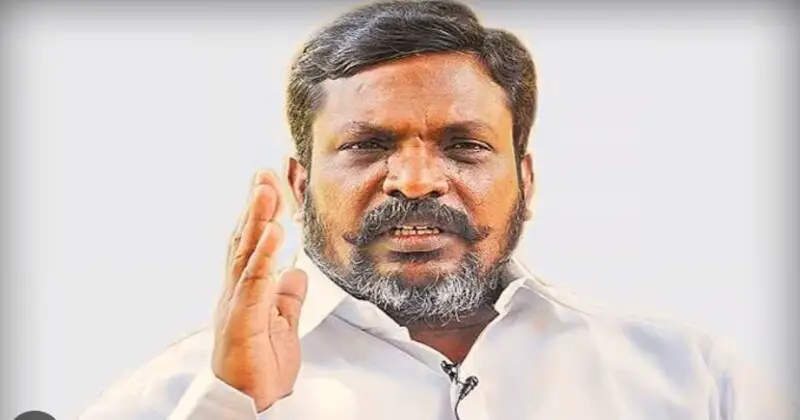
It seems that Tamil Nadu has become the hub of appeasement politics. During a recent protest organised by the Federation of All Muslim Organisations (FAMO) in Chennai’s Egmore Rajarathinam Stadium, Thol Thirumavalavan spoke passionately in support of Hamas. He described the Israeli actions as a “brutal war of aggression” and called for an immediate halt to the conflict. Thirumavalavan highlighted a recent United Nations Assembly resolution where Jordan proposed a resolution with overwhelming support, criticising Israel’s actions.
Thirumavalavan’s fiery speech included harsh rhetoric, such as referring to Israel as an “occupier nation” and suggesting that the Jewish race has enmity with many countries. He claimed that Israel was not the ancestral homeland of the Jewish people but a territory they occupied with the assistance of superpowers like the United States. Drawing parallels with the Eelam ethnic conflict, he argued that both Palestinians and Tamils had suffered due to alleged occupation and suppression by external forces.
Controversy and Political Reaction
Thirumavalavan’s support for Hamas and his controversial remarks have sparked a fierce debate in Tamil Nadu. Critics argue that his statements are divisive and promote hostility against a particular community. The political landscape in Tamil Nadu has been evolving since the installation of the DMK government in 2021, and Thirumavalavan’s stance is seen as reflective of the changing dynamics.
It’s important to note that Thirumavalavan’s speech was delivered in the context of ongoing protests in Tamil Nadu expressing solidarity with Hamas and Palestinians. The DMK government has faced criticism for what some view as appeasement and a soft approach towards certain radical elements.
In the Chennai protest, organised by FAMO and attended by thousands, leaders from various political parties, including M.H. Jawahirullah of ManithaNeya Makkal Katchi, Nellai Mubarak of SDPI, and K Balakrishnan of CPM, expressed their condemnation of Israel’s actions in Palestine.
The Broader Implications
Thirumavalavan’s support for Hamas and the protests in Tamil Nadu highlight the complex interplay of regional politics, religious sentiments, and global conflicts. These developments have implications for the social and political landscape in Tamil Nadu, raising questions about the role of leaders in shaping public opinion.
The controversy surrounding Thol Thirumavalavan’s statements underscores the need for careful and responsible rhetoric, especially when discussing sensitive international issues.
A Historical Perspective
In a recent address, Thol Thirumavalavan spoke about his attendance at a conference in Durban, South Africa, in 2001. He recalled that the event focused on opposing apartheid, and Palestinian activists were present with banners. Despite the language barrier, Thirumavalavan expressed solidarity with the Palestinians during their protests, setting the stage for his recent statements.
Thirumavalavan characterises Hamas as a movement that primarily seeks to protect Palestinians and their land. He asserts that Hamas is not a war-frenzied or occupier-frenzied organisation, and it does not harbour animosity towards other races. Thirumavalavan challenges the global classification of Hamas as a terrorist or extremist organisation, particularly by certain factions in the United Nations Assembly.
Thirumavalavan argues that the recent actions taken by Hamas, including rocket strikes on October 7, 2023, should be seen not as acts of aggression but as responses to aggression. He raises essential questions about whether these actions constitute terror attacks or defensive measures. He further posits that the historical fact is that the Jewish population occupied Palestinian territory.
Thirumavalavan firmly labels Israel as an occupier nation established with the support of the United States. He questions the rationale behind Israel’s devastating attacks on Palestinians, who, according to him, had initially welcomed the Jewish immigrants when they arrived in Palestine. Thirumavalavan emphasises that the call for justice unites the protesters, transcending religious boundaries.
Political Influence on India’s Stance
The VCK leader alleges that India’s current stance on the conflict is influenced by what he terms “Sanathana forces.” He accuses the Indian government of blindly supporting Israel, which he perceives as an occupier nation, while overlooking the justice in favor of Palestinians. Thirumavalavan suggests that the BJP government’s policies have driven a wedge between the Indian perspective and the true nature of the conflict.
Parallel to the LTTE Conflict
Thirumavalavan draws a parallel between the conflict in Palestine and the Sri Lankan Civil War, where India and the United States supported the Sinhalese government in their fight against the Liberation Tigers of Tamil Eelam (LTTE). He claims that by designating Hamas as a terrorist organization and endorsing actions against it, innocent Palestinians are being harmed, turning this into a case of genocide rather than a war on terrorism.
A Call for Support and Reevaluation
Thirumavalavan emphasizes the need for widespread support, similar to the expressions of solidarity observed in Kerala. He asserts that millions of people in Tamil Nadu oppose Israel’s actions and call for the immediate cessation of the conflict. He condemns India’s stance and urges a reassessment of the country’s position. Efforts are expected to exert pressure on India to take a more vocal stand against the continuation of the war.
The controversy surrounding Thol Thirumavalavan’s statements underscores the intricate interplay of regional politics, global conflicts, and the moral obligations of governments and individuals in the face of such crises.
It is not known how Thirumavalavan, an MP under oath, could speak against the stand of sovereign national policy. Can he be sued ? Questions are being asked in Tamil Nadu.













Comments