
Beyond Fluidity: Marriage, Choice and Rights
December 5, 2025
  • Read Ecopy
  • Circulation
  • Advertise
  • Careers
  • About Us
  • Contact Us
Android AppiPhone AppArattai
Organiser
  • ‌
  • Bharat
    • Assam
    • Bihar
    • Chhattisgarh
    • Jharkhand
    • Maharashtra
    • View All States
  • World
    • Asia
    • Europe
    • North America
    • South America
    • Africa
    • Australia
  • Editorial
  • International
  • Opinion
  • RSS @ 100
  • More
    • Op Sindoor
    • Analysis
    • Sports
    • Defence
    • Politics
    • Business
    • Economy
    • Culture
    • Special Report
    • Sci & Tech
    • Entertainment
    • G20
    • Azadi Ka Amrit Mahotsav
    • Vocal4Local
    • Web Stories
    • Education
    • Employment
    • Books
    • Interviews
    • Travel
    • Law
    • Health
    • Obituary
  • Subscribe
    • Subscribe Print Edition
    • Subscribe Ecopy
    • Read Ecopy
  • ‌
  • Bharat
    • Assam
    • Bihar
    • Chhattisgarh
    • Jharkhand
    • Maharashtra
    • View All States
  • World
    • Asia
    • Europe
    • North America
    • South America
    • Africa
    • Australia
  • Editorial
  • International
  • Opinion
  • RSS @ 100
  • More
    • Op Sindoor
    • Analysis
    • Sports
    • Defence
    • Politics
    • Business
    • Economy
    • Culture
    • Special Report
    • Sci & Tech
    • Entertainment
    • G20
    • Azadi Ka Amrit Mahotsav
    • Vocal4Local
    • Web Stories
    • Education
    • Employment
    • Books
    • Interviews
    • Travel
    • Law
    • Health
    • Obituary
  • Subscribe
    • Subscribe Print Edition
    • Subscribe Ecopy
    • Read Ecopy
Organiser
  • Home
  • Bharat
  • World
  • Operation Sindoor
  • Editorial
  • Analysis
  • Opinion
  • Culture
  • Defence
  • International Edition
  • RSS @ 100
  • Magazine
  • Read Ecopy
Home Bharat

Beyond Fluidity: Marriage, Choice and Rights

Prafulla KetkarPrafulla Ketkar
Oct 23, 2023, 02:00 pm IST
in Bharat, Editorial
Follow on Google News
FacebookTwitterWhatsAppTelegramEmail

“The institutional space of marriage is conditioned and occupied synchronously by legislative interventions, customary practises, and religious beliefs. The extant legislative accommodation of customary and religious practices is not gratuitous and is, to some extent, conditioned by the right to religion and the right to culture, constitutionally sanctified in Articles 25 and Article 29 of the Constitution of India. This synchronously occupied institutional space of marriage is a product of our social and constitutional realities, and therefore, in my opinion, comparative judicial perspectives offer little assistance. Given this nature of marriage as an institution, the right to choose a spouse and the right of a consenting couple to be recognised within the institution of marriage cannot but be said to be restricted”. – Justice P S Narasimha, while delievering a separate judgement on Supriyo @ Supriya Chakraborty & Anr. Versus Union of India (Popularly known as Same-Sex Marriage Case), October 17, 2023


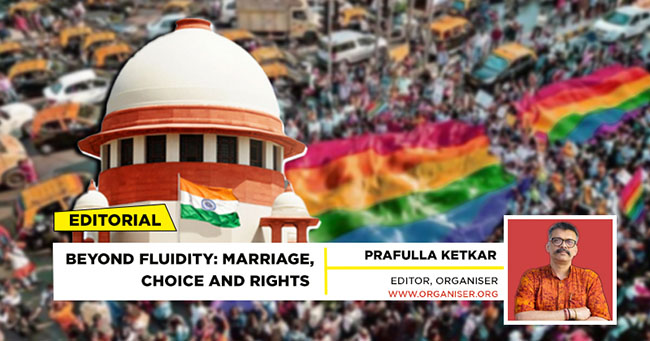
In a landmark majority judgement, a five-member bench of the Supreme Court of Bharat refused to legalise same-sex marriage as an institution and asked the Government to make appropriate rules through a panel to ensure same-sex couples certain rights. People with same-sex orientation should not face any discrimination is the consensual tone of the judgement, along with the recognition that making marriage-related laws is the prerogative of the Parliament. Naturally, this judgement has invoked reactions from both sides – opposing and demanding legalising same-sex marriages. The ruling has set aside the fluid arguments over legalising same-sex relationships as marriage for the time being, providing us with an opportunity for more serious deliberation among social, religious and intellectual leaders about the issues involved and possible repercussions.

As the apex court mentioned in the judgement, marriage as an institution is not static, and it has evolved over time. Difference in sexual orientations is also not new and have existed since time immemorial. The transgender community has been there, and at least in Bharat, it has a unique space and place, both socially and culturally. The crux of the problem has been discrimination and criminalisation. In 2018, the Supreme Court decriminalised homosexuality after the Government gave a favourable opinion and scrapped the colonial-era law of Article 377. Since then, there has been a demand for granting equal rights to same-sex couples as heterogeneous couples, which resulted in a contentious debate. Last year, 18 same-sex couples sought acknowledgement of their relationship as a marriage through a petition. The Supreme Court has now rejected the plea. Beyond a legal debate about amending the Hindu Marriage Act or Special Marriage Act, the gender discourse has social, cultural and economic dimensions that need further deliberation.

While ‘trans’ is gender and widely recognised as a ‘third’ gender, all other identities like lesbian, gay, queer etc. are sexual orientations. Including transgender people in the LGBTQ+ movement to increase the numbers while making noise is unjust to them. The issues of exploitation and discrimination faced by trans-genders are different from others as their identity, most of the time, cannot be hidden. Even families abandon them. The woke strategy of mixing up the issues of transphobia with homophobia is a dangerous one. The Supreme Court judgement, by recognising the marital rights of the trans-community, has differentiated the third gender from the sexuality issues.

As accepted and recognised by all societies and traditions, the purpose of the institution of marriage is not just about sexual choices – it is also about establishing a household, procreation and providing care for the offspring. The ideology of wokeism is fundamentally against marriage as an institution. Adherents of the same wokeism conveniently demand marital rights with their fluid logic. In the name of rights and choices, they bring in many concepts, theories and behavioural patterns antithetical to the evolved standards of women’s and children’s rights. Trends such as gender-neutral toilets used to perpetuate crimes, inappropriate content shown at a tender age, parents being denied the right to provide upbringing to their offspring, etc, are just symptoms visible in the Western world. Discrediting and destroying all institutions is the ultimate goal. Sexual orientation is a personal choice. Can it be imposed on the future of society is the real question. The economic interests of the big pharmaceutical corporations, who are mindlessly promoting gender reassignment surgeries and pills for the profit motive, should also be considered in this debate.

As Justice Ravindra Bhat has rightly alerted, “If we throw caution to the wind, we stand the risk of paving the way to untold consequences that we could not have contemplated”. The fundamental argument of fluid gender identity is the sure-shot recipe for irresponsible individuals and anarchic society. While being empathetic to people with varied sexual orientations, we need to assess the natural laws and logic behind the evolution of customary laws. Not fluidity and wokeism but awakened impact assessment will pave the way for evolving sensitivities and regulations for equality and inclusion.

 

Topics: Hindu Marriage ActSupreme Court judgementJustice P S NarasimhaArticle 377trans-genders
Prafulla Ketkar
Prafulla Ketkar
Prafulla Ketkar, is the Editor, Organiser (Weekly) since 2013. He has a experience of over 20 years in the fields of research, media and academics. He is also Advisory Committee School of Journalism, Delhi University. He has been writing on issues related to International politics and foreign policy, with special reference to China and Democracy, Hindutva, and Bharatiya Civilisation. He was also a member of the Editorial team of the recently published Complete Works of Pt Deendayal Ji in 15 Volumes. He has 2 books, 29 academic articles, 2 entries in Encyclopedia of India and numerous articles to his credit. [Read more]
ShareTweetSendShareSend
✮ Subscribe Organiser YouTube Channel. ✮
✮ Join Organiser's WhatsApp channel for Nationalist views beyond the news. ✮
Previous News

Myanmar: Indian envoy proposes setting up joint working group for traditional medicine

Next News

Jammu and Kashmir: Devotees throng Mata Vaishno Devi temple in Katra on last day of Navratri

Related News

A representative image

Is Panchayati divorce legally valid? Punjab and Haryana HC seeks clarity in case of a police constable

A representative image

Minority status doesn’t exempt Jains, Buddhists, Sikhs from Hindu Marriage Act: MP High Court

Electoral Bonds: Do we have an Alternative

Patna High Court

‘Not able to bear child due to disease not ground for divorce, husband’s marital duty to cooperate’: Patna High Court

Judiciary: Need a major course correction

Gujarat: BJP and Congress MLA’s demand parents sign be made mandatory for ‘Love Marriage’ registrations

Load More

Comments

The comments posted here/below/in the given space are not on behalf of Organiser. The person posting the comment will be in sole ownership of its responsibility. According to the central government's IT rules, obscene or offensive statement made against a person, religion, community or nation is a punishable offense, and legal action would be taken against people who indulge in such activities.

Latest News

Image for representational purpose only, Courtesy Vocal Media

Bihar to get ‘Special Economic Zones’ in Buxar and West Champaran

Thirupparankundram Karthigai Deepam utsav

Andhra Pradesh: AP Dy CM Pawan Kalyan reacts to Thirupparankundram row, flags concern over religious rights of Hindus

23rd India-Russia Annual Summit

India-Russia Summit heralds new chapter in time-tested ties: Inks MoUs in economic, defence, tourism & education

DGCA orders probe into IndiGo flight disruptions; Committee to report in 15 days

BJYM leader Shyamraj with Janaki

Kerala: Widow of BJP worker murdered in 1995 steps into electoral battle after three decades at Valancherry

Russian Sber bank has unveiled access to its retail investors to the Indian stock market by etching its mutual fund to Nifty50

Scripting economic bonhomie: Russian investors gain access to Indian stocks, Sber unveils Nifty50 pegged mutual funds

Petitioner S Vignesh Shishir speaking to the reporters about the Rahul Gandhi UK citizenship case outside the Raebareli court

Rahul Gandhi UK Citizenship Case: Congress supporters create ruckus in court; Foreign visit details shared with judge

(L) Kerala High Court (R) Bouncers in Trippoonithura temple

Kerala: HC slams CPM-controlled Kochi Devaswom Board for deploying bouncers for crowd management during festival

Fact Check: Rahul Gandhi false claim about govt blocking his meet with Russian President Putin exposed; MEA clears air

Union Minister for Road Transport and Highways Nitin Gadkari (Right)

India set for highway overhaul as Union Minister Nitin Gadkari unveils nationwide shift to MLFF electronic tolling

Load More
  • Privacy
  • Terms
  • Cookie Policy
  • Refund and Cancellation
  • Delivery and Shipping

© Bharat Prakashan (Delhi) Limited.
Tech-enabled by Ananthapuri Technologies

  • Home
  • Search Organiser
  • Bharat
    • Assam
    • Bihar
    • Chhattisgarh
    • Jharkhand
    • Maharashtra
    • View All States
  • World
    • Asia
    • Africa
    • North America
    • South America
    • Europe
    • Australia
  • Editorial
  • Operation Sindoor
  • Opinion
  • Analysis
  • Defence
  • Culture
  • Sports
  • Business
  • RSS @ 100
  • Entertainment
  • More ..
    • Sci & Tech
    • Vocal4Local
    • Special Report
    • Education
    • Employment
    • Books
    • Interviews
    • Travel
    • Health
    • Politics
    • Law
    • Economy
    • Obituary
  • Subscribe Magazine
  • Read Ecopy
  • Advertise
  • Circulation
  • Careers
  • About Us
  • Contact Us
  • Policies & Terms
    • Privacy Policy
    • Cookie Policy
    • Refund and Cancellation
    • Terms of Use

© Bharat Prakashan (Delhi) Limited.
Tech-enabled by Ananthapuri Technologies