





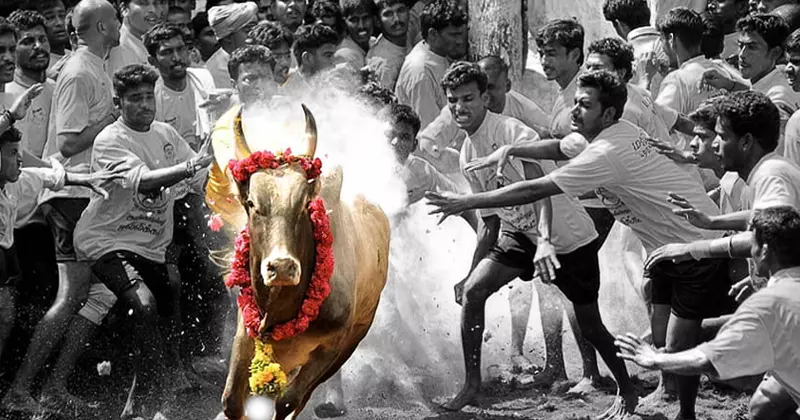
Not long ago, Jallikattu, the traditional sport of bull-fighting played by Tamil-speaking people since time immemorial, hit the headlines for the massive protest against the ban on the game and a series of legal battles that followed. Finally, the ban was permanently lifted by an ordinance supported by the Central Government in 2017. Hailed as a victory for protection of Tamil culture, this sport also symbolises victory for Sanatan practices of ancient Tamils because no Jallikattu event started without worshipping “the Gods near the waterways, Gods under the old and bulky tress and Gods under the banyan trees”, said the classical Tamil poem Kalitthogai (verse 101).
Auspicious Start
Worshipping God before starting any work is a Sanatan practice till date and one will be surprised to know that Tholkappiyam, the Sangam age grammar book, has laid down clear cut rules for composing verses on worship of God in the beginning of any literary work. Every poet including Thiruvalluvar of Thirukkural fame and Kambar who wrote Ramayana in Tamil followed the tradition of worshipping God in the very first verse of their celebrated works. That tradition existed at the start of Jallikattu, too, and the contestants worshipped Gods before entering the arena. Even the casual chat among the girls gathered to watch the event reflected the deep impact of Gods in their thoughts. For example, the mere appearance of bulls reminded them of their Gods. Seeing a white bull, the girls shouted that it looked like the white skinned Balarama; black bulls reminded them of Krishna; red bulls were compared with Shiva and spotted bulls with Indra (Kalitthogai: 105).
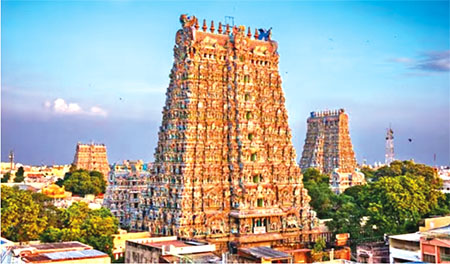
Daily worship done inside the house is also indicated in Sangam texts and there is a specific mention in Silappadikaram of how the evening worship could not be done when Kannagi burnt Madurai.
Worship of God is an essential feature of every religion – not unique to Hindus alone. But the Gods worshipped by ancient Tamils were the same ones revered by all Hindus through all times. The ancient Pandyan dynasty claimed the Shiva-Parvati couple as their founders. The Cholas claimed ancestry from none other than Rama of the Ikshvaku dynasty if we go by King Vira-Rajendra Chola’s ‘Kanyakumari’ inscriptions and the eulogies on Chola kings. The Chera kings held a title ‘Vaanavan’, meaning Indra, claiming their descent from Indra.
Followers of Vedic Rituals
The kings of all these ancient Tamil dynasties followed Vedic rituals, known not only from Tamil classics but also from works found in other parts of Bharat. For instance, the great poet Kalidasa while imagining the self-choice ceremony of Indumati, the grandmother of Rama, to select her suitor, noted the presence of the Pandyan king, too, as one of the suitors who was introduced by Sunanda, the friend of Indumati, for his involvement in Vedic rituals! Describing this event in Raghvamsham (6-61), Kalidasa visualised the Pandyan king with “his body still wet after the concluding sacred bath of ashvamedha ritual” given by sage Agastya, notwithstanding the fact that Agastya appeared one generation later, as a contemporary of Rama. While material pleasures were highlighted for every other king contending to attract Indumati’s attention in the ceremony, Agastya ‘s Vedic influence on the Pandyans was remembered by the people of ancient Bharat, with Raghuvamsham offering testimony.
The ancient Tamil lands geographically divided into five were guarded by deities of the Vedic pantheon. The origin and identity of Indra is mythical to many scholars, but ancient Tamils held Indra as the deity of Marudham division of lands irrigated by rain-fed rivers. The twin epics of Silappadhikaram and Manimekalai bear evidence to the continuous observance of the Indra festival annually until 2,000 years ago in Poompukar – long after Krishna stopped it in Vrindavan.
The mention of Poompukar evokes an important feature not known to many both inside and outside of Tamil Nadu. Poompukar was almost like the original place for Jambudweepa because the guardian deity of Jambudweepa was residing in Poompukar only. It is stated in Manimekalai’ that long before river Kaviri formed, a woman engaged in meditation under a Jambu tree in Poompukar, attained Godhood. She obtained a boon to protect the entire landmass of Jambudweepa as its patron deity and the place where she meditated was named after her as Jambupati. Poompukar was a later name, given after Kaviri started flowing.
It is everybody’s knowledge that our country Bharat Varsha was part of Jambudweepa – invoked in ‘Sankalpa’ mantras. Poompukar, an ancient city – with proven antiquity through marine excavations – located in the southeast part of Tamil Nadu claims its primacy in the geography of Jambudweepa! Should we need any other evidence for the Sanatan identity of Tamils and Tamil lands?
Sanatan means eternal
The definition of Sanatan and Sanatan Dharma finds resonance with several Tamil verses and belief systems contained in them. ‘Sanatan’ means eternal, always and universal. Those principles and practices that are universal in application, i.e., which apply to one and all are ‘Sanatan’.
For example, Newton’s third law of motion, which states that every action has an opposite reaction, is universal; It cannot be destroyed. It applies to human actions too, including those done through thought and word. This has given rise to a saying – what one does, so one reaps. The action once done, its reaction cannot be denied or destroyed, and that is the basis for the concept of ‘karma’! If we do an action, the reaction will definitely reach us. This karmic concept applies to everyone – regardless of one’s religious leanings, time and location. It applied to those who lived many years ago or who will live in the future. This makes the Karma concept universal, in other words, Sanatan.
Even if one dies before experiencing one’s reactionary karma, one has to take another birth to experience that reaction. So rebirth also applies to everyone, making it a Sanatan concept. If actions are good deeds, good reactions will be obtained. We call it Punya. If bad deeds are done they will cause hardship, we call it sin. Therefore, sin and virtue are universal and hence Sanatan. Whether one believes in them or not, they are forever and indestructible. The God concept comes only in this context to minimise the impact of the indestructible Karma or completely to escape from its grip.
God is somewhere ‘out there’ in other religions, but according to Hindu thought God is within us and within every animate and inanimate things; using Him we have to attain Him. God being both the means and the end is the Sanatan thought and therefore this Dharma preaches how to live with minimal reactionary karma and maximum awareness of what one does to rise to the level of God. All the do’s and don’t-s of this Dharma are aimed to reach this state.
The fact of the matter is that all the above facets of Sanatan Dharma are evidenced in Tamil literature standing as proof for the Sanatan way of living of the Tamils. Silappadhikaram repeatedly stresses Karma theory and rebirth. Kannagi attained peace of mind only after being told of her husband’s misdeed in his previous birth that resulted in his gory death following a false accusation. The famous verse Yaadum oore, Yaavarum Kelir that every Tamil takes pride in quoting as the mirror of Tamil culture is indeed about karmic consequence of one’s action that demands one to develop kinship with everyone and not collision course (Purananuru: 192).
Kannagi also stands as a classic Sanatan case of how one can be elevated as a god, but she reminiscented to Manimekalai born to the other woman in her life that she (Kannagi) must be reborn some day to work out the karma for having burned Madurai due to her anger.
Kannagi’s story brings into focus the case of ‘other woman’ when a man is already married. The ancient grammar book ‘Tholkappiyam’ doesn’t approve of this feature by referring to the karmic consequence of having another woman (3 – 268). Desiring another man’s woman is also frowned upon; Thiruvalluvar has dealt with this in a full chapter of ten couplets. Desiring another man’s wife is not Sanatan Dharma – so says Rama to Vaali who misbehaved with Ruma, his brother’s wife who he should have treated as his daughter-in-law (Valmiki Ramayana: 4-18- 18)
Man getting elevated as God is mentioned by Thiruvalluvar (Thirukkural:50) who preached the three purusharthas -Dharma, Artha and Kaama – as Aram, Porul and Inbam in 1330 verses called Kural . Only when one is steadfast on these three can one attain Moksha, the fourth and the last Purushartha. Due to its Sanatan nature, Thirukkural is translated into at least 42 world languages.
Almost every ancient text of ‘the group of eighteen’ known as Padhinen- keel- kanakku expresses rules and practices of Sanatan Dharma – what we call as way of life – because by living through a principled life one gets away from the karmic cycle of rebirth.
What is shown here is just an outline of Tamils’ way of life. If someone thinks or doubts it to be other than Sanatan Dharma, it means they are ill- informed. If someone claims that they can annihilate this Dharma, they deserve to be in mental asylum – a suggestion written by Pt Nehru in his letter to Kamaraj on November 5, 1957, in response to the genocidal call by EVR to exterminate Brahmins in the name of ‘eradicating castes’.












Comments