The Idea of Bharat
August 14, 2026
  • Read Ecopy
  • Circulation
  • Advertise
  • Careers
  • About Us
  • Contact Us
Android AppiPhone AppArattai
Organiser
  • ‌
  • Bharat
    • Assam
    • Bihar
    • Chhattisgarh
    • Jharkhand
    • Maharashtra
    • View All States
  • World
    • Asia
    • Europe
    • North America
    • South America
    • Africa
    • Australia
  • Editorial
  • International
  • Opinion
  • RSS @ 100
  • More
    • Op Sindoor
    • Analysis
    • Sports
    • Defence
    • Politics
    • Business
    • Economy
    • Culture
    • Special Report
    • Sci & Tech
    • Entertainment
    • G20
    • Azadi Ka Amrit Mahotsav
    • Vocal4Local
    • Web Stories
    • Education
    • Employment
    • Books
    • Interviews
    • Travel
    • Law
    • Health
    • Obituary
  • Subscribe
    • Subscribe Print Edition
    • Subscribe Ecopy
    • Read Ecopy
  • ‌
  • Bharat
    • Assam
    • Bihar
    • Chhattisgarh
    • Jharkhand
    • Maharashtra
    • View All States
  • World
    • Asia
    • Europe
    • North America
    • South America
    • Africa
    • Australia
  • Editorial
  • International
  • Opinion
  • RSS @ 100
  • More
    • Op Sindoor
    • Analysis
    • Sports
    • Defence
    • Politics
    • Business
    • Economy
    • Culture
    • Special Report
    • Sci & Tech
    • Entertainment
    • G20
    • Azadi Ka Amrit Mahotsav
    • Vocal4Local
    • Web Stories
    • Education
    • Employment
    • Books
    • Interviews
    • Travel
    • Law
    • Health
    • Obituary
  • Subscribe
    • Subscribe Print Edition
    • Subscribe Ecopy
    • Read Ecopy
Organiser
  • Home
  • Bharat
  • World
  • Operation Sindoor
  • Editorial
  • Analysis
  • Opinion
  • Culture
  • Defence
  • International Edition
  • RSS @ 100
  • Magazine
  • Read Ecopy
Home Bharat

The Idea of Bharat

In our country, the welfare force is endemic in society, it permeates the society as religion. That is why so far India considered saving its religion and society as the only way to self-preservation. She has not valued the kingdom, but society. That is w

Prafulla KetkarPrafulla Ketkar
Sep 5, 2023, 04:00 pm IST
inBharat, Editorial, Opinion
Follow on Google News
Facebook
Twitter
WhatsAppTelegramEmail
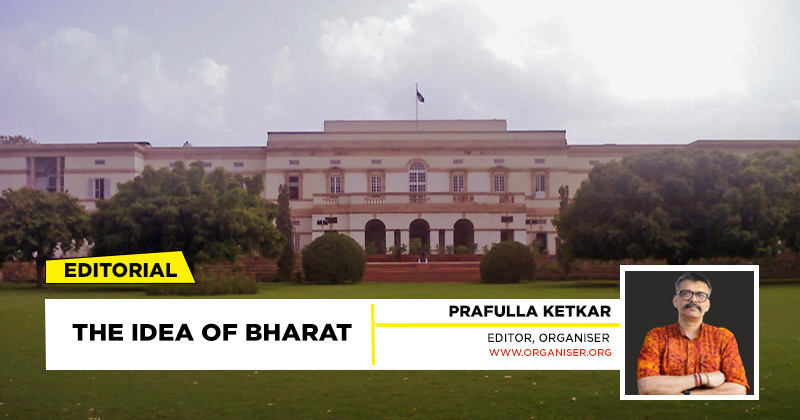
Recently, the proposal to turn the Nehru Memorial Museum and Library into the ‘Museum for Prime Ministers’ became a huge controversy. The allegations of obliterating the Nehru’s legacy and undermining his ‘idea of India’ were made. In the debate, no one asked two pertinent questions. Why did Nehru decide to shift to the official residence of the Commander-in-Chief of the Indian Armed Forces (Originally the Teen Murty House was built for the C-in-C of the Armed forces, and it remained so till 1948) only after Mahatma Gandhi’s death and a year into his tenure? Why and how this public property could not continue as the official residence of the Prime Minister is also a matter of research. But more importantly, what was Nehru’s ‘Idea of India’ that does not accommodate and accept the other Prime Ministers of Bharat in the same premises? The answer lies in denial of the ‘Idea of Bharat’.

In 1833, while addressing the British Parliament as secretary to the East India Company Board of Control, Lord Macaulay had stated –“It may be that the public mind of India may expand under our system till it has outgrown that system; that by good Government we may educate our subjects into a capacity for better Government; that, having become instructed in European knowledge, they may, in some future age, demand European institutions. Whether such a day will ever come, I know not. But never will I attempt to avert or retard it. Whenever it comes, it will be the proudest day in English history”. Despite all contributions of Nehru to the freedom struggle and providing stability to the post-Independence democratic processes, his ‘idea of India’ was essentially a European construct is the fact which is evident from the Nehruvian idea of democracy based on socialism and secularism.

What is then the ‘Idea of Bharat’ that differentiates us as a nation? Firstly, the idea of Bharat always rested in the decentralised form of institutions and Governance. The idea of central planning and imposition of legislation from above was never in tune with the idea of Bharat. We are not lawbreakers, but laws and policies, emanating from above essentially disconnect us from the roots of family, village and the entire ecosystem with geo-cultural context. Bharatiya democracy was always rested with the society and not with the centralised democratic institutions, as Nehru believed.

Secondly, Dharma, not religion in the Semitic sense but more in the spiritual sense, was the guiding and practising force of this decentralised society. This autonomy of society made our civilisation resilient of external aggressions. The Melas, Yatras, temples and festivals were not just religious affairs; they were the instruments of bonds for this nation, as Gurudev Rabindranath Thakur understood in his Swadesi Samaj. Managing education, ensuring food, health-care, water resources for all etc. were not the State but societal responsibilities. The Participatory and collective approach was inherent in it. The British, being the alien civilisation either demonised or crushed this approach. The ‘Nehruvian’ ideals in the name of ‘secularism and socialism’ continued that process, with more sophisticated, institutionalised and democratic fashion.

Thirdly, the assimilation and accommodation process of people coming from outside had a very peculiar process in Bharat, since time immemorial. ‘We, the people’, never considered any group or society as our enemy, either by ideology or religion. It was always beyond ‘tolerance’ and more of acceptance which many Nehruvians would never agree. While practising that acceptance, Bharat never compromised with the basic spirit of respecting all ways. Relinquishing the soul in the name of accommodation was never the Idea of Bharat. That is why this nation has produced a tradition of selfless sages in the ancient period, and Buddha, Kautilya, Shankaracharya, Sant tradition of Bhakti Parampara, warriors like Shivaji and Guru Gobind Singh etc. followed them at various times to save this soul of the nationhood.

Nehru’s commitment to his ideals of democracy, secularism and socialism was undeniable; regrettably, those ideals were non-Bharatiya is the problem. It led to denying the soul of Bharat that is decentralisation, Dharma and securing the tradition of acceptance and assimilation.

Thanks to the influence of Gandhiji and many other stalwarts of the Freedom Movement, our Constitution essentially carried forward the age-old spirit of democracy based on societal Dharma. That is the reason original Constitution did not mention the alien concepts like ‘socialism and secularism’. Nehru brought this through his monopoly over the party structure and eventually made these as our national goals through education. The elitist monopolisation of ‘Idea of India’ based on the façade of secularism and socialism led to the appropriation of public property into a private museum. Over the period, both the Nehruvian ideals are rejected by the society. What should be the replacement in the changed context is the real contestation?

After completing 71 years of Independence, we have made strides in different walks of life, but simultaneously, we are still struggling with many of the basic issues. The artificial divides of North-South, Rural-Urban, Majority-Minority etc. are the direct outcome of Anglicised ‘Idea of India’. Many of us, with the prism provided by the Nehruvian education system, have also lost the vision to see Bharat from Bharatiya perspective. With our true tradition of accommodation, how to rekindle the ‘idea of Bharat’, that already exists somewhere deep in our minds or among the groups living in villages and forests, for the opinionated, educated minds. How to restore the sanctity of traditions like that of Kumbh and the real intellectual churning like that of Naimeshyaranya, is the real challenge before us. The Government can at the most facilitate this process, but revitalising the social mindset through formal and informal education is the key. This Independence Day, if we could resolve to experience and realise Bharat with Bharatiya perspective, it will not be the obliteration of the Nehruvian legacy but digesting and assimilating it with the true Independence of Bharat.


Topics: Bharat
Prafulla Ketkar
Prafulla Ketkar
Prafulla Ketkar, is the Editor, Organiser (Weekly) since 2013. He has a experience of over 20 years in the fields of research, media and academics. He is also Advisory Committee School of Journalism, Delhi University. He has been writing on issues related to International politics and foreign policy, with special reference to China and Democracy, Hindutva, and Bharatiya Civilisation. He was also a member of the Editorial team of the recently published Complete Works of Pt Deendayal Ji in 15 Volumes. He has 2 books, 29 academic articles, 2 entries in Encyclopedia of India and numerous articles to his credit. [Read more]
Share
Tweet
SendShareSend
✮ Subscribe Organiser YouTube Channel. ✮
✮ Join Organiser's WhatsApp channel for Nationalist views beyond the news. ✮
Previous News

Cricket World Cup 2023: India announces 15-member squad; KL Rahul in, Samson out

Next News

“Country was and will always remain Bharat”: Union Minister Rajeev Chandrasekhar amid controversy

Related News

Representative Image

Leftist agenda targets emotional Gen Z; Logical thinking crucial for next generation for national well-being

Representative Image

The significance of Shatrubodh: Bharat’s legacy of being a strong and enduring civilization

Representative Image

The Toolkit of Instability: How social media became deep state’s weapon against Bharat

Ex-JNU Prof Nivedita Menon continues her anti-Bharat rant

Bharat is a “manhus desh”: Ex-JNU Professor Nivedita Menon continues her anti-India rants, sparking massive outrage

Representative Image

Youth Power: Not anyone’s pawn, but the engine of a developed India

Representative Image

Bharatiya Modernity vs Western Modernity: An understanding of self & sustainable model of modernity

Load More

Latest News

Great Calcutta Killings 1946

Great Calcutta Killings in August 1946: Urban pogrom and the teleology of partition in colonial Bengal and India

Ram Temple CEO Candidates Faced No Questions on Religion or Personal Lifestyle

Ram Mandir Trust’s CEO Interview: Professional governance takes precedence over personal life in selection process

Representative Image

Why Bharat needs to pursue independence from big tech

India corner opens at Kenya school library; Echoes nation’s freedom struggle, civilisational heritage & growth story

Keralam: NIA seizes massive 89,600 explosive sticks in Malappuram, reports suggest Kerala Kumbh Mela was target

August 14 is observed as Partition Horrors Remembrance Day

From Crushing 1857 Jihad to Muslim Appeasement: British and Gandhi’s policies that helped partition India

Ousted President of Syria Bashar al-Assad sentenced to death

Syria: Ousted President Assad sentenced to death for crimes against humanity; Will verdict aid extradition from Russia?

Bar Council of India defers enrolment of NALSAR’s 2026 law graduates, seeks report over campaign targeting CJI

1947 Partition and Bengal: The unvarnished truth

Bastar Dussehra Begins in Jagdalpur:

Bastar Dussehra Begins in Jagdalpur: A 75-day celebration of tribal faith, tradition and cultural heritage

Load More
  • Privacy
  • Terms
  • Cookie Policy
  • Refund and Cancellation
  • Delivery and Shipping

© Bharat Prakashan (Delhi) Limited.
Tech-enabled by Ananthapuri Technologies

  • Home
  • Search Organiser
  • Bharat
    • Assam
    • Bihar
    • Chhattisgarh
    • Jharkhand
    • Maharashtra
    • View All States
  • World
    • Asia
    • Africa
    • North America
    • South America
    • Europe
    • Australia
  • Editorial
  • Operation Sindoor
  • Opinion
  • Analysis
  • Defence
  • Culture
  • Sports
  • Business
  • RSS @ 100
  • Entertainment
  • More ..
    • Sci & Tech
    • Vocal4Local
    • Special Report
    • Education
    • Employment
    • Books
    • Interviews
    • Travel
    • Health
    • Politics
    • Law
    • Economy
    • Obituary
  • Subscribe Magazine
  • Read Ecopy
  • Advertise
  • Circulation
  • Careers
  • About Us
  • Contact Us
  • Policies & Terms
    • Privacy Policy
    • Cookie Policy
    • Refund and Cancellation
    • Terms of Use

© Bharat Prakashan (Delhi) Limited.
Tech-enabled by Ananthapuri Technologies