





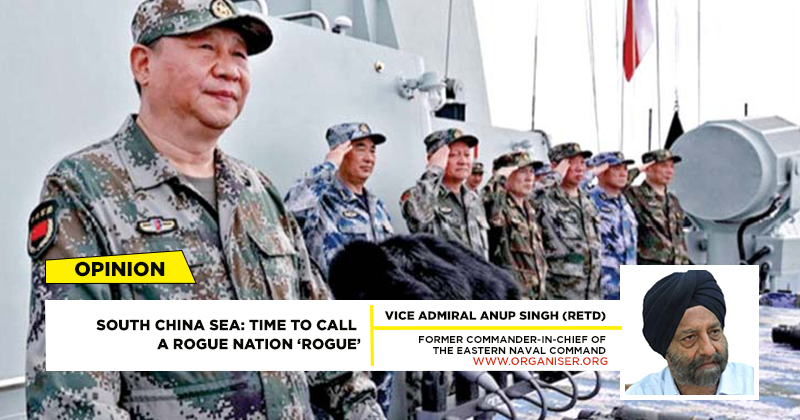
There’s been a conspicuous intent on the part of China, to capture and expand land and lately, maritime space known to be legally within maritime zones of others. The world has been viewing China’s recent moves relating to the seas as representing illegitimate maritime expansion.
Ever since its unusual claim of the 9-dash line covering most of the South China Sea, China’s actions became unbearable for all other claimants. Its aggressive behaviour and assertive attitude violated all norms of civilised behaviour within the South China Sea, grabbing reefs, rocks and islets in other countries’ maritime zones. It did all this in an orchestrated fashion, using its maritime militia, Coast Guard, and at times even the PLA (Navy). In a short period of four years since the 2009 reiteration of the 9-dash line, it started building artificial islands over some of the captured reefs, and blocked access to certain shoals/lagoons which lay within the Exclusive Economic Zones (EEZ) of other claimant countries.
One country that stood up to China was the Republic of the Philippines. Despite being much weaker militarily and economically, the Philippines filed arbitral proceedings against China in early 2013, in the Permanent Court of Arbitration (PCA) of the UN. The stated dispute concerned maritime entitlements and the legality of Chinese activities in the South China Sea (SCS). Not unexpectedly, China informed the Philippines that it rejected the proceedings. As per China, the Arbitral Tribunal ‘did not have jurisdiction in the case because China’s acceptance of dispute settlement under the UN Convention on the Law of the Sea (UNCLOS) was limited and excluded sea boundary delimitations and historic titles.’ However, in the first victory of good order at sea, in end 2015, the tribunal delivered its first verdict that it certainly had jurisdiction, and, finally on July 12, 2016, it gave the final award heavily favouring the Philippines. Once again China rejected the ruling.
Instead of curbing its illegal activities thereafter, China actually doubled down on violations of UNCLOS, its uncivil crusades through the maritime militia and built military stations on some of the artificial islands which were within the maritime jurisdictions of others.
Cause and Effect
The first incident of forceful occupation took place in the Paracel Islands in 1974 when the Chinese removed the Vietnamese garrison and settled one of its own. Then in 1988, it repeated such an act on the Johnson Reef in the Spratly Islands. So, aggressive behaviour has been known to exist amongst the Chinese for a long time.
But their leadership of the past decade is specially to blame for what is being seen as ‘maritime expansion’. They have come to talk about making their country a maritime power.
In the political report delivered by General Secretary Hu Jintao in the autumn of 2012 to the eighteenth National Congress of the Communist Party of China, which stands at the top of the country’s power structure, he stated, “We should enhance our capacity for exploiting marine resources, develop the marine economy, protect the marine ecological environment, resolutely safeguard China’s maritime rights and interests, and build China into a maritime power.” This was Hu’s final report as the top leader of the Communist Party of China; after delivering which he stepped down from his posts as General Secretary and Chairman of the Central Military Commission and was succeeded by Xi Jinping who went a step ahead on this line of pursuit. At the National People’s Congress, in March 2014, Xi was elected to succeed Hu in the largely ceremonial post of President. But that transition did not change the ‘method’ and commitment to building China into a maritime power.
For Xi Jinping, building China into a maritime power is an essential path on the way to becoming a ‘global power’
For Xi Jinping, building China into a maritime power is an essential path on the way to the sustained development of the Chinese nation as a ‘global power’. Every action that China takes against others, is intended to take a piece of the ocean pie by hook or by crook.
The idea behind China’s uncivil behaviour at sea, was to first test the waters, and when it succeeded in the first few incidents, it got emboldened to carry-on regardless. The world meekly objected, did not find it necessary to vehemently criticise, nor did anyone (want to) think of sanctions/trade restrictions and boycotts. The result has been a tongue-in-cheek smile by the culprit nation which has now got so emboldened that it wants to set aside the meaning of a ‘rules-based order’. The effect is there for everyone to see and will linger for ages.
In fact, China’s aggressive behaviour is not just seen at sea but on land too. In fact, few people are aware that while China shares its land borders with 14 countries from North Korea to Vietnam it has some claim or the other with almost all of them! This paradigm is unique to the modern world where a large and mighty country finds itself unsatiated with all its legitimate possessions despite a large landmass and unprecedented economic strength.
India’s Straight Talk
In the last week of June, Secretary of Foreign Affairs of the Philippines Enrique Manalo visited India for a bilateral meeting on foreign cooperation. In a joint statement towards the end of that meeting, Foreign Minister S. Jaishankar underlined the need for peaceful settlement of disputes; for adherence to the law as enshrined in the UN Convention on the Law of the Sea (UNCLOS) and compliance with the 2016 arbitral award on the South China Sea. While India’s respect and support for the UNCLOS has always been unequivocal, this was the first time that India has unambiguously called upon China to adhere to the verdict of the UN-based tribunal. Further the two Foreign Ministers expressed shared interest in a Free, Open and Inclusive Indo-Pacific (FOIP). They also discussed India-Philippines maritime and defence cooperation which would expectedly include maritime exercises, enhanced collaboration on other aspects of defence and security, a line of credit for military equipment and the acquisition of naval assets.

The Philippines was the first foreign country to receive the Brahmos anti-ship cruise missile from India and that was only the beginning of defence cooperation. The road ahead is full of opportunities for the two and all facets of defence and security cooperation must receive full attention.
If India’s straight talk in the joint statement on June 29, 2023, and the new vistas of cooperation between India and Philippines gets China’s goat, so be it. In fact, there is a point worth noting. While China vehemently objected to the Hiroshima G-7 statement on the SCS, nothing was said on the Indian statement last week. This itself may be a sign of guilt and burden that China feels in having tried an ill-coceived assault in Galwan in the summer of 2020.
India has been claiming strategic autonomy in preference to coalitions and military alliances. Afterall India is a large country with conspicuous levels of critical mass in terms of population, assets and economic prowess. All these are components of strategic heft. The statement of June 29, uninhibited cooperation with all victims in Southeast Asia and strong words on FOIP are truly the ‘way to go’ for India.










Comments