





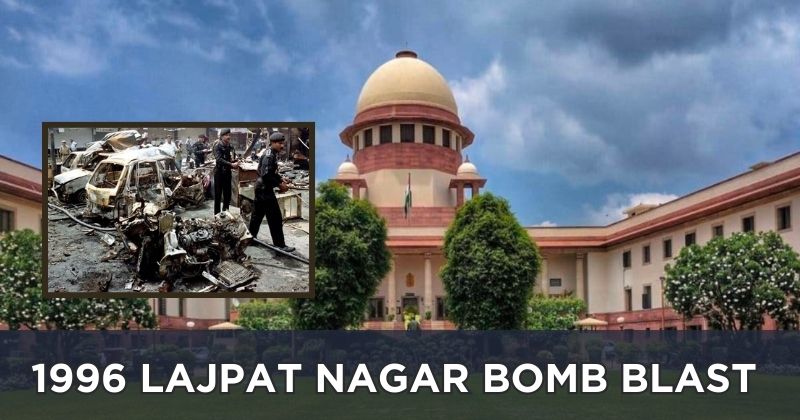
On July 6, the Supreme Court of India upheld the conviction of two accused – Mohammad Naushad and Javed Ahmed Khan – in the 1996 Lajpat Nagar Bomb Blast Case and sentenced them to life imprisonment without remission. The court also restored the life sentences, extending to the rest of their natural lives, of the two former death row convicts – Mirza Nissar Hussain and Mohammed Ali Bhatt – who were earlier discharged by the Delhi High Court.
The court’s three-judge bench, comprising Justice BR Gavai, Vikram Nath and Sanjay Karol, was hearing Mohd Naushad and Javed Ahmed Khan’s appeal against their conviction and sentence, State’s plea challenging the Delhi High Court’s decision commuting Naushad’s death sentence to life imprisonment and acquitting two other death row convicts – Mirza Nissar Hussain and Mohammed Ali Bhatt.
The court dismissed Naushad and Khan’s appeal challenging their conviction and sentence, however, the court also refused to restore their death sentence.
“Even though it is the rarest of the rare case, nonetheless considering several factors, we impose a sentence of imprisonment without remission extending to natural life. The accused, if on bail, are directed to immediately surrender. A5 (Mirza Nissar Hussain) and A6 (Mohammed Ali Bhatt) are directed to surrender,” the court said.
Background
On May 21, 1996, a bomb blast occurred in Delhi’s Lajpat Nagar Central Market, claiming 13 lives and injuring 38 others. The Jammu and Kashmir Islamic Front (JKIF) – a designated terror organisation under the provisions of the Unlawful Activities (Prevention) Act, 1967 – claimed responsibility for the blast.
The police investigation revealed that the JKIF chief Bilal Ahmed Beg conspired with Inter-Services Intelligence (ISI), in Pakistan, to orchestrate the terror attack. Delhi Police booked six Kashmiri militants, and two others, including a woman. The police also alleged the involvement of mafia dons Dawood Ibrahim and Tiger Menon as accused in the bomb blast.
In April 2010, the trial court awarded the death penalty to three out of the six convicts – Mohammad Naushad, Mohammed Ali Bhatt and Mirza Nissar Hussain – noting that their involvement in the terror attack warranted capital punishment. The court convicted Javed Ahmed Khan to life imprisonment, while the other two were convicted on milder charges – Farooq Ahmed Khan and Farida Dar – and released in view of the time served during the trial.
Four convicts moved the Delhi High Court against the trial court’s verdict. In 2012, the Delhi High Court rapped the police for ‘grave prosecution lapses’ and said, “The nature of grave prosecution lapses, in regard to various issues such as lack of proof connecting some of the accused with the bomb incident, failure to hold TIP (Test Identification Parade) of articles and the accused…not recording the statements of vital witnesses…underline not only its lapses and inefficiencies, but also throw up a question mark as to the nature and truthfulness of the evidence produced.”
The Delhi High Court’s division bench, comprising Justices S Ravindra Bhat and GP Mittal, acquitted two death row convicts while commuting the death sentence of Mohammad Naushad to life imprisonment. The court also upheld the life sentence awarded to Javed Ahmed Khan.
The two convicts later moved the Supreme Court to challenge their life imprisonment sentence and conviction. The State also filed a special leave petition seeking to restore the death sentence imposed on the accused Kashmiri militants. In 2013, the court issued notice in appeals before it, and in 2016, the case was placed before a three-judge bench.
Jammu and Kashmir Islamic Front (JKIF)
Notably, the investigation revealed that the JKIF chief Bilal Ahmed Beg conspired with the ISI to orchestrate the bomb blast in Lajpat Nagar. On October 4, 2022, the Government of India declared Beg as a terrorist, noting that his organisation, JKIF, is a banned terror organisation under the provisions of the UAPA.
The Government of India’s notification reveals that Beg, originally from Srinagar, was residing in Rawalpindi, Pakistan. On October 4, 2022, the Government of India designated JKIF chief Bilal Ahmed Beg as a terrorist, as the outfit was listed as a terror organisation under UAPA. The Government of India’s notification read that Beg, originally from Srinagar, was residing in Rawalpindi, Pakistan. The notification further read that Beg is involved in the “smuggling of arms and ammunition into Jammu and Kashmir.”
Furthermore, the notification said, Beg is involved in the “financing of militancy activities in Jammu and Kashmir” and recruitment of Kashmiri youths for terrorist outfits. The Government of India said that it believes Beg is “involved in terrorism and the said Bilal Ahmad Beigh @Babar is to be notified as a terrorist under the said Act.”















Comments