Value Addition Courses: Infusing Education with Bharatiya values
September 14, 2026
  • Read Ecopy
  • Circulation
  • Advertise
  • Careers
  • About Us
  • Contact Us
Android AppiPhone AppArattai
Organiser
  • ‌
  • Bharat
    • Assam
    • Bihar
    • Chhattisgarh
    • Jharkhand
    • Maharashtra
    • View All States
  • World
    • Asia
    • Europe
    • North America
    • South America
    • Africa
    • Australia
  • Editorial
  • International
  • Opinion
  • RSS @ 100
  • More
    • World Hindu Congress 2026
    • Op Sindoor
    • Analysis
    • Sports
    • Defence
    • Politics
    • Business
    • Economy
    • Culture
    • Special Report
    • Sci & Tech
    • Entertainment
    • G20
    • Azadi Ka Amrit Mahotsav
    • Vocal4Local
    • Web Stories
    • Education
    • Employment
    • Books
    • Interviews
    • Travel
    • Law
    • Health
    • Obituary
  • Subscribe
    • Subscribe Print Edition
    • Subscribe Ecopy
    • Read Ecopy
  • ‌
  • Bharat
    • Assam
    • Bihar
    • Chhattisgarh
    • Jharkhand
    • Maharashtra
    • View All States
  • World
    • Asia
    • Europe
    • North America
    • South America
    • Africa
    • Australia
  • Editorial
  • International
  • Opinion
  • RSS @ 100
  • More
    • World Hindu Congress 2026
    • Op Sindoor
    • Analysis
    • Sports
    • Defence
    • Politics
    • Business
    • Economy
    • Culture
    • Special Report
    • Sci & Tech
    • Entertainment
    • G20
    • Azadi Ka Amrit Mahotsav
    • Vocal4Local
    • Web Stories
    • Education
    • Employment
    • Books
    • Interviews
    • Travel
    • Law
    • Health
    • Obituary
  • Subscribe
    • Subscribe Print Edition
    • Subscribe Ecopy
    • Read Ecopy
Organiser
  • Home
  • Bharat
  • World
  • Operation Sindoor
  • Editorial
  • Analysis
  • Opinion
  • Culture
  • Defence
  • International Edition
  • RSS @ 100
  • Magazine
  • Read Ecopy
Home Bharat

Value Addition Courses: Infusing Education with Bharatiya values

Infusing Bharatiya values to education is a must for Bharat to become a Jagadguru. The Delhi University’s ‘Value Addition Courses’ can be considered to be a quintessential model

Prof Niranjan KumarProf Niranjan Kumar
Jun 12, 2023, 08:30 pm IST
inBharat, Opinion
Follow on Google News
Facebook
Twitter
WhatsAppTelegramEmail

National Education Policy (NEP) 2020, a watershed moment in the history of modern education, is going to complete three years in the next month. Designed to meet the challenges of the 21st century, especially keeping the youth in mind, the aims and objectives of the NEP 2020 are lofty and far-reaching. If we decode the NEP-2020, one of its major goals is the ‘character building’ of students. The very first page of the policy document mentions, “Education must build character, enable learners to be ethical, rational, compassionate, and caring”. This is reiterated again, on the same page, “This Policy proposes the revision and revamping of all aspects of the education structure …, while building upon India’s traditions and value systems” so as “to develop all aspects and capabilities of learners; and make education more well-rounded”. In the ‘Principles of the Policy’, it is emphasised further, “The purpose of the education system is to develop good human beings capable of rational thought and action, possessing compassion and empathy, courage and resilience, scientific temper and creative imagination, with sound ethical moorings and values.”

Character building and holistic personality development reflecting the Indian value system, in fact, have been important goals of Vidya or Shiksha in the Indian thought tradition

It is not a coincidence that along with the announcement of NEP-2020, the ‘Ministry of Human Resource Development’ was changed to the ‘Ministry of Education’. The term ‘Human Resource’ implied that human beings were resource material, devoid of sensibility and values, who could be used and thrown away. It was, in a way, inspired by the materialistic philosophy of the West. On the other hand, the Shiksha (Education) designation, brought back again in place of ‘HRD’, encompasses, along with the material aspect, all other facets of human character, including the cultural and psychological, a reflection of the Indian value system.

Character building and holistic personality development reflecting the Indian value system, in fact, have been important goals of Vidya or Shiksha in the Indian thought tradition- the idea being captured in the oft-repeated Sanskrit shloka Vidya Dadaati Vinayam. With over half the population (52 per cent) under 30 ( as per National Family Health Survey-5), India is the ‘youngest country’ in the globe. But the youth of the country is at crossroads with personality disorders and imbalances afflicting a substantial section. The need for character building and holistic personality development having an Indian value system is an urgent requirement of the education system in current times.

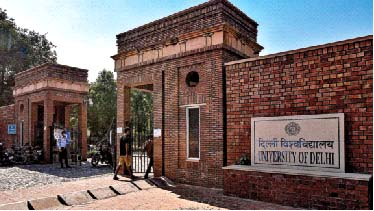
Considering these needs of youth, the University of Delhi took the initiative, in the course of implementing NEP-2020, and designed ‘Value Addition Courses’ for the undergraduate program- an innovative and historic step in the university system of the country, with far-reaching consequences.

With the firm belief that education has an important role to play in dealing with the issues mentioned above, the Value Addition Courses (VACs) are a well-thought-out and far-reaching effort and are being keenly watched by academics of the entire country. The main objective of these VACs, developed with the help of experts from across the country, is holistic personality development and character building of students; “embedding ethical, cultural and constitutional values; promoting critical thinking, Indian Knowledge Systems, scientific temper, communication& soft skills as well as teamwork.” A major hallmark of these VACs, in keeping with the spirit of the NEP 2020, is that these are not purely theoretical courses, as had been propagated by the Macaulay model continuing for almost two hundred years. Rather, taking inspiration from the ancient Indian pedagogy of ‘Gurukula’ system and Mahatma Gandhi’s model of experimentation and application, these courses have at least 50 per cent of the component as hands-on learning or practical or application-oriented. The practice or practicum section will range from fieldwork, surveys, and projects to other experiential learning and other applied aspects. Importantly, the 50 per cent practical-based study will not be limited to science-oriented courses but also to courses inclined towards humanities, social sciences or commerce, providing hands-on experience to these students. Another notable feature of VAC, is that instead of pure laboratory-based practicals, the experiments and applied activities will be conducted in the ‘laboratory of life’, connecting the students with society and with the country at large.

Another feature of VAC is that irrespective of the streams, any student, whether from the sciences, humanities, social sciences or commerce etc., can opt for them. This will promote multi-disciplinarity while enriching the diversity of the class, a need of the hour in current times. In addition, unlike some ‘Add on’ short-term courses, offered at some places, these VAC are credit courses, and marks obtained will be part of the grade sheet, thus, engendering seriousness into their study.

So far, 26 courses have been prepared for the academic session 2022-23. A total of about 40 to 50 such courses will be developed for the entire undergraduate program. Some of the current courses include- Vedic Mathematics, Swachh Bharat, Panchkosh: Holistic Development of Personality, Indian Bhakti Tradition and Human Values, Ayurveda and Nutrition, Yoga: Philosophy and Practices, Sahitya, Sanskriti and Cinema, Ethics and Values in Ancient Indian Tradition, Science and Society, Fit India, Art of Being Happy, Emotional Intelligence, Constitutional Values and Fundamental Duties, Sports for Life, Digital Empowerment etc. A unique attribute of the VACs is that elements of the rich Indian Knowledge System (IKS) have been duly incorporated, as specified in the NEP-2020. For example, ‘Vedic Mathematics’ is a unique course of its kind, which is being taught as a credit course in a prestigious university like the DU in the country.

Similarly, ‘Panchkosh: Holistic Development of Personality’ will prove helpful in dealing with the increasing personality imbalance, mental stress and aggressive behaviour among the youth today. Similarly, the course ‘Yoga: Philosophy and Practice’ will also be very useful given the complex and stressful life today. To apprise students of the great heritage of IKS, 25 per cent of the total courses are from subject areas related to IKS. Patriotism is another value which the VACs have tried to inculcate among the students.

With its economic strides, the ‘New India’ of our youth is in high gear to take the world by storm, in the 21st century. But it would be expedient that this ‘New India’ is also balanced, has Charitra and Moolya (character and values), and is socially responsible with a sense of patriotism. Only then can India rebecome a Jagadguru. ‘Value Addition Courses’ of Delhi University would be a quintessential model, in this regard, for the Higher education institutes of the country.



Topics: National Education PolicyNEP 2020Swachh BharatPanchkoshVAC are credit coursesacademic session 2022-23Indian Knowledge SystemsValue Addition Courses
Share32
Tweet
SendShareSend
✮ Subscribe Organiser YouTube Channel. ✮
✮ Join Organiser's WhatsApp channel for Nationalist views beyond the news. ✮
Previous News

Uttar Pradesh: Minor Hindu girl abducted and raped by 50-year-old Shah Alam, Irfan and Nadeem

Next News

Two arrested under anti-conversion law in Uttarakhand: Police

Related News

Kerala Governor Rajendra Vishwanath Arlekar inaugurates the silver jubilee celebrations of Mar Baselios College of Engineering and Technology

Jantar Mantar protests highlight erosion of civility; character formation vital for students: Keralam Governor Arlekar

Skill India 2.0: From Training Millions to Linking Skills With Jobs and Wages (This image is generated from AI)

Skill India Decade: 7.67 crore trained, Rs 34,000 crore push for the next phase

Union Minister Dr Jitendra Singh (Right)

Swachh Sagar Surakshit Sagar 5.0: Jitendra Singh unveils week-long campaign for cleaner beaches and safer oceans

Yuva Sangam 2026: Phase VII registration deadline extended to August 31; Youth aged 18–30 can apply

The UDISE+ 2025–26 report highlights India’s steady progress in school education, with gains in enrolment, teacher availability and retention

UDISE+ 2025–26 report highlights stronger school education system with better enrolment & improved infrastructure

India’s journey from Swadhinta to Swatantrata begins with decolonising minds and embracing Bharatiya values (This image is generated by AI)

Decolonising the Mind: How citizens can embrace Bharatiya languages, traditions & values to realise absolute freedom

Load More

Latest News

A representative image

Bankers Books Evidence Act 2026 to replace 1891 law from October 1: Here’s what will change?

SSC CGL exam Schedule (This is an AI generated image)

SSC CGL Tier 1 exams from September 30 to October 30; Check schedule and admit card details, vacancies

New Delhi, Sep 12 (ANI): Prime Minister Narendra Modi holds a bilateral meeting with Chinese President Xi Jinping on the sidelines of the BRICS Summit 2026, in New Delhi on Saturday. External Affairs Minister S. Jaishankar, NSA Ajit Doval and Principal Secretaries to the PM, Pramod Kumar Mishra and Shaktikanta Das also present. (@MEAIndia X/ANI Photo)

BRICS 2026: Why Putin, Xi and Pezeshkian meetings stand out in PM Modi’s diplomacy

Odisha Chief Minister Mohan Charan Majhi addresses the media at Bhubaneswar airport after returning from his UAE visit on September 13, 2026.

Odisha secures Rs 2.43 lakh crore investment proposals during CM Majhi’s five-day UAE outreach programme

Bhagwan Ganesh

Ganesh Chaturthi: Rationale behind worshipping Bhagwan Ganesh

RSS Akhil Bharatiya Sah-Bauddhik Shikshan Pramukh Deepak Vispute addressing the gathering

‘Nation First’ should be the guiding principle for every individual, regardless of their Field: Deepak Vispute

‘India was not poor; it was made poor’: The truth re-emerges through Jema Ferrer’s perspective

Six years after talent manager Disha Salian was found dead, her father Satish Salian on September 11 recorded a detailed statement with the Central Bureau of Investigation (CBI), naming Shiv Sena (UBT) leader Aaditya Thackeray, actors Dino Morea and Sooraj Pancholi, and others.

Disha Salian Murder Case: Father names Aaditya Thackeray in CBI statement; Lawyer claims gang rape, murder cover-up

Release of a book at Vishwa Bandhutva Diwas programme that was organised in Ujjain

Bharat’s youth rooted in sacrifice, service & discipline can give new direction to World: Parag Abhyankar

AI Generated Representative Image

“Let Go” — But only when it suits you? Exposing the double standards of Kashmir’s political leadership

Load More
  • Privacy
  • Terms
  • Cookie Policy
  • Refund and Cancellation
  • Delivery and Shipping

© Bharat Prakashan (Delhi) Limited.
Tech-enabled by Ananthapuri Technologies

  • Home
  • Search Organiser
  • Bharat
    • Assam
    • Bihar
    • Chhattisgarh
    • Jharkhand
    • Maharashtra
    • View All States
  • World
    • Asia
    • Africa
    • North America
    • South America
    • Europe
    • Australia
  • Editorial
  • Operation Sindoor
  • Opinion
  • Analysis
  • Defence
  • Culture
  • Sports
  • Business
  • RSS @ 100
  • Entertainment
  • More ..
    • Sci & Tech
    • Vocal4Local
    • Special Report
    • Education
    • Employment
    • Books
    • Interviews
    • Travel
    • Health
    • Politics
    • Law
    • Economy
    • Obituary
  • Subscribe Magazine
  • Read Ecopy
  • Advertise
  • Circulation
  • Careers
  • About Us
  • Contact Us
  • Policies & Terms
    • Privacy Policy
    • Cookie Policy
    • Refund and Cancellation
    • Terms of Use

© Bharat Prakashan (Delhi) Limited.
Tech-enabled by Ananthapuri Technologies