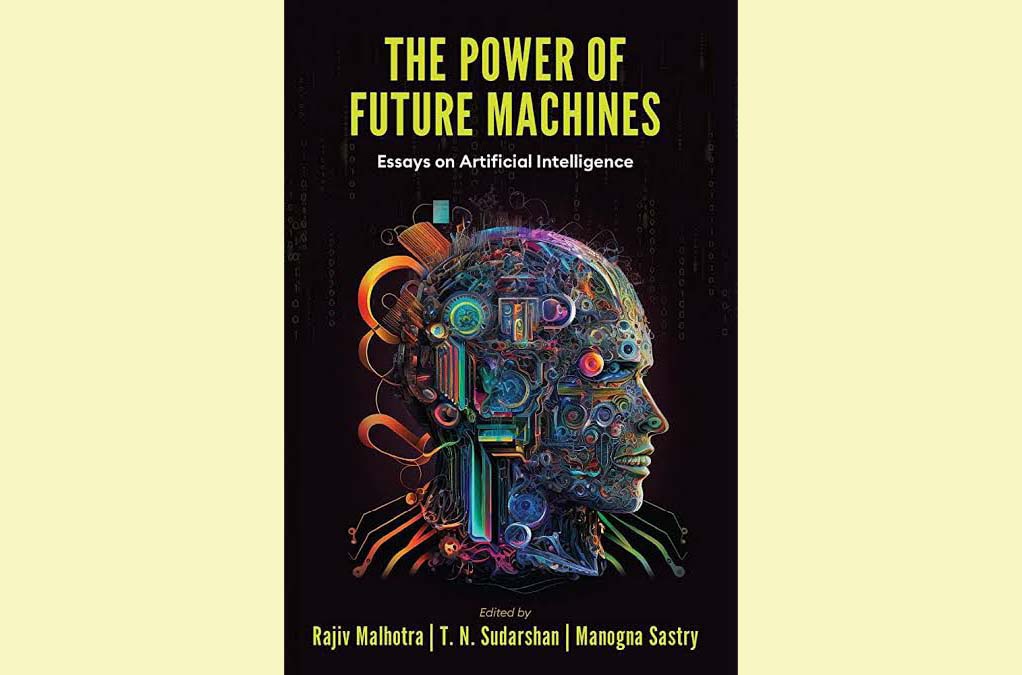
The Power Of Future Machines Essays On Artificial Intelligence, Editor by Rajiv Malhotra TN Sudarshan Mandogna Shastri Part 1, Published by BlueOne Ink, LLP Year-2023,
The Power of Future Machines is a collection of essays by experts exploring the future impact of Artificial Intelligence in various fields of human endeavor. Building upon the dialectical and analytical framework provided in the book Artificial Intelligence and the Future of Power: 5 Battlegrounds, experts from military, geopolitics, strategic affairs, physics, policy, and others engage and describe for a wider audience the potential impact of AI.
Given their specific vantage points and deriving from their areas of expertise, this anthology makes for a fascinating read. The essays discuss how AI will affect policy making, both in narrow areas of expertise as well as its effect on humanity at large.
Aimed at policy makers, experts and a broader audience, these varied perspectives on AI add something vital to the current skewed AI discourse.
The book includes nine chapters with topics like “The Winner of the Fourth Industrial Revolution Takes It All, India’s Role in the Battle for World Dominion”, “The Impact of AI on Freedom of Speech, Examining the Problem of Bias in Content Moderation”, “Artificial Intelligence for National Security” and “AI-MING for a Theory of Everything.”
Brief On Authors
Rajiv Malhotra
Rajiv Malhotra is a researcher and public intellectual on civilizational studies, world religions, and cross-cultural encounters. He was trained initially as a physicist, and then as a computer scientist specializing in Artificial Intelligence in the 1970s. After a successful corporate career in the USA, he became an entrepreneur and founded and ran several IT companies across twenty countries. Since the early 1990s, as the founder of his non-profit Infinity Foundation (Princeton, USA), he has been researching civilizations from a historical, social sciences, and mind sciences perspective.
Manogna Sastry
Manogna Sastry is a Master of Science from the Indian Institute of Astrophysics, with a strong background in theoreti-cal physics and mathematics. Her research interests span major domains including astrophysics, Indology, civilizational studies, consciousness studies, work Sri Aurobindo, sustainability and education.
Sastry, says that it took more than 2 years to complete this book.
T. N. Sudarshan
T. N. (Therani Nadathur) Sudarshan considers himself to be an eclectic amalgamation of dharmic modernity. He is schooled in the western methods and techniques of Sciences and Engineering, and is a Computer Scientist by profession, engaging primarily in the fields of Artificial Intelligence and related technologies.
Sudarshan, who is a computer scientist and specialised in AI, as well as related technologies, states that about 100 authors, from India as well as abroad, shared their views through the essays included in the book.
Brief Introduction
The book, The Power of Future Machines, is a thought-provoking exploration of the impact of technology on humanity and society.
It is a collection of essays, which explores the possibilities and potential of artificial intelligence (AI) and its impact on society. The book features contributions from leading experts in the field.
The book is divided into nine chapters, each covering a different aspect of the topic.
It explores the potential of AI to revolutionize various industries, from healthcare to finance, discusses the benefits of AI, such as increased efficiency and accuracy, and its potential to improve the quality of life for people around the world.
It delves into the potential risks and challenges posed by AI. The essays explore the ethical and societal implications of AI, such as the potential for job displacement, the impact on privacy and security, and the risk of AI systems becoming too powerful and beyond human control.
It offers insights into how society can best prepare for the future of AI,discusses the importance of collaboration between industry, government, and academia, the need for ethical guidelines and regulations, and the potential for AI to be used for social good.
“The Power of Future Machines” provides a comprehensive overview of the current state of AI and its potential to shape the future of society. The book offers a balanced perspective on the benefits and risks of AI, and provides valuable insights into how society can best prepare for the challenges and opportunities that lie ahead.
Chapter 1-Analysing The Battlegrounds Of Artificial Intelligence Conversation With Rajiv Malhotra
In chapter 1, Malhotra examines the history of technology and how it has evolved over time. He argues that while technology has brought many benefits to humanity, it has also caused significant harm. He discusses how the industrial revolution led to environmental degradation and the exploitation of workers.
He explores the current state of technology and its impact on society,discusses the rise of artificial intelligence, robotics, and automation and how they are changing the nature of work and the economy. He also examines the ethical implications of these technologies and raises important questions about who will benefit from them and who will be left behind.
Malhotra looks to the future and explores the potential impact of emerging technologies such as quantum computing, nanotechnology, and biotechnology. He argues that these technologies have the potential to transform society in profound ways, but that we must be careful to ensure that they are developed and used in ethical and responsible ways.
Chapter Two – The Winner Of The 4th Industrial Revolution Takes It All- India’s Road In Battle For World Domination By Valina Tchakarova.
Key points from the chapter:
- AI has the potential to disrupt existing industries and create new ones.
- Countries that are able to successfully adopt AI will have a significant advantage in the global economy.
- India has the potential to be a major player in the AI revolution.
- India should invest in AI research and development and develop a national AI strategy.
The chapter discusses the potential impact of artificial intelligence (AI) on the global economy and power dynamics. Tchakarova argues that AI has the potential to disrupt existing industries and create new ones, and that countries that are able to successfully adopt AI will have a significant advantage in the global economy.
She begins by discussing the history of AI and the different waves of AI development, then discusses the potential impact of AI on the global economy. She argues that AI has the potential to automate many tasks that are currently done by humans, and that this could lead to widespread job losses. AI could create new jobs in areas such as data science, software development, and engineering.
She then discusses the potential impact of AI on global power dynamics, argues that countries that are able to successfully adopt AI will have a significant advantage in the global economy, cites the example of China, which has made a major investment in AI and is now considered to be a world leader in AI research and development.
India has the potential to be a major player in the AI revolution. She cites India’s large population, its strong engineering and IT sector, and its government’s commitment to AI as factors that could help India to succeed in the AI race.
She concludes with a call for India to invest in AI research and development and to develop a national AI strategy. She argues that India has the potential to be a major player in the AI revolution, and that by investing in AI, India can help to ensure its future economic and geopolitical success.
Chapter 3 – The Courage To Invent The Future Can We Avoid Sleepwalking Into A New Age Of Artificial Intelligence Enabled By Imperialism, Colonization And Balkanization By Ruchir Sharma .
Ruchir Sharma argues that the development of artificial intelligence (AI) is a major historical turning point. AI has the potential to revolutionize our world, but that it also poses a number of risks. We need to be careful about how we develop and use AI, or we could end up sleepwalking into a new age of imperialism, colonization, and balkanization.
He begins by discussing the history of AI, argues that AI has its roots in the Enlightenment project, which was a European project to create a new world order based on reason and science. Enlightenment project was also a project of imperialism, colonization, and balkanization. He argues that the Enlightenment project was based on the belief that Western values and ideas were superior to all others, and that this belief led to the colonization of the non-Western world.
He argues that AI could be used to create new forms of imperialism, colonization, and balkanization. AI could be used to create new forms of surveillance and control, and that it could be used to create new forms of warfare. AI could be used to create new forms of inequality, as AI systems could be used to automate jobs and displace workers.
We need to be careful about how we develop and use AI. He argues that we need to develop AI in a way that is ethical and responsible, and that we need to develop AI in a way that is inclusive and that reflects the values of all people. We need to have the courage to invent a new future, a future that is free from imperialism, colonization, and balkanization.