Book Review: Exploring the Third Way
December 5, 2025
  • Read Ecopy
  • Circulation
  • Advertise
  • Careers
  • About Us
  • Contact Us
Android AppiPhone AppArattai
Organiser
  • ‌
  • Bharat
    • Assam
    • Bihar
    • Chhattisgarh
    • Jharkhand
    • Maharashtra
    • View All States
  • World
    • Asia
    • Europe
    • North America
    • South America
    • Africa
    • Australia
  • Editorial
  • International
  • Opinion
  • RSS @ 100
  • More
    • Op Sindoor
    • Analysis
    • Sports
    • Defence
    • Politics
    • Business
    • Economy
    • Culture
    • Special Report
    • Sci & Tech
    • Entertainment
    • G20
    • Azadi Ka Amrit Mahotsav
    • Vocal4Local
    • Web Stories
    • Education
    • Employment
    • Books
    • Interviews
    • Travel
    • Law
    • Health
    • Obituary
  • Subscribe
    • Subscribe Print Edition
    • Subscribe Ecopy
    • Read Ecopy
  • ‌
  • Bharat
    • Assam
    • Bihar
    • Chhattisgarh
    • Jharkhand
    • Maharashtra
    • View All States
  • World
    • Asia
    • Europe
    • North America
    • South America
    • Africa
    • Australia
  • Editorial
  • International
  • Opinion
  • RSS @ 100
  • More
    • Op Sindoor
    • Analysis
    • Sports
    • Defence
    • Politics
    • Business
    • Economy
    • Culture
    • Special Report
    • Sci & Tech
    • Entertainment
    • G20
    • Azadi Ka Amrit Mahotsav
    • Vocal4Local
    • Web Stories
    • Education
    • Employment
    • Books
    • Interviews
    • Travel
    • Law
    • Health
    • Obituary
  • Subscribe
    • Subscribe Print Edition
    • Subscribe Ecopy
    • Read Ecopy
Organiser
  • Home
  • Bharat
  • World
  • Operation Sindoor
  • Editorial
  • Analysis
  • Opinion
  • Culture
  • Defence
  • International Edition
  • RSS @ 100
  • Magazine
  • Read Ecopy
Home Bharat

Book Review: Exploring the Third Way

As PM Narendra Modi is crafting the foreign policy based on the Indic values of ‘Shanti’ (peace) and ‘Shakti’ (power), it is imperative to analyse the Indic tools and theories based on Bharatiya knowledge tradition

Dr Anoop Kuma GuptaDr Anoop Kuma Gupta
Apr 29, 2023, 11:00 am IST
in Bharat, Book Review, Books
Follow on Google News
FacebookTwitterWhatsAppTelegramEmail
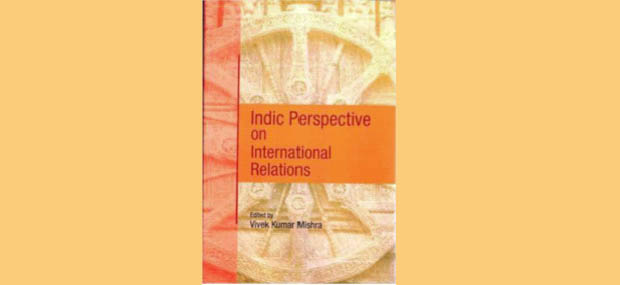
Title: ‘Indic Perspective on International Relations’, Publication: Pentagon Press,
Editor: Vivek Kumar Mishra(ed.), Pp 256. , Rs 895.00

International Relations emerged as a formal academic discipline in Europe after the First World War. In the past hundred years, several approaches/theories have been developed in international relations on the philosophical, ontological and epistemological foundations of realism, liberalism, empiricism, scientism, Marxism, neo-Marxism, positivism, post-positivism and post-modernism.

However, the International Relations Theory is Euro-centric, status quoist, and exclusionary.

In this regard, Amitav Acharya and Berry Buzan say that despite the claims of Western International Relations theory as a universal theory, its roots lie in European diplomatic history and the Western tradition of social theory and practice.

Due to Western dominance in International Relations Theory, no place has been given to non-Western history and its knowledge tradition. The Chinese School of International Relations has been developed recently, but no serious academic efforts have been taken to develop an Indic perspective on International Relations.

The book Indic Perspective on International Relations, edited by Dr Vivek Kumar Mishra, is a commendable effort towards evolving an Indic worldview of International Relations. This volume is a remarkable academic endeavour towards developing the Indic theory of International Relations while analysing the current Euro-centric nature of  International Relations.

In the foreword of the volume, Akhil Bharatiya Prachar Pramukh of Rashtriya Swayamsevak Sangh Sunil Ambekar says that the colonial mindset in International Relations has blocked India from leaving a mark on the global pitch.

Western mindset has influenced the first-generation leadership in India after Independence. Ambekar emphasised that dealing with the undue influence of Western values in the field of International Relations and establishing an Indic perspective is a challenge. According to him, after the publication of the article titled “Hindu Theory of International Relations” in The American Political Science Review by Benoy Kumar Sarkar in 1919, no serious effort was made in the field of International Relations to take the discourse forward.

The thought-provoking introductory article of this edited volume by Prof Aswini K Mohapatra, former Dean of the School of International Studies, JNU, has critically examined the current Euro-centric format of International Relations and several other related theories on the one hand and put forwarded the foundational scheme for developing the Indic School of International Relations. Prof Mohapatra has aptly analysed the challenges posed by post-positivism to the claim of presenting a universal theory of International Relations on the basis of empiricism and positivism. He also discusses the third debate in Western International Relations theory in detail and how the Frankfurt School, Critical Theory, feminism, social constructivism, post-modernism and post-structuralism have emerged in the field of International Relations under the ontological assumptions of post-positivism resulted in a disciplinary crisis and academic disarray in International Relations Theory. Seeing this disciplinary crisis as an academic opportunity, Prof Mohapatra says that based on the Indian Rishi tradition, the Indic theory of International Relations should be developed by Indian International Relations scholars by incorporating India’s historical context, philosophical foundation and normative dimension.

The edited volume by Dr Mishra comprises twelve chapters. In the first chapter, Dr Praveen Kumar analysed the concept of power in the Indian context. In the second chapter, Dr Anoop Kumar Gupta does a textual analysis of Valmiki Ramayana from a strategic perspective. Dr Gupta explores India’s strategic culture’s roots and the contemporary relevance of Valmiki Ramayana. According to Dr Gupta, Rama’s strategic preferences were based on public welfare and national security, while Ravana’s strategy revolved around hegemony, expansionism and stratagem.

In the third chapter, Dr Vivek Kumar Mishra analysed Prime Minister Narendra Modi’s Pakistan policy based on the Indic values of Shanti (peace) and Shakti (power). This article is significant because Dr Mishra provides an Indic tool for analysing India’s foreign policy on the basis of Indian knowledge tradition rather than Western concepts of realism and liberalism. In chapter four, Dr Manan Dwivedi highlighted Indo-US relations, and in chapter five, Dr Abhishek Srivastava threw light on India’s cultural diplomacy.

In chapter six, Shounak Set analyses International Relations in ancient India by re-reading Kautilya’s Arthashastra. In Chapter Seven, Dr Sandipani Dash analyses the liberal-idealist tradition in the non-Western world. In chapter eight, Dr Jajati K Patnaik analyses sub-regional cooperation and strategies with Bangladesh.

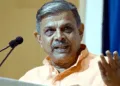
In the foreword of the volume, Akhil Bharatiya Prachar Pramukh of RSS Sunil Ambekar says that the colonial mindset in International Relations has blocked India from leaving a mark on the global pitch

Sourabh Jyoti Sharma and Chau Khahn Tam have analysed India’s Look East Policy and soft power dimensions and their role in Indo-Vietnam relations in chapters nine and ten, respectively. In chapter eleven, Dr Arvind Kumar Singh emphasises building India’s international image by linking India’s soft power diplomacy with Buddhist heritage. Finally, Dr Amit Kumar analysed Buddhism’s importance in Buryatia, Russian Federation, in chapter twelve.

Overall, this edited volume is an important academic initiative regarding developing the Indian perspective on International Relations. It would have been even better if the texts from Mahabharata, Kamandaki, Shukra Nitisar and Thirukul were also included in this volume. The concepts of war and peace, friendship and enmity, use and non-use of force, diplomacy and military strategy, capacity building and alliance making etc., have been deeply discussed and analysed in Indian knowledge tradition. Academic rigour and an interdisciplinary approach are required for the contemporary interpretation of rich Indic tradition from the point of view of International Relations Theory. An urgent need is to create indigenous vocabulary through the textual study of the entire Indian knowledge tradition. It will be helpful in the development of the Indic theory of International Relations.
Topics: Prime Minister Narendra Modi'sBuddhism's importanceIndic Perspective on International RelationsInternational RelationsRashtriya Swayamsevak SanghValmiki Ramayana
Share13TweetSendShareSend
✮ Subscribe Organiser YouTube Channel. ✮
✮ Join Organiser's WhatsApp channel for Nationalist views beyond the news. ✮
Previous News

Hindutva, that is Hinduness, and Hinduism X-rayed by Ranga Hari Ji

Next News

Operation Kaveri: India continues to evacuate citizens from war-torn Sudan; IAF rescues 121 personnel from Wadi Seidna

Related News

Rashtriya Swayamsevak Sangh (RSS) Sarkaryavah Dattatreya Hosabale

RSS at 100 | Hindutva, Hindu, & Hindu Rashtra collectively form identity of Bharat: RSS Sarkaryavah Dattatreya Hosabale

M. Sivadas (75), senior Sangh Swayamsevak of Kochi and former  Vibhag Pracharak passes away at 75

Kerala: M Sivadas Ji, former RSS Vibhag Pracharak and emergency-era activist passes away at 75 in Kochi

Ram Mandir Dhwajarohan: Flag of resolve and realisation

'Shakha to Nation' book released in Bengaluru

‘Shakha to Nation’ released in Bengaluru: Illustrates greatest speeches of Sangh to inspire the path of nation-building

G 20 Summit in Johannesburg: A civilisational blueprint for a fairer global order

RSS Sarsanghchalak Dr Mohan Bhagwat

Fraternity is Bharat’s civilisational strength; dispute is not in our nature: RSS Sarsanghchalak Dr Mohan Bhagwat

Load More

Comments

The comments posted here/below/in the given space are not on behalf of Organiser. The person posting the comment will be in sole ownership of its responsibility. According to the central government's IT rules, obscene or offensive statement made against a person, religion, community or nation is a punishable offense, and legal action would be taken against people who indulge in such activities.

Latest News

Union Minister for Road Transport and Highways Nitin Gadkari (Right)

India set for highway overhaul as Union Minister Nitin Gadkari unveils nationwide shift to MLFF electronic tolling

RSS Akhil Bharatiya Prachar Pramukh Shri Sunil Ambekar

When Narrative Wars result in bloodshed, countering them becomes imperative: Sunil Ambekar

Ministry of Civil Aviation mandates emergency action: IndiGo ordered to stabilise flight operations by midnight

Chhattisgarh CM Vishnu Deo Sai at Panchjanya Conclave, Nava Raipur, Image Courtesy - Chhattisgarh govt

Panchjanya Conclave: Chhattisgarh CM Sai shares views on development projects in Maoist hotbed, women empowerment

Union Finance Minister Nirmala Sitharaman

‘TMC is holding Bengal back’: Sitharaman slams Mamata govt over industrial & healthcare setbacks

Karnataka: Muslim youth Mohammed Usman accused of sexual assault, blackmail & forced conversion in Bengaluru

Social Justice Is a cover; Anti-Sanatana dharma is the DMK’s real face at Thirupparankundram

Karnataka: Hindus demand reclaiming of Anjaneya Mandir at the site of Jamia Masjid; Setting wrongs of Tipu Sultan right

Assam govt proscribes all forms of Jihadi literatures in state; Islamic terror groups trying to recruit Muslim youth

Retired Subedar held for leaking Army details to Pak handlers posing as Indians

Gujarat ATS dismantles spy network involving Ex-Army personnel and woman for sharing information with Pakistan

Load More
  • Privacy
  • Terms
  • Cookie Policy
  • Refund and Cancellation
  • Delivery and Shipping

© Bharat Prakashan (Delhi) Limited.
Tech-enabled by Ananthapuri Technologies

  • Home
  • Search Organiser
  • Bharat
    • Assam
    • Bihar
    • Chhattisgarh
    • Jharkhand
    • Maharashtra
    • View All States
  • World
    • Asia
    • Africa
    • North America
    • South America
    • Europe
    • Australia
  • Editorial
  • Operation Sindoor
  • Opinion
  • Analysis
  • Defence
  • Culture
  • Sports
  • Business
  • RSS @ 100
  • Entertainment
  • More ..
    • Sci & Tech
    • Vocal4Local
    • Special Report
    • Education
    • Employment
    • Books
    • Interviews
    • Travel
    • Health
    • Politics
    • Law
    • Economy
    • Obituary
  • Subscribe Magazine
  • Read Ecopy
  • Advertise
  • Circulation
  • Careers
  • About Us
  • Contact Us
  • Policies & Terms
    • Privacy Policy
    • Cookie Policy
    • Refund and Cancellation
    • Terms of Use

© Bharat Prakashan (Delhi) Limited.
Tech-enabled by Ananthapuri Technologies