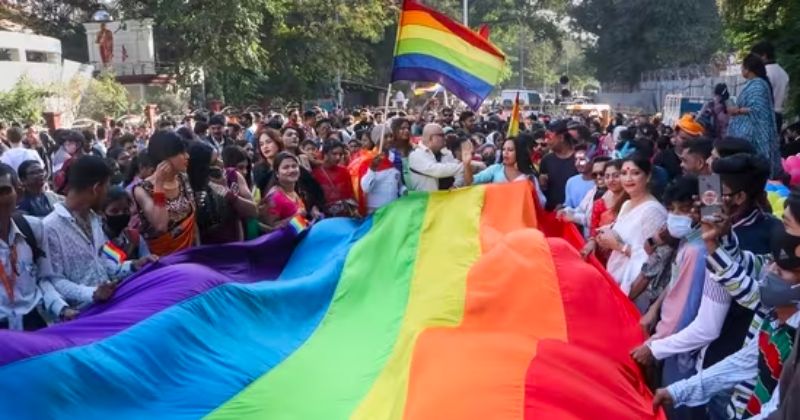
On April 24, the Co-ordination Committee of All District Court Bar Associations of Delhi passed a resolution “expressing its displeasure on the day-to-day proceedings going on before the Constitutional Bench of the Hon’ble Supreme Court” in the matter concerning the legal recognition for same-sex marriages.
The Co-ordination Committee’s resolution said while the Supreme Court “pivotal and crucial role in upholding the rule of law and thus maintaining harmony in the society, there are certain issues that are too complex and have far-reaching consequences that they cannot be left to the discretion of the Hon’ble Courts.”
The resolution said that the social ramifications of the ongoing proceedings before the Supreme Court are “colossal and have the potential to have an unintended impact on the fabric of the society.”
“There are certain issues that are deeply entrenched in societal norms, values, and beliefs. These issues require careful consideration and public debate, as any decision or action taken without societal acceptance may have far-reaching consequences,” the resolution added.
The Co-ordination Committee stated that such issues require a broad-based consensus which can only be achieved through public debate and discussion. “. Therefore, it is important that issues that have the potential to affect society at large are discussed and debated in Parliament, where elected representatives can take into account the views and concerns of their constituents,” the resolution added.
The resolution opined that decisions made in isolation, without the benefit of the view of society, are likely to be ineffective and may even be counterproductive. Furthermore, it claimed that such drastic changes in law must be made keeping in mind the society as a whole which can only be achieved through broad-based societal acceptance. The resolution reiterated that it is important to discuss such issues in the Parliament.
The legalisation of same-sex marriages can only be determined by the legislature through due legislative process, which involves consultation with all relevant stakeholders as the legislature “reflect the collective wisdom and conscience of the nation and take into account cultural values, social standards, and other factors that define acceptable human behavior when making decisions about regulating, permitting, or prohibiting human relationships.”
The Co-ordination Committee stated that the issue of legalisation of same-sex marriages cannot be adjudged through judicial interpretation as it requires an extensive consultation process with various stakeholders and affected parties. It said that the issue cannot be condensed into a single court case and it requires dialogue and collaboration. Therefore, the issue must be referred to the Parliament where such process can take place.
The Co-ordination Committee said that marriage and incidental issues are “blended with the social structure in a manner that it touches each and every individual on many levels including cultural, religious, emotional etc.” Therefore, the issue of legalisation of same-sex marriages requires wide consultative process which is not possible with the “limited judicial adjudicatory precincts.” The resolution stated that “therefore judicial intervention in the said matter is not advisable on the basis of equity and fairness as well.”
The resolution said, “There is no gainsaying that the Legislature, while drafting the various laws pertaining to marriage, never envisaged the issue of marriage between same sexes. Hence, any judicial endeavour to interpret the “legislative intent”, when none existed, would be rendered nugatory.”
“In a democratic setup, the duty of law-making is typically delegated by the electorate to its elected representatives. Thus, the legislature would be best suited to foray into the new arenas of law-making, as per the evolving needs of the society. The issue of same sex marriage and its societal, psychological and medical impacts are at its nascent and experimentative stage and thus should be treated with utmost caution and wide consultation and discussions,” the resolution concluded.
Bar Council of India Resolution
On April 23, 2023, the Bar Council of India (BCI) passed a resolution opposing the grant of legal recognition to same-sex marriage in the country. BCI Chairman Manan Kumar Mishra said the resolution was passed after the BCI held a meeting with representatives of all State Bar Councils.
BCI said ever since the inception of human civilization and culture, marriage has been typically accepted and categorized as a union of biological man and woman for the twin purpose of procreation and recreation. In such background, it would be catastrophic to overhaul something as fundamental as the conception of marriage by any Court of Law, howsoever well-intentioned it may be. Issues pertaining to social and religious connotations should typically be dealt with by Courts through the doctrine of deference, the Bar Council said.
“The legislature being truly reflective of the will of the people is best suited to deal with such sensitive issues. Every responsible and prudent citizen of the country is worried about the future of his/her children after coming to know about the pendency of this matter before the Supreme Court. More than 99.9 per cent of people of the country are opposed to the idea of same-sex marriage in our country,” BCI said.
The Government of India opposes the legalisation of same-sex marriages
The Government of India submitted an affidavit opposing the legalisation of same-sex marriages. It stated that marriage is “an exclusively heterogenous institution” and those seeking marriage equality in India merely represent “urban elitist views for the purpose of social acceptance”. The voices are not coming from the common Indians, said the government.
The government as per the affidavit submitted that “The institution of marriage is necessarily a social concept and a sanctity to the said institution is attached under the respective governing laws and customs as it is given sanctity by law on the basis of social acceptance. It is submitted that social acceptance and adherence to societal ethos, common values, and shared beliefs across religions, in case of recognition of the “socio-legal institution of marriage” is not be confused with majoritarianism.”
The government while opposing the demands said that “conventional and universally accepted socio-legal relationships like marriages across all religions, are “deeply rooted in the Indian social context and indeed is considered a sacrament in all branches of Hindu law. Even in Islam, though it is a contract, it is a sacred contract and a valid marriage is only between a biological male and a biological woman”.
“It’s purely a matter of legislative policy under Entry 5 of List III of Schedule VII of the Constitution, which ought to be determined by the appropriate Legislature only,” the Government emphasised.
Former Judges oppose the legalisation of same-sex marriages
On March 24, a group of former judges issued an open letter stating that the legalisation of same-sex marriages “will strike at the very root of the family system and thus will have devastating impact on the society at large,” signed by Justice SN Dhingra. The letter noted, “purpose of marriage is not confined only to the physical intimacy of partners but goes far beyond and is indispensable for the growth of society by way of procreation of progeny.”
The letter claimed that certain “versed interest groups having no knowledge and regard of the civilizational importance of marriage” have approached the Supreme Court for legalising same-sex marriage. It is pertinent to note that the plea to legalise same-sex marriage has been referred to a Constitution Bench. The letter stated, “Any attempt at weakening a great and time-tested institution should be opposed vociferously by the society. Indian cultural civilization has constantly been attacked for centuries but survived against all odds.”
Furthermore, the letter remarked on the Supreme Court’s hearing of the plea, stating, “Instead of having wide-range discussions and deliberations amongst the stakeholders and without there being any vociferous demand from any section of society, such a hasty judicial intervention is unfortunate, and totally unwarranted. The separation of powers is a part of the basic structure of the Indian Constitution. The exercise of law-making is an exclusive domain of the legislature and not the judiciary, especially in matters exclusively within social and political domain.”