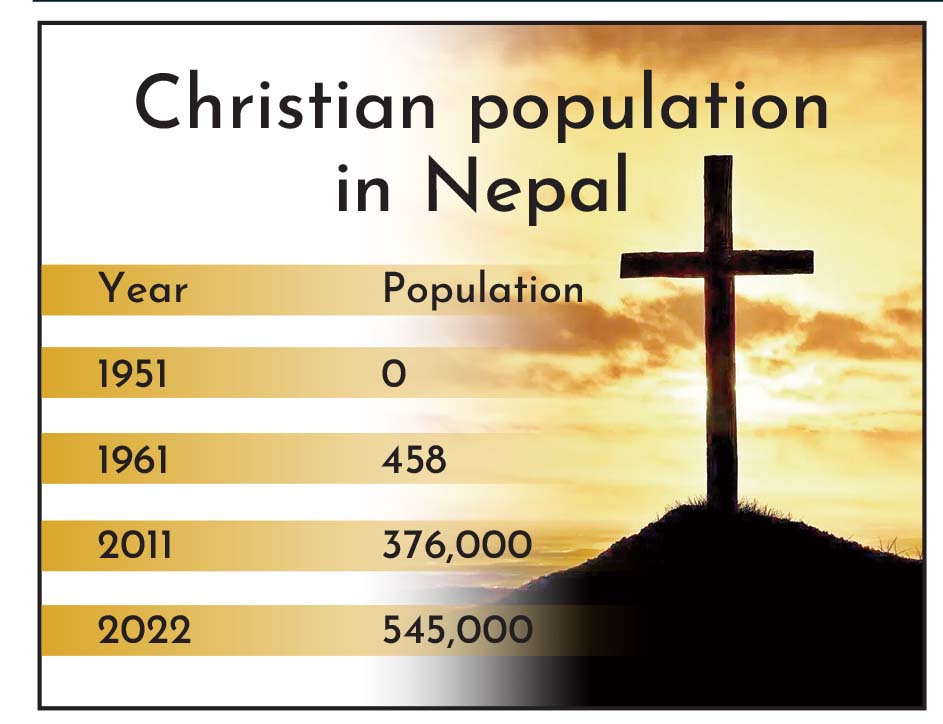
Miracle in the typical Christian missionaries’ style is happening in the erstwhile Hindu Kingdom of Nepal. The magic of this miracle embedded in the infamous aggressive proselytising has made Christianity as the fastest-growing religion in this Himalayan country. From 458 Christians in 1961 to constituting around 1.4 per cent (2011 Census) till 2011 and now touching around 10 per cent of the total population (Federation of National Churches of Nepal), the number of people finding ‘new meaning’ to their lives by abandoning their traditional religions are growing rapidly. This huge change in the demography of Nepal comes with serious socio-religious and political consequences.
Rise in Conversion
Political and socio-religious stability ensured by the erstwhile Hindu kingdom prevented the conversions to Abrahamic faiths. But dismantling of monarchy in 2006 and subsequent establishment of Nepal as a ‘secular’ state provided them an opportunity and led to the sudden rise in evangelical activities. Today, this issue of religious conversions has assumed serious and contentious proportions in this nation. It has led to societal tensions among various ethnic and religious communities. Hindus, Buddhists and practitioners of the traditional Kiranta faith have repeatedly resented against these conversions. Though the Nepalese Constitution makes religious conversion a punishable offence, very few get prosecuted under this law. Flush with foreign funds with tactical support from foreign NGOs, international organisations, foreign diplomatic missions and domestic political set-up, Christian Missionaries have found the best possible climate for conversions in ‘secular’ Nepal.
Tools Deployed by Missionaries
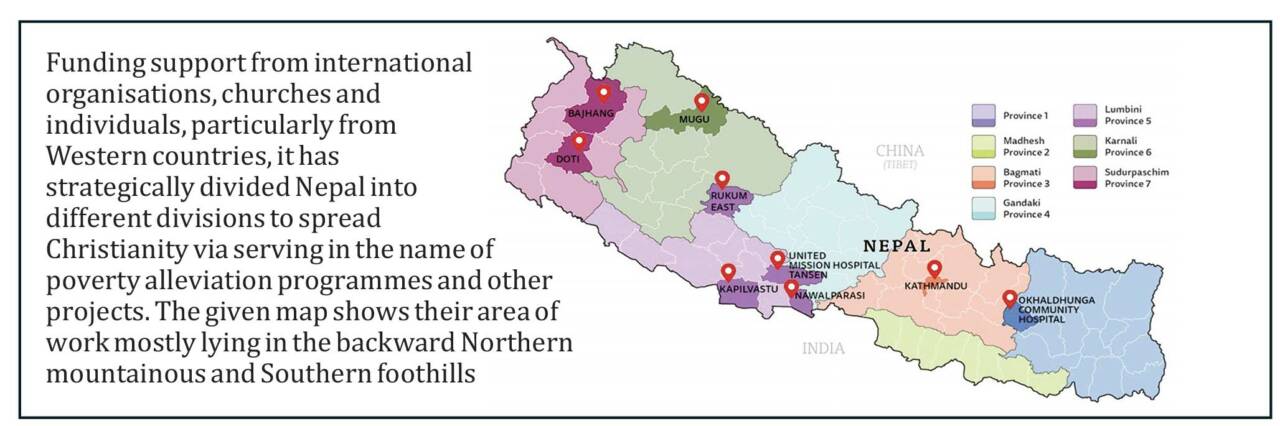
Proselytising in the grab of welfare and poverty alleviation programmes have been one of the time-tested tools deployed by the Missionaries. In this context the infamous role of the United Mission to Nepal (UMN) is worth mentioning. With a history of more than 65 years of serving in the name of Jesus, United Mission to Nepal has a stated mission of “to make Christ known by word and life”.
Widening Gap between Converts & Non – Converts
Thirdly, most beneficiaries of UMN’s programmes are Christians. The rampant proselytisation can be observed in the Northern districts. There is stark difference in the households who have fallen prey to Christian missionaries’ propaganda and those who have resisted the lure. Those who have succumbed to the lure have better living standards and jobs with Western agencies and their neighbours, who stayed with their traditional faith, struggle to make a decent living. Thus all these points clearly demonstrate that the real intent behind these so-called social and welfare services by Christian groups is to lure poor into Christianity by using monetary and other material enticements. For Abrahamic faiths, Freedom to Religion in the form of right to conversions has always been on their agendas and they make a lot of noise about it. Similar noise is being made in Nepal with different Islamic and Christian religious leaders and groups demanding that the right to change religion be guaranteed. However, this appeal for the right to change religion is not limited just to religious leaders of the said faiths, but foreign High Commissions also known to indulge in this. For example, in 2014, British ambassador to Nepal, Andrew Sparks while appealing to members of the constituent assembly remarked, “We encourage you to ensure that the right to change religion is protected, and that the right to hold opinions and to express them freely will remain strong”. This interference in Nepal’s internal affairs by various foreign NGOs and organisations is a routine now. According to Kamal Thapa, then chairman of the Rashtriya Prajatantra Party-Nepal, these types of interference by these groups is aimed at to “ensure proselytising Christian missionaries face no hurdles in their activities and would have a field day converting Nepal’s poor people using blatant blandishments. Or else what business do they have with religious matters? Their only objective is to ensure that Christian missionaries from Europe and the West are free to proselytise in Nepal”.
Targeting Underprivileged
Flush with foreign funds, the poor are the easiest prey for Christian evangelical activities. While Christian groups claim that they are not indulging in forceful conversions but Hindu, Buddhist and Kiranta groups allege that financial and other kinds of material enticements along with superstitious methods are used for conversions. They ask, if their only concern is to improve the lives of the poor and ameliorate their sufferings, why are only the beneficiaries of such programmes converting to Christianity? Why is the Bible gifted along with financial doles? Why is Mother Teresa style Gospel of truth preached while serving them? And no doubt, these fundamental questions go unanswered.
Another standard modus operandi for these missionaries is to make full use of natural tragedies under the grab of relief work. In the case of Nepal, be it the earthquake of 2015 or COVID-19 of recent times, maximum conversions have happened during these grim times. In this context, Diana Riboli, an Italian anthropologist points out that “After the earthquakes, Christian missions in Chepang areas became more and more active and the number of churches is dramatically increasing”. She also informs about the negative consequences of these conversions in the form of socio-religious conflicts as Christian missionaries’ term their faiths as “regressive” and “pagan”. She states, “Missionaries emphasise the healing aspect of Christianity, trying to put an end to the traditional rituals and charismatic power of shamans.”
Thus Riboli rightly points out that conversions are “creating an alarming situation” in Chepang communities, where internal conflicts are becoming more frequent. Also, in poorer and less literacy areas, missionaries indulge in the superstitious methods of miracles and faith healings.
Another aspect of rampant proselytisation in Nepal is the fact that Missionaries are hand in glove with Communists. Senior leadership from communist parties have close financial relations with foreign NGOs and Western donor agencies. For example, in 2018, former Prime Minister Oli attended the Asia Pacific Summit which was organised by Universal Peace Foundation, a South Korean NGO which has been accused of funding and promoting conversions to Christianity.
The negative consequences of evangelical activities are becoming more apparent in the form of changed demography, inflaming passions by hurting the religious sentiments of the majority, creating socio-religious divides and conflicts within communities. It also increases outside interference in Nepal’s internal affairs. A changed demography or reduced Hindu population also favours Chinese designs in the Himalayan republic.
Against this background, a call to obliterate the ‘Secular’ tag and return to ‘Hindu Rashtra’ is becoming louder. Many prominent civil society members, including social activists, journalists, bureaucrats and politicians, feel that turning the country to an alien ethos like a ‘secular republic’ was a poor and hasty decision made by Maoists without much consultations with civil society members and opposition leaders. These people point out the fact that the 1990s constitution proclaimed Nepal as ‘Hindu Rashtra’ but Hinduism was not a state religion and no one was discriminated against on the basis of their religious identity. Similar views are echoed by the prominent medical practitioner, Suraj Shrestha when he contends, “Hinduism, by its very nature, is a secular, tolerant and all-encompassing religion. So there was no need to make Nepal a secular country”.
The demand to return to Hindu Rashtra is getting support from across party and religious lines. Many factions in Communists parties also support it. Among religious communities even Muslims who constitute around 5 per cent of the population and are victims of evangelical activities, have come out in its support. For example, chairperson of the Rashtrabadi Muslim Manch Nepalgunj, Babu Khan Pathan is of opinion that “We don’t need a secular identity, but want to see the country called Hindu State as this ensures safety and security for all”.
Effective implementation of anti-conversion laws, and keeping an eye on funding mechanism and proselytisation activities of foreign NGOs and agencies is the way forward for Nepal to stop the impending challenge of demography imbalance and resultant socio-religious conflicts. However, returning to the status of Hindu Rashtra is the penultimate solution to the evil designs of conversion mafias.