





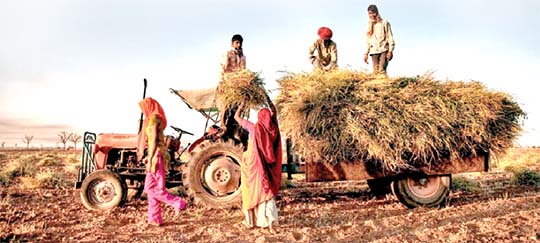
‘ Jai Jawan, Jai Kissan’ – the words spoken by the late Prime Minister Lal Bahadur Shastri, capture the gratitude which, we as a nation feel towards our soldiers and farmers.
As per the Ministry of Agriculture census of 2015-16, the average size of operational holding is 1.08 hactare, with small & marginal farmers being 86.08 per cent (nearly 13 crore families). It has taken seven decades to bring some cheer to Jawans of India (over 3 million) with respectable remuneration and ‘One Rank One Pension’ concept. But most marginal and small farmers’ families continue to be poor, deep in debt, and a few committing suicides out of desperation every year.
Modern day resources and technology enable us to be efficient and sustainable with our agricultural needs. While nature provides profusely, and we can work with nature to ascertain what grows where. Crops like rice and wheat that need larger volumes of water should be grown in areas with perennial water sources and suitable soil conditions. Crops like millets grow very easily in semi-arid zones of meagre water availability. We have made rapid progress in science & technology with inventions like tractors, agricultural implements, chemical fertilisers, pesticides, and new lab grown strains of rice and wheat. India achieved a green revolution to ensure food adequacy. Nonetheless, even in periods of record agricultural produce, marginalised farmers still continue to be poor, unable to repay the loans with some taking extreme steps. Non- remunerative prices, no protection from vagaries of weather and acute shortage of water at critical stages of farming add to the woes. Also, agricultural sciences have caused severe damages to ecosystems in many ways which need immediate fixing.
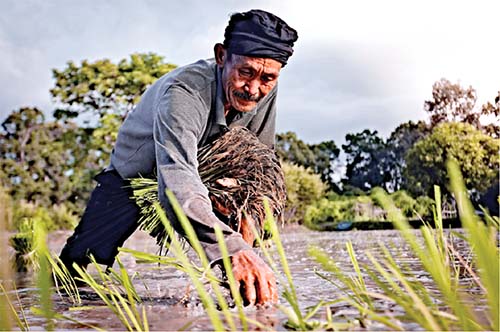
When we consider the preparedness of people to spend money for cooked food in restaurants and hotels, at Rs 500/- to Rs 1000/- per plate on an average, one may wonder, how little reaches the farmers, the original food-providers; less than Rs 50/- per plate. Is there a problem with how we classify and measure economic contribution, where a hotelier earns greater respect and prosperity than a farmer? Why is the farmers’ share in the overall food economy so dismal? Furthermore, why does it continue to be so?
Two things have gone wrong:
(1) Village-Economy has become unviable:
There was a time, say, a few centuries ago, when the Indian economy was essentially built around 600,000 villages with farmers and artisans engaged in all domains of economy: agriculture, manufacturing, and services, in an interlinked manner. Agriculture was pivotal but still a part of the Village-economy. For instance, a carpenter, blacksmith, weaver etc. were also essential contributors to the village economy. Today, unfortunately the village-economy is essentially tied only to agriculture, while all other goods and services are allocated for and developed by people who live and thrive in bigger cities. So, migration from villages to towns and cities has become essential for survival.
(2) Food-Chain is harming the Health of Soil, Society and Environment:
There are several negative effects of misuse or excessive use of chemicals (pesticides, fertilisers etc.) in farming on the health of soil and society. Tragic realities include increasing incidences of cancer, soil desertification, decreasing levels of underground water-tables and environmental imbalances through release of carbon dioxide and other harmful gases.
Keeping this background in mind, we need to understand the problems of agriculture and aspire to achieve farmers’ prosperity, while also keeping the changing trends of industrialisation and technological innovations in perspective.
Four-Pronged Transformational-Initiatives:
We need strategic, and systemic course-corrections, with due political will of leadership. Our proposal lies in four “disruptive changes”, through concerted efforts at all levels of society: citizens as consumers, government as policymakers, professionals as innovators, pioneering business leaders as champions, and farmers/villagers as rural entrepreneurs.
Demand-Shift towards Nutritional- Food & Preventive Healthcare Healthy crops like millets, organic edible oils, healthier eating habits with fibre & nutrients leading to enormous reduction on health costs. Besides, shifting to the right crops for the right environment is the only way to conserve water tables. For instance, 1 kg of rice paddy consumes 4,000 to 5,000 litres of water whereas millets require only 200 litres. India is rich with biodiversity with many types of nutritional & healthy crop varieties. Similarly, cereals and pulses requiring much less water for irrigation need to be promoted. We as citizens, need education so that we may make informed decisions about what we eat, and what we should not!
There are several negative effects of misuse or excessive use of chemicals in farming on the health of soil and society. Tragic realities include increasing incidences of cancer, soil desertification, decreasing levels of underground water-tables
Reversal of Migration: City-Village Symphony Redesign existing and new cities, to not exceed 10-15 kms from end to end with a population of say, 5 lakh people surrounded by a cluster of 50 to 100 villages, under a common Masterplan, called Cillage. In view of modern digital technologies, such city-village entities need to be seen as minimum viable habitats, as villages used to be viable centuries ago. This way, all people will have access to both city and village life simultaneously on a day-to-day basis. Farm produce will have a ready market nearby. Villagers would live in their villages instead of slums in cities and yet have access to all the amenities in the form of schools, clinics, hospitals, playgrounds and much more in the border areas with cities. This would optimise access to greater opportunities for growth for every person, with sustainability intact. It is pertinent to note that research by scientists from Finland (REF: MDPI.com Resources 3(3) 2014,488-515 Michael Lettenmeier, etal) have estimated that the western countries need to reduce their consumption by 80 per cent from about 40 to 8 tons/capita/year, to achieve sustainability.
Decentralised Economy & Decentralised Entrepreneurs: Value-added Sustainable Agriculture A robust economy of producers & consumers in a sustainable environment, excellent flexibility and decentralised decision making, with much reduced roles for Governments/bureaucracy and increased role for society itself. Above all, a true coming together of village produce of dexterity and hand skills side by side with highly valued IT driven global services/reach.
- Legally recognise farmers as entrepreneurs: They are owners of agricultural land and manufacturing food for all. Policies should encourage and empower groups of small farmers to form collective and collaborative entities to meet specific demands of groups of consumers. Such entities would be able to source inputs in bulk to save costs.
- Expert city-based professionals would provide guidance in managing every aspect of this entity.
- Value-addition activities should be done near farms – like flour milling, extracting edible oil (sesame, mustard, ground nut, coconut and many more seeds / nuts), making purees out of tomato, ginger, garlic, and other such items. These value addition facilities would provide excellent local employment opportunities to all villagers. In view of 8 million women SHG (self-help groups) in the country, the next logical step is rural-women becoming rural- entrepreneurs, once decentralised economic opportunities are available to them. This would unlock the hidden unmonetized potentials of rural areas, currently camouflaged in 30-40 per cent idle time.
Transition-Planning Initiative: Mission Lifestyle-Disruption
A missionary approach to trigger the above three disruptions is required to ensure capital provision through advances from consumers, opportunity creation by government and private businesses, self-initiative by individual entrepreneurs & professionals, appropriate policies, and awareness campaigns by societal institutions to bring about lifestyle disruptions at massive scale. The trend of lifestyle changes with a focus to go local has got highlighted
Policies should encourage and empower groups of small farmers to form collective and collaborative entities to meet specific demands of groups of consumers
Simultaneously, the global economic system is falling apart in every developed nation, due to excessive centralisation of capital with 0.1 per cent population, including in the mighty USA. As a decentralised economy aided by sustainable- agriculture, India can pave a new path of “sustainable prosperity,” for the world to follow!















Comments