Sardar Patel: The real statesman and unifier of India
December 5, 2025
  • Read Ecopy
  • Circulation
  • Advertise
  • Careers
  • About Us
  • Contact Us
Android AppiPhone AppArattai
Organiser
  • ‌
  • Bharat
    • Assam
    • Bihar
    • Chhattisgarh
    • Jharkhand
    • Maharashtra
    • View All States
  • World
    • Asia
    • Europe
    • North America
    • South America
    • Africa
    • Australia
  • Editorial
  • International
  • Opinion
  • RSS @ 100
  • More
    • Op Sindoor
    • Analysis
    • Sports
    • Defence
    • Politics
    • Business
    • Economy
    • Culture
    • Special Report
    • Sci & Tech
    • Entertainment
    • G20
    • Azadi Ka Amrit Mahotsav
    • Vocal4Local
    • Web Stories
    • Education
    • Employment
    • Books
    • Interviews
    • Travel
    • Law
    • Health
    • Obituary
  • Subscribe
    • Subscribe Print Edition
    • Subscribe Ecopy
    • Read Ecopy
  • ‌
  • Bharat
    • Assam
    • Bihar
    • Chhattisgarh
    • Jharkhand
    • Maharashtra
    • View All States
  • World
    • Asia
    • Europe
    • North America
    • South America
    • Africa
    • Australia
  • Editorial
  • International
  • Opinion
  • RSS @ 100
  • More
    • Op Sindoor
    • Analysis
    • Sports
    • Defence
    • Politics
    • Business
    • Economy
    • Culture
    • Special Report
    • Sci & Tech
    • Entertainment
    • G20
    • Azadi Ka Amrit Mahotsav
    • Vocal4Local
    • Web Stories
    • Education
    • Employment
    • Books
    • Interviews
    • Travel
    • Law
    • Health
    • Obituary
  • Subscribe
    • Subscribe Print Edition
    • Subscribe Ecopy
    • Read Ecopy
Organiser
  • Home
  • Bharat
  • World
  • Operation Sindoor
  • Editorial
  • Analysis
  • Opinion
  • Culture
  • Defence
  • International Edition
  • RSS @ 100
  • Magazine
  • Read Ecopy
Home Bharat

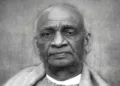
Sardar Patel: The real statesman and unifier of India

A comprehensive account of how Sardar Patel integrated and unified the whole of India and changed the political map and underlying unity foreverWith the advent of Narendra Modi in the national politics, the corpus of writing on Sardar Vallabhbhai Patel seems to have increased. This year alone, we have seen at least three well-known authors coming out with monographs on Patel. What explains this rejuvenated interest and engagement with Patel’s legacy in contemporary India?The answer, perhaps, lies in t

Archive ManagerArchive Manager
Dec 15, 2022, 02:15 pm IST
in Bharat
Follow on Google News
FacebookTwitterWhatsAppTelegramEmail
A comprehensive account of how Sardar Patel integrated and unified the whole of India and changed the political map and underlying unity forever
With the advent of Narendra Modi in the national politics, the corpus of writing on Sardar Vallabhbhai Patel seems to have increased. This year alone, we have seen at least three well-known authors coming out with monographs on Patel. What explains this rejuvenated interest and engagement with Patel’s legacy in contemporary India?
The answer, perhaps, lies in the fact that the seven decades of independent India have been overly focussed on the achievements, ideas and misadventures of the Nehru-Gandhi dynasty. Since Narendra Modi, in the interest of nationalist history and the nation itself, commenced exploration of other icons, the literature has to come up as well!
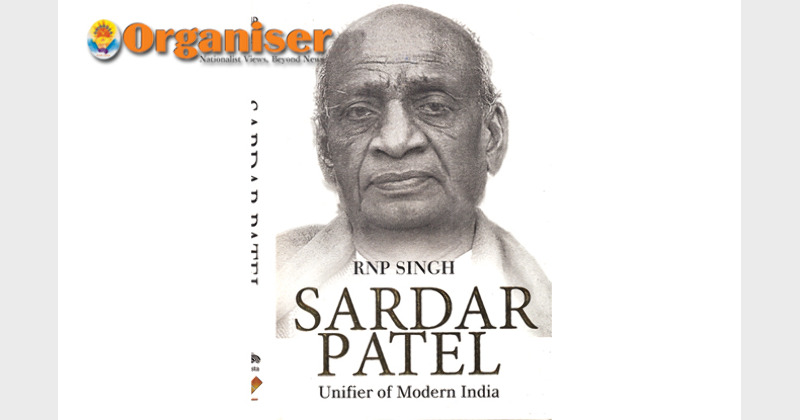
Sardar Patel Unifier of Modern India (2018) is a sincere attempt in the direction of producing well-researched monographs on the other nationalist icons. Significantly, RNP Singh, the author, frees himself from the ‘Great Men Theory; in the preface itself. He observes that Patel has been perceived as a “Superman, and a leader with ‘superlative brains’. He was none of that. What he was, was a statesman gifted with the rare quality of astuteness and pertinacity in his approach to problems.”
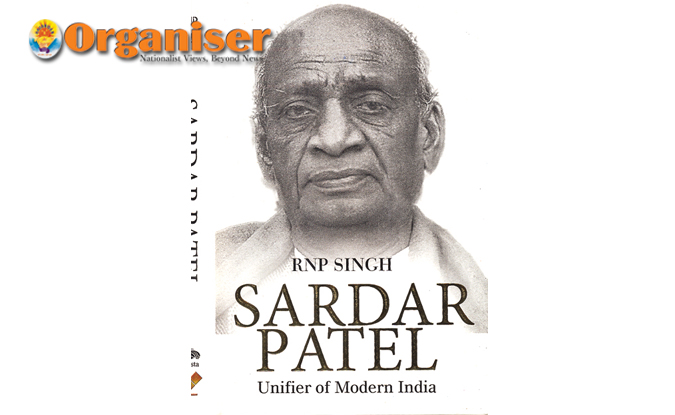
Singh, RNP, Sardar Patel Unifier of Modern India Vitasta Publishing (New Delhi), 2018 p. 356, Rs 795 (Hardbound)
This particular insight doesn’t come in retrospect. It has been derived, validated and provided with a keen sense of veracity in the author’s work. Depending on a not so large bibliography of secondary sources, the author has delved and depended primarily on the primary sources to build up his factual narrative account.
The temporal frame of the book shapes up since 1947 and extends till 1950 when Patel died. The narrative account in the duration of these three years then becomes a saga of diplomatic and realpolitik craft which Patel displayed in great details. The history of the integration of the Indian States in the book takes a linear chronological line. After having introduced the context in the first chapter, the book goes on to examine the respective cases of the Eastern States, Greater Rajasthan, Travancore, Jodhpur, Kathiawar, Bhopal, Junagadh, Hyderabad and finally Jammu & Kashmir.
In-Depth Accounts
The front flap of the book quotes the Soviet leader Nikita Khrushchev said, “You Indians are amazing people. How on earth did you manage to liquidate the Princely rile without liquidating the Princess?” And that what the book sets out to show. The brilliance of Patel was not merely in the fact that he made some 584 princely states to accede to India. His deliberation style and pragmatic approach which facilitated a majorly peaceful accession is something which was brilliant.
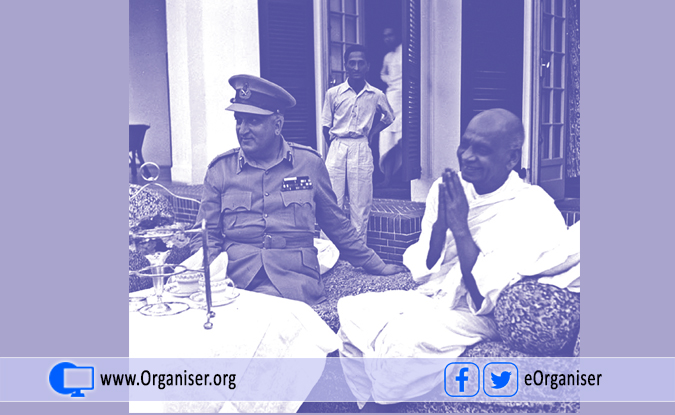
 

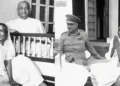
Sardar Vallabhbhai Patel hosted an At Home on April 20, 1948 to meet the Rulers of Central India who were in New Delhi in connection with the formation of the Malwa Union. In this rare photo, he is seen with Maharaja Hari Singh
By far the popular readers of Modern Indian history used to know the dealings of Patel majorly to tough nuts like Junagadh, Hyderabad and J&K. The latter two cases also saw an active involvement of armed forces and instruments of violence. However, the more remarkable story lies in the cases of those princely states which acceded peacefully!
Someone like Patel, who was called ‘the accurate bowman of Gandhian struggle’ by Vinoba didn’t shy away to twist the arms of those Princes who tried to play rash and difficult However, someone like Patel, who was called ‘the accurate bowman of Gandhian struggle’ by Vinoba didn’t shy away to twist the arms of those Princes who tried to play rash and difficult. As mentioned above, a few cases like Nizam of Hyderabad are well-known. But little-forgotten details such as how Patel dealt with Maharaja of Alwar and his Prime Minister NB Khare are the treasure anecdotes of the book. Maharaja and Khare were put under house arrest in Delhi after the news came out that Gandhiji’s assassination had been celebrated in Alwar with the distribution of sweets. Patel sent Indian troops to Alwar and took control of the State. But having done that, Patel also visited Alwar to talk to the people face-to-face at a public meeting on February 25, 1948 and made his positions clear. (Singh, 2018, p. 65)
One princely State after the other, the deal was done one after another. Unification of over 560 princely States took around 18 months. It moved fast, with the speed of a soft whirlwind, gently drawing the Princes into its warm embracing, hurting none. Patel was watching with wonder and admiration for redrawing the map of India: first with Accession, followed by the merger of neighbouring States, and finally, with the formation of large, viable Unions at par with the provinces.
Presentation and Layout
While the main text in the book runs around 240 pages, the other advantages to the reader are manifold. There is a detailed listing of many important correspondences in appendices. The book is filled with rich illustrations and cartographic content. The chronological unfolding of the narrative along with the maps of the respective princely States provides the reader with the opportunity to witness the making of the Indian political map.
The index is fairly elaborate and comes out in three different classifications of the subject, names of the individuals and names of the place. This makes the book fairly accessible, and for any book which contains a huge number of individuals and places should’ve done it.
What the book lacks in is a serious methodological issue of history writing. Patel’s legacy as the unifier of modern India serves as its primary subject, protagonist, but also its context. Certainly, the context is not enough! Supposedly a reader who may be getting introduced to Patel for the first time is going to ask that how he became ‘Greater than Bismark’. What went in the making of the ‘Sardar’; the ‘Lauh Purush’ (Iron Man)? Why was he respected so much and how could he achieve achieve that vantage point from where he could bargain, deliberate and if needed, twist the arms of the princely? The context in which we should’ve met Sardar Patel of 1947 is completely missing in the book! For a narrative which complains that we didn’t allow our young generation to know leaders beyond Nehru-Gandhi dynasty, a finer biographical approach is required along with a theme exploration exercise.
Topics: Sardar PatelIron Man of India
ShareTweetSendShareSend
✮ Subscribe Organiser YouTube Channel. ✮
✮ Join Organiser's WhatsApp channel for Nationalist views beyond the news. ✮
Previous News

Bangladesh Muktijuddha Mancha requests Pakistan to apologise for 1971 war crimes

Next News

If someone consumes liquor, they will die, says Bihar CM Nitish Kumar on Hooch tragedy

Related News

Sardar Vallabhbhai Patel-The Iron Man of India

Sardar Vallabhbhai Patel: Architect of India’s unity and guardian of her sovereignty

Sardar Vallabh Bhai Patel

India’s Destiny Reimagined: If Sardar Patel had been the first Prime Minister of Bharat

Maniben: Devoted daughter who nursed Sardar Patel for 41 years from 1909 to 1950 after her mother Javerbha’s death

CM Mohan Charan Majhi inaugurated ‘Run for Unity’ at Kalinga Stadium

“Bharat stands united owing to Sardar Patel’s vision,” says Odisha CM; flags off ‘Run for Unity’

“Had Congress not committed that sin…”: PM Modi slams Congress for removing part of ‘Vande Mataram’

Jawaharlal Nehru (Left) and Sardar Vallabhbhai Patel (Right)

Major Conflicts Between Sardar Patel and Nehru: How Nehru’s policies undermined Sardar Patel’s united Bharat vision

Load More

Comments

The comments posted here/below/in the given space are not on behalf of Organiser. The person posting the comment will be in sole ownership of its responsibility. According to the central government's IT rules, obscene or offensive statement made against a person, religion, community or nation is a punishable offense, and legal action would be taken against people who indulge in such activities.

Latest News

Union Minister for Road Transport and Highways Nitin Gadkari (Right)

India set for highway overhaul as Union Minister Nitin Gadkari unveils nationwide shift to MLFF electronic tolling

RSS Akhil Bharatiya Prachar Pramukh Shri Sunil Ambekar

When Narrative Wars result in bloodshed, countering them becomes imperative: Sunil Ambekar

Ministry of Civil Aviation mandates emergency action: IndiGo ordered to stabilise flight operations by midnight

Chhattisgarh CM Vishnu Deo Sai at Panchjanya Conclave, Nava Raipur, Image Courtesy - Chhattisgarh govt

Panchjanya Conclave: Chhattisgarh CM Sai shares views on development projects in Maoist hotbed, women empowerment

Union Finance Minister Nirmala Sitharaman

‘TMC is holding Bengal back’: Sitharaman slams Mamata govt over industrial & healthcare setbacks

Karnataka: Muslim youth Mohammed Usman accused of sexual assault, blackmail & forced conversion in Bengaluru

Social Justice Is a cover; Anti-Sanatana dharma is the DMK’s real face at Thirupparankundram

Karnataka: Hindus demand reclaiming of Anjaneya Mandir at the site of Jamia Masjid; Setting wrongs of Tipu Sultan right

Assam govt proscribes all forms of Jihadi literatures in state; Islamic terror groups trying to recruit Muslim youth

Retired Subedar held for leaking Army details to Pak handlers posing as Indians

Gujarat ATS dismantles spy network involving Ex-Army personnel and woman for sharing information with Pakistan

Load More
  • Privacy
  • Terms
  • Cookie Policy
  • Refund and Cancellation
  • Delivery and Shipping

© Bharat Prakashan (Delhi) Limited.
Tech-enabled by Ananthapuri Technologies

  • Home
  • Search Organiser
  • Bharat
    • Assam
    • Bihar
    • Chhattisgarh
    • Jharkhand
    • Maharashtra
    • View All States
  • World
    • Asia
    • Africa
    • North America
    • South America
    • Europe
    • Australia
  • Editorial
  • Operation Sindoor
  • Opinion
  • Analysis
  • Defence
  • Culture
  • Sports
  • Business
  • RSS @ 100
  • Entertainment
  • More ..
    • Sci & Tech
    • Vocal4Local
    • Special Report
    • Education
    • Employment
    • Books
    • Interviews
    • Travel
    • Health
    • Politics
    • Law
    • Economy
    • Obituary
  • Subscribe Magazine
  • Read Ecopy
  • Advertise
  • Circulation
  • Careers
  • About Us
  • Contact Us
  • Policies & Terms
    • Privacy Policy
    • Cookie Policy
    • Refund and Cancellation
    • Terms of Use

© Bharat Prakashan (Delhi) Limited.
Tech-enabled by Ananthapuri Technologies