





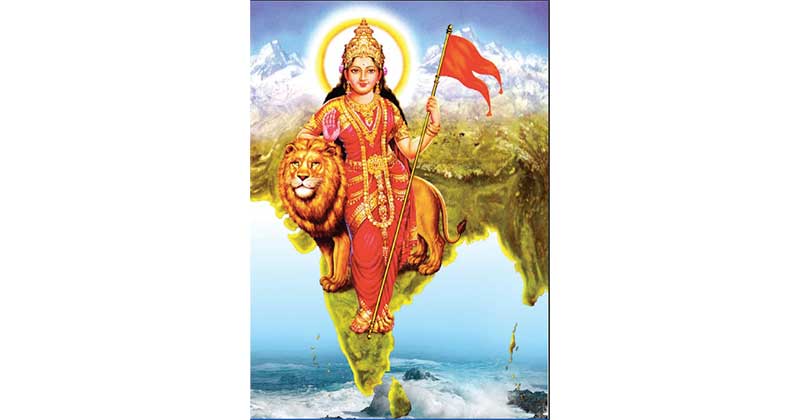
We all, Bharatvasi, personify our country as ‘Bharat-Mata’, which means ‘Mother Bharat’. So, we call our country our ‘Matrabhoomi’ or ‘Motherland’. The great patriotic song, ‘Vande-Mataram,’ was adopted as the National Song of Bharat in October 1937 by the Congress Working Committee, almost a decade before the end of colonial rule in August 1947. In 1907, the great freedom fighter, Madam Bhikaiji Cama, made the first version of ‘Tiranga’, with ‘Vande-Mataram’ written in the middle band.All over the world, people who call their country of origin or native country are referred to as Fatherland, Motherland, or simply as homeland. Whether one personifies one’s government as the Fatherland or the Motherland depends upon the traditions, history, culture and socio-political developments in that country and the personal preference of its citizens. In today’s world, nationalistic attachments and patriotic choices manifest differently. The use of Motherland or Fatherland may sound nationalistic and politically or socially right or wrong, but it’s an undeniable truth. It emphasizes or states one’s patriotism as its identification. The history of personification of native land is not a new concept. Human figures are used to represent particular countries, their citizens, or ideas of the national character. We find an early example of National personification in a gospel book dated 990 BC: Slavonia, Germania, Gallia, and Roma, were bringing offerings to Emperor Otto III. Sometimes personification of nations becomes controversial as it is intended to represent a large & diverse society by a single person, often representing a simple idea. Again figures used to describe a country or its citizens can become sites of political or cultural debate, defining who has the most legitimate claim to be the backbone of the country or to formulate independence or other political movements.
The idea and image of the Motherland seem to be more successful than that of the Fatherland. Most modern nations depict themselves in the image of a woman. The female personifications of nations have a long lineage going back to ancient Greek literary and artistic personifications of cities, lands, and countries. Female personifications of the government also include strong and confident women holding a sword, indicating the preparedness of women to defend their nation, like Germany or Britannia. The city of Athens may have provided a visual example of this, as its emblem was the goddess Athena. Although it’s not a personification, the anthropomorphic conception of a deity, Athena, appears in full armour. In addition, images of the revived concept of ‘La Patrie’ around the time of the French Revolution also show ‘La Patrie’ in fully armed female form. Almost 80 countries of the world consider their nation a ‘Motherland’. Some Slavic and Baltic countries called themselves the Fatherland. The Netherlands is also known as the Fatherland. All other countries call their country Motherland. Only a few countries refer to their country as ‘Homeland’ without the symbol ‘mother’ or ‘father’, like the United States of America. In an article for the British magazine Time and Tide’ on January 19, 1940, Muhammad Ali Jinnah, then future founder of Pakistan, explained Bharat as a “common motherland of Hindus and Muslims.” But interestingly, he never called Pakistan a ‘Motherland’ or ‘Fatherland.’
The concept of personification of ‘Bharat’ as ‘Bharat Mata’ was started in the last quarter of the 19th century by a poem written by one Bengali Deputy Collector, Bankim Chandra, for his novel, ‘Anand-Math’. Then the incredible transformation of ‘Vande-Mataram’ from a simple, innocent song into a great revolutionary slogan resulted from the efforts of Bengali youth agitators against the Bengal partition in 1905-06. Anand-Math was the story of ‘Sanyasis’ (monks) who renounced their home, worldly bondage, family and everything and devoted their entire life to the service of their Motherland. The characters in her novel portrayed the ‘Motherland’ as the Mother Goddess and worshipped her as a deity. They did not worship any other God than their Motherland and did not know any religion other than the religion of ‘Rashtra-Bhakti’.
Gurudev Rabindranath Tagore first sang this poem in the 1896 session of the Indian National Congress. After that, ‘Vande-Mataram’ became a war slogan of national revival during the Bhartiya independence movement. Later this song and the novel were banned by the British government, but freedom fighters and the general public defied this ban. Many were imprisoned repeatedly for singing this song in public, with the ban being overturned by the Bhartiya government after Bharat gained independence from colonial rule in 1947. This song has also inspired many Bhartiya poets. It has been translated into many Bhartiya languages, like the Tamil language by great nationalist Tamil poet, Subramaniam Bharati, Telugu, Kannada, Odiya, Malayalam, Assamese, Hindi, Marathi, Gujarati and Punjabi. One of our era’s notable Bhartiya Muslim intellectuals, Mr Aarif Muhammad Khan, translated this song into Urdu. ‘Bharat Mata’ is usually depicted as a typical but traditional Bhartiya lady, holding the national flag or the conventional saffron flag in a saffron or white Saree. Pictures of Bharat Mata are present in numerous forms in our society, like in posters, calendars, other printed documents, and idols. In ‘Indian Opinion’, Mahatma Gandhi wrote in South Africa on December 2, 1905, “The song, it is said, has proved so popular that it has come to be our National Anthem. Just as we worship our mother, so is this song a passionate prayer to India.” But unfortunately, when Muslims started disliking this song, the same Mahatma stopped singing and defied its sacred national spirit. That’s not the end of the story, but Mahatma Gandhi also persuaded Congress not to insist on singing it as the National Anthem. What could be more demoralizing to the oldest living civilizations of our planet than this act of Mahatma, who is also considered the Father of Nation?
Regarding this song, Pandit Jawaharlal Nehru once wrote a letter to Gurudev Rabindranath Tagore, in which he shamelessly mentioned, “I have managed to get the English translation of ‘Anandmath’, and I am presently writing it in the background of the song. Reading to know, it seems that the background is bound to trouble Muslims… I wouldn’t understand it without the help of a dictionary”. It depicts the mindset and level of patriotism of the first Prime Minister of Bharat.Our feeling for the personification of our nation is so profound that we Bharatvasi are unable to accept any insult to ‘Bharat Mata’. In the second last decade of the 20th century, a renowned, controversial Artist, M. F. Hussain, drew a nude map of Bharat, although he never correlated this painting with ‘Bharat Mata’. The sentiments of Bharatvasi got so affected by his picture that it caused so much outrage in the country that he had to take self-exile and leave for Dubai and get citizenship there. After this incident, he got so infamous in Bharat that not even his dead body was allowed to be buried in Bharat-Bhoomi. Per our Bhartiya philosophy, it is believed that after death, we should forget the sins of the person & we need to forgive the dead body for all his ill deeds. Still, after recognizing this deep faith of the Bhartiya people in Bharat Mata, some sections of our society do not feel comfortable reciting ‘Vande-Mataram’. According to them, they are not allowed to worship anything outside their own religious belief. It’s not only ridiculous but also very unfortunate for our Bhartiya society. There is absolutely nothing wrong with anyone bowing down in front of one’s Motherland or personification of one’s own country.
Constitutionally, we cannot compel any Bhartiya to recite ‘Vande-Mataram’. This is a national song and not the national anthem of Bharat. So, refusing to sing it cannot be construed as disrespecting our nation. Nevertheless, the primary purpose of reciting ‘Vande-Mataram’ is not to praise any imaginary deity. It is the most practical way to pay tribute to our great freedom fighters and martyrs, who sacrificed everything for the country’s freedom. It is essential to mention here that it is not only a patriotic song but also the moral duty of all Bhartiya people to sing ‘Vande-Mataram’ with great pride and respect. It is noteworthy that it comes from a heartstring regulated by the purest forms of patriotism and nationalism. Every Bharatvasi, irrespective of his identity, gets a feeling of patriotism just by saying or singing the slogan ‘Vande-Mataram’. It reminds us of the endless struggle of our freedom fighters during the Bhartiya freedom struggle against the ruthless British government. We are celebrating the ‘Amrit Mahotsav’ of 75 years of our independence across the country. At this moment, the nectar of devotion to the Motherland should flow in mind and heart of our centenary generation. Again worshipping one’s Motherland has nothing to do with anyone’s religious belief system. All Bhartiya people should ignore the mutual differences present among us in our society. Let’s pledge to dedicate the best of our talent, efforts and everything that belongs to our existence for the glory of our ‘Matra-Bhoomi’.
Vande-Mataram!












Comments