





A social media reel uploaded by a mainstream bridal glossy doing the rounds shows a tutorial where stickers of artificial henna design are applied to a person’s palms. That it’s a quick and easy substitute to the authentic art of the mehndi application is the selling pitch adopted by the company marketing these stickers. Clearly, the magazine (BridesToday) didn’t put much thought before promoting the seller considering these paid campaigns hardly consider the wrong narratives being set amongst the masses. But, if the editors would consider investing in analysis, the reel would not have been made in the first place. Because the stickers not only encourage the application of harmful synthetics on the skin but also their very usage aims to take over the market during the Indian wedding season when mehndi walas look at doing brisk business, putting their creativity and art to use.
If one reads Lakshmi Vishwanathan’s Women of Pride, one is bound to come across the beautiful art of the mehndi tattoo practiced by women in ancient Bharat. A skill that showcases deft artistry and design elements, it is not for nothing that the indigenous craft has thrived in India since many, many years. The beautification also found patronage when invaders spread throughout this country. While aromatic powder has health benefits, women and men have always encouraged the art during celebrations, especially at weddings. In such a scenario, cheap substitutes usurping the original art form can only be directed at extinguishing the craft and robbing the artisans of their livelihood.
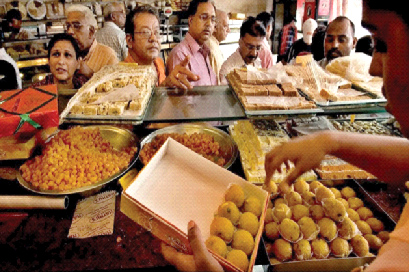
This is not the first time that authentic Indian art and craft forms have been targeted by money-mongering agencies who find their agenda peddled liberally by the mainstream media during festive as well as celebratory seasons. If the British upset the indigenous weaves sector of Bharat so that they could earn using our local produce and market, modern-day corporates have always tried to push their products amongst people at the cost of what is thoroughly Indian. The narrative set is so strong that before people realise the damage, the shift has already permeated far and deep. Be it in clothes, lifestyle or food, western modules overtaking Bharatiya culture and concepts is a phenomenon that must be recognised and called out. And since we celebrate Lakshmi Ganesh puja during Deepawali in a few days, a good topic to discuss would be Cadbury as well as other chocolates and confectionaries forcing their calorific sweetness in our festivities than the tasty and wholesome mithai made by local halwais. While small towns have still stuck to traditions, the urbanscape has seen the narrative shift for some time now.
Media Reports targeting locally made sweets
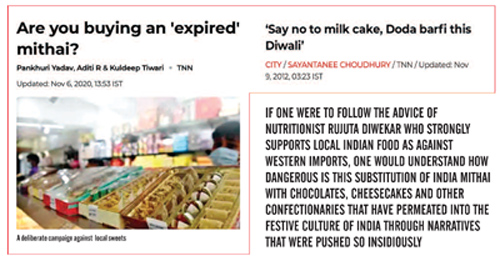
Just before Diwali in 2019, The Times of India (TOI) brought out a feature where they warned readers not to buy sweets from local halwais citing that with high demand, they are likely to use spurious milk and adulterated raw materials in their products. Similar stories have been regularly published for many years (in 2012, TOI’s article Say No to Milk cake, Doda Barfi this Diwali harped on the boycott of local mithai), introducing the narrative amongst people that it would be safe to switch from them. Now, considering that corporate gifting during the festival have increasingly seen the reduction of motichoor laddus and other Indian mithai-filled dabbas to the rise of chocolates and pastries being exchanged, your guess is as good as ours as to which lobbies could have engineered this shift! However, even with people blindly accepting the diktat of ‘fancy’ sweetmeats not once did the reports expose how unhealthy these were with raw materials that didn’t contain the goodness of ghee, khoya or other materials Indian sweets get made with. Moreover, it also fuels the wheel of corporate colonisation where sweets resonating with our Bharatiya culture are discredited to make way for products that were originally foreign. If one were to follow the advice of nutritionist Rujuta Diwekar who strongly supports local Indian food as against western imports, one would understand how dangerous is this substitution of India mithai with chocolates, cheesecakes and other confectionaries that have permeated into the festive culture of India through narratives that were pushed so insidiously.
The true essence of Vocal for Local
Sweet making, as practiced by generations of halwais in so many towns and cities of India, is a veritable art form that has stood the test of time. Specific to regions, climate and tastes of people, India has a colourful and rich mithai-making industry that speaks highly of the culinary abilities of the experts involved in the trade. During festivals like Diwali, Holi, and Dussehra, these mithai makers go on an overdrive to create delicious products that satiate their clients and exhibit their strength in the art form. So, to give a thrust to the very concept of vocal for locals, it is imperative that these halwais and mithai walas are encouraged during festivities. Not only would that boost the local economy it also spreads a beacon of hope for the survival of an art form that is facing the brunt of rapid corporatisation and commercialisation of the sweet gifting culture during festivals. Every festival celebrated in India has a specific character. We enjoy laddus and kalakand during Diwali, gujjia during Holi, sewaiyya during Eid, cakes, plum pudding in Christmas and sandesh, mihidana during Durga Puja. Now imagine them being horribly mixed up and interchanged. Not only would food traditions be botched up, but the karigars making the sweets for the particular festivals would also find it difficult to earn through their expertise. Worse still would be corporates flying in and declaring all these indigenous sweets as harmful and feeding the blinkered customers with a boring, conveyor belt-manufactured array of chocolates.
Understanding the Wheel of Economics
To comprehend how these local industries are important in building a prosperous economy, one must acknowledge that ours has been an agrarian and craftsmanship-based economy since ancient times. While the period of Sharad Purnima is one when Kharif crops are harvested, selling these crops creates wealth. This wealth is further reinvested in buying crafts for self and home during the period from Navratri to Dev Deepawali. Essentially this is the concept of gifting that creates more wealth and ensures equitable distribution. We must recognise that every artisan is involved in this process of generating wealth for an economy. Yes, even the sweetmakers whose karigari gave us delicious mithai since ages. It is this time of the year they wait for, too, so that they can reinvest their earnings that lead to the prosperity of their families and thus the country in totality. For it is wholesomeness that is the real wealth (Lakshmi Swaroop) and which entails prosperity, health and happiness.
For this reason, local crafts need to be supported and patronised even more because that will ensure equitable reploughing of wealth. Corporate gifting might get fluffed up, and the media campaigns might get even more strong against our local halwais, but it’s high time we realise the potential of Indian mithais and give in to the temptation this Deepawali to enjoy a tastier and wholesome festival. Or, for that matter, any craft that is indigenous to the Sanatan soul of Bharat.













Comments