
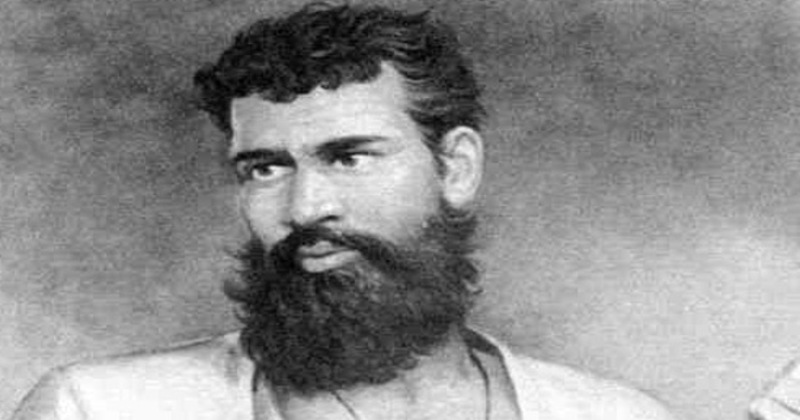
This discussion focuses on Maharashtra’s revolutionary struggle that greatly impacted India’s struggle for (real) Swaraj. Vasudev Balwant Phadke was a prominent figure among all of the revolutionaries, playing a significant role in the beginning, direction, and leadership of the revolutionary movement in the region. During the revolutionary movement sparked by Maharashtra, there were many distinct phases, each crucial in its own right. However, during its history, the revolutionary movement was inspired by various sources, which changed regularly. As time passed and the movement progressed, the ideological underpinnings also underwent a significant transformation. There is a possibility that his insurrection had an indirect impact on the narrative of Bankim Chandra Chatterjee’s Anandamath. It is, therefore, to one’s best advantage to investigate the distinctive characteristics of the political views of important revolutionary actors at various points during the movement.
Political thoughts of Phadke
Phadke was unquestionably the first Indian revolutionary to organize armed resistance against the Britishers to free the homeland from foreign control. His actions are credited with beginning India’s freedom struggle. It was primarily due to his contributions that the revolutionary movement in Maharashtra was able to get off the ground. In this setting, other revolutionaries such as Chapekar and Savarkar openly acknowledged the significance that Phadke played and hailed him as their inspiration. Nevertheless, it is sad that many historians continue to be reluctant to recognise Phadke as a national revolutionary and pay insufficient regard to his contribution to the freedom struggle. Phadke was more of a man of action than of words, and as a result, he did not publish many political treatises that would enlighten us regarding his political philosophy. His opposition to British control was boosted by the nationalist politics prevalent in Poona at the time.
Phadke, meantime, was under the impression that the only way to alleviate the plight of the Indian people was for them to achieve their independence, so he began working toward that purpose. He aimed to achieve political freedom for the motherland by utilizing educational and revolutionary strategies. Through his educational methods, he organized public lectures, informing the populace about the deteriorating conditions they were experiencing due to British rule. He knew that revolutions always start with a small group of committed individuals and eventually spread throughout the country. With this thought in mind, he challenged the British empire with this conviction. He knew that revolutions always start with a small group of dedicated people. In addition, he was optimistic that the topography of this region was highly suited to engaging in guerrilla warfare against the Britishers and that the conflict would ultimately result in victory. Therefore, his political methods included not only educative means but also direct revolutionary conspiracy, which involved the organization of a secret society, raising the army, committing political dacoities to raise funds, adopting guerrilla tactics, and finally fighting an ultimate war of independence with the assistance of poor and impoverished people in the country. His strategies were never successful, but they introduced revolutionary techniques to future generations and helped set the stage for a revolutionary movement in Maharashtra.
Understanding Phadke’s political ideas require looking at his overall political program. His comprehension of the British regime’s exploitation drove him to consider national freedom. He advocated armed opposition to British rule and took revolutionary actions to achieve India’s political freedom. His words and statements suggest that his political program aspired to build the Indian Republic. Phadke’s political program also emphasized helping peasants and the needy. His political efforts show he had little hope for the urban, security-minded middle class who hesitated to act on their values.
He saw the princely states’ limitations in liberating the motherland. When he committed political dacoities, he targeted the Sahukars and wealthier villagers. The British inferno and starvation reaffirmed Phadke’s desire to rise in the armed revolution. Swaraj, ultimate independence was his only solution. “Your ills won’t go away without independence and Swaraj,” he remarked. Phadke comprehended colonial rule’s impact and characterized the rulers as exploiters. This view of rulers as exploiters informed his political priority: total independence for the motherland.
Phadke’s analysis of the British administration
The rise of modern Indian political thought can be traced back to the country’s resistance to the influence of British rule. The perception of British rule was the primary factor that early political players in India used to establish the political priorities that they pursued. Understanding and describing the relationship between those who rule and those who are governed is one of the most pressing challenges in political thought. Actions on the political front can only be taken if a precise grasp of the interaction between the two has been attained. On the one hand, such an understanding makes the process of determining the political priorities on the part of the political actor. On the other, it lays down the base for defining the political issue of the time on the theoretical ground. Both of these benefits come from having such an understanding. Theoretically defined political problems are the source of political ideas.
For Phadke, British rule in India was the sole cause of the people’s misery. He was convinced that British rule stood for India’s economic ruin. In his autobiography, Phadke observed, “if a European does long and meritorious service in India, he is paid Rupees 75,000 as a gratuity on his retirement. Why does he get this little amount? By law, their law is mint coining money. A military officer draws in addition to the salary, Rupees 800 and 1000- a month for a staff appointment…. whose is this money? Is this their father’s money? Their (the Britisher’s) external policy is generous and internal treacherous. There are thousands of examples of such deception”. Further, he explained the brutalities of the British administration in his own style, like “Hindu people were dying due to starvation and during this time Britishers were taking excessive salaries and living their life luxuriously. There is huge discrimination between Europeans and Indians. Due to your discrimination and atrocities against us during the drought, I, with my small army, started an armed struggle to throw out Europeans from my motherland. But I failed, my Indian citizens. Please forgive me, my dear Indian people, for I couldn’t get you freedom”. Thus, for Phadke, the rule in India symbolised treachery and deception, which could be stopped only after ousting the Britishers from India.
Phadke was undoubtedly a valiant revolutionary; nonetheless, Indian history has failed to recognize his contributions. Therefore, it is essential that the bravery and valour he displayed be remembered for all time. For as long as terms like Indian nationalism and national gratitude for the sacrifices of the land continue to exist, the name Phadke will continue to be revered with particular splendour in the annals of the history of the Indian fight for independence. Furthermore, Phadke’s works are worth studying in light of today’s events since, throughout all those works, he has voiced concern for the independence and unparalleled development of the nation. This makes Phadke’s contribution more relevant to contemporary issues. Without a doubt, his revolutionary career might have been short and a bit unique, but he prepared the path for organized military action for India’s [real] Swaraj.