





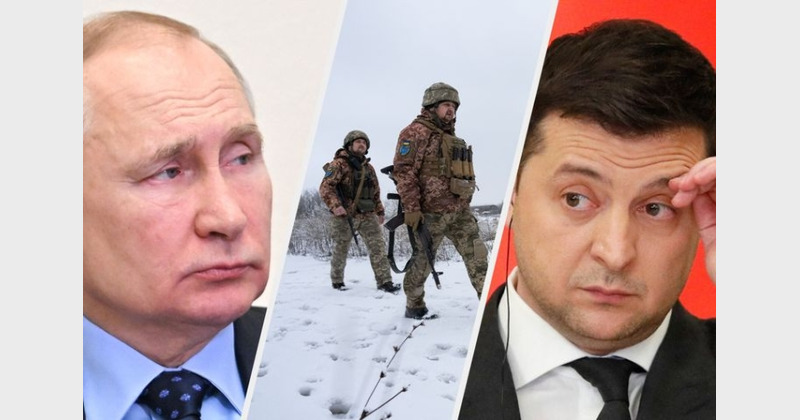
The focus must be on denying Russia to remain in the Gray Zone. The US and its allies and partners must work to counter this threat.
Why isn't Ukraine seen as a 'nuclear flash point'? After all USA, NATO and Russia are all nuclear weapons states. The limits of US and NATO's power, unity, cohesion have been tested by Russia, whose incursion into separatists and pro-Russian regions in Ukraine has resulted in much shouting but limited economic sanctions.
Is Russia's decision to move troops into Luhansk-Donetsk regions to put more pressure to wangle a security agreement with Europe and Nato on more favourable terms? The US seems to be waiting for greater provocation. Therefore, all eyes are on the USA and Russia foreign ministers' meeting this week.
Russian President Vladimir Putin's decision to recognise the independence of two separatist areas of Ukraine's eastern Donbas region, Donetsk and Luhansk, ratcheted up Europe tensions and set a dangerous precedent. Putin has provoked again by ordering Russian troops into Donbas for "peace-keeping". The US and EU have responded with targeted sanctions, focusing on the two Ukraine areas and Russian officials. Germany has halted the certification process of the Nord Stream 2 pipeline that would have doubled Russian gas exports to Berlin.
If the Nord Stream 2 pipeline is junked altogether, the EU would need to find alternative sources to meet its energy needs. Oil prices are already touching $100, and most major economies, including India, are facing high inflation.
As for India, which has historical ties with Russia, growing ties with the US and a huge threat from China, is in a tough spot. India has rightly taken a neutral approach to the Ukraine crisis. But Can you stay neutral on Russia going further into Ukraine if you want the world to be with you on China's expansionism?
Gray Zone Warfare At A New Level
Russia's actions in the seizure of Crimea in 2014 and its subsequent involvement in the war in Ukraine has set the pattern for what has been viewed as hybrid warfare, a combination of non-state actors, cyber-attacks, special forces, private armies (Wagner group) and electronic warfare, backed up with the threat and occasional use of conventional force were used to wrest control of the Crimean peninsula and destabilise Ukraine by drawing its armed forces into a prolonged conflict.
Russia appears to have taken gray zone warfare to a new level, using subversion and clandestine operations to undermine Ukraine and expand its influence. However, Russia's use of these methods has not resulted in the subjugation of Ukraine, and Russia's military buildup shows the limits of gray zone warfare.
Russia's escalation in its long-simmering conflict with Ukraine is on for eight years now. The military conflict between Ukraine and Russia began after the Euro-maidan crisis. Russian forces in disguise, dubbed "little green men," moved to occupy Crimea in early 2014. This, however, drove the United States and Europe into inaction. Since then, Russian-backed separatists in Eastern Ukraine have exchanged sniper and artillery fire with the Ukrainian army, and Russian intelligence agencies have conducted aggressive cyber and information operations targeting Ukrainian systems and public opinion. The Russian intervention in Ukraine has become the gray zone conflict, a form of limited military options that are not peaceful but short of full-scale war.
Gray Zone War Who is winning
This gray zone war constitutes a failure of NATO's military and nuclear deterrence. Russia is gaining concessions from NATO, while avoiding most of the costs associated with war. Cyber attacks on military and civilian infrastructure have been one of the biggest threats posed by Russia.
The outcome of the risks posed by grey zone tactics is less than conventional warfare. In the gray zone, conflict is limited because countries like China and Russia want it to be so.
Rather than overt military actions, gray zone conflict involves destabilisation, disruption and subversion. Similar methods have been described under the hybrid war, nonlinear war, salami tactics, limited war, multi-domain war, or unrestricted war.
The infamous Wagner mercenaries, Russia's cyber attacks fall into a similar niche: the 2020 Solar Winds attacks and cyber espionage are elements of Russia's grey zone tactics instead of simple espionage. Equally, the migrant crisis on the border between Belarus and Poland.
Nato is unable to help de-escalate, even though members of the alliance are firm in their support for Kyiv. Deploying large military formations at a neighbour's border is a cunning strategy by Russia, frightening investors. Russia can also cause real harm to Ukraine, whose economy badly needs a stable currency and foreign investment. Russia needs to prolong the uncertainty and add the occasional military exercises near the border to hurt Ukraine.
Effect of the Gray Zone War in Ukraine
Ukrainian military capabilities to combat Russian separatists have improved due to better weapons, training and significant experience. The United States has committed $2.5 billion in lethal and nonlethal defensive aid to Ukraine since 2014, including more than $400 million in 2021 alone.
Russian cyberattacks have had little effect on battlefield events, and Russian subversion has failed to politically weaken Ukraine. On the contrary, Kyiv now leans further toward Western Europe and the United States. And the NATO alliance has been galvanised with a sense of purpose not seen for long. In short, Russian efforts in the gray zone have proved counterproductive in Ukraine, at least for now.
Responding to the Threat
The focus must be on denying Russia to remain in the Gray Zone. Russia has proven especially adept at information operations. Technological solutions are already being developed, which utilise machine-learning algorithms to detect Russian propaganda and recruitment, bots (applications that perform an automated task, such as reposting and disseminating misinformation) and comment trolls (individuals involved in disseminating false and pernicious information). The US and its allies and partners must work to counter this threat.
Putin's government remains sensitive to casualties. "Peacetime casualty" information classified as a state secret and civil society organisations, such as the Union of the Committees of Soldiers' Mothers of Russia (formed by the mothers of fallen soldiers to advocate for their families during the Soviet invasion of Afghanistan), have been branded as "foreign agents" for collecting data on Russian casualties. Can they be made use of?
In short, responding to Gray Zone aggression requires integrating kinetic and non-kinetic approaches that will simultaneously increase domestic political costs by denying Russian forces the ability to continue to operate in obscurity. At the same time, efforts to ensure Ukrainian forces can withstand Russian escalation and that friendly populations are better insulated from Russian information operations are also necessary.
While Russia might be credited with the advent of Gray Zone war, China has employed even more gradual approaches in the South China Sea. Salami slicing tactics that are executed subtly and over extended time horizons will further complicate responses.
Despite the long-term consequences, ambiguity can allow politicians to ignore Gray Zone challenges. The military instrument of power shapes the use of non-military instruments. However, many government approaches are still required, given the relatively greater availability of non-military instruments. Unfortunately, democracies like India and Europe are at an inherent disadvantage relative to centralised regimes like China and Russia.
Gray zone tactics on the border of Russia have not worked as desired, and posturing has not resulted in the kinds of concessions Putin can brag about at home or abroad.
The unconventional elements of Russia's approach represent the most significant threat that the country poses. In the Indian context, we also need a public discourse on grey zone threats from China and Pakistan. How would India compel china to stop its grey zone war against India by a whole of government approach and multi-domain capabilities?

The writer is a Retd. Army Veteran and Security Analyst.
- Brig Hemant Mahajanhttps://organiser.org/guest-author/brig-hemant-mahajan/
- Brig Hemant Mahajanhttps://organiser.org/guest-author/brig-hemant-mahajan/

- Brig Hemant Mahajanhttps://organiser.org/guest-author/brig-hemant-mahajan/
- Brig Hemant Mahajanhttps://organiser.org/guest-author/brig-hemant-mahajan/








Comments