Book Review: Lessons from Familial Model of Sustainability
October 3, 2026
  • Read Ecopy
  • Circulation
  • Advertise
  • Careers
  • About Us
  • Contact Us
Android AppiPhone AppArattai
Organiser
  • ‌
  • Bharat
    • Assam
    • Bihar
    • Chhattisgarh
    • Jharkhand
    • Maharashtra
    • View All States
  • World
    • Asia
    • Europe
    • North America
    • South America
    • Africa
    • Australia
  • Editorial
  • International
  • Opinion
  • RSS @ 100
  • More
    • World Hindu Congress 2026
    • Op Sindoor
    • Analysis
    • Sports
    • Defence
    • Politics
    • Business
    • Economy
    • Culture
    • Special Report
    • Sci & Tech
    • Entertainment
    • G20
    • Azadi Ka Amrit Mahotsav
    • Vocal4Local
    • Web Stories
    • Education
    • Employment
    • Books
    • Interviews
    • Travel
    • Law
    • Health
    • Obituary
  • Subscribe
    • Subscribe Print Edition
    • Subscribe Ecopy
    • Read Ecopy
  • ‌
  • Bharat
    • Assam
    • Bihar
    • Chhattisgarh
    • Jharkhand
    • Maharashtra
    • View All States
  • World
    • Asia
    • Europe
    • North America
    • South America
    • Africa
    • Australia
  • Editorial
  • International
  • Opinion
  • RSS @ 100
  • More
    • World Hindu Congress 2026
    • Op Sindoor
    • Analysis
    • Sports
    • Defence
    • Politics
    • Business
    • Economy
    • Culture
    • Special Report
    • Sci & Tech
    • Entertainment
    • G20
    • Azadi Ka Amrit Mahotsav
    • Vocal4Local
    • Web Stories
    • Education
    • Employment
    • Books
    • Interviews
    • Travel
    • Law
    • Health
    • Obituary
  • Subscribe
    • Subscribe Print Edition
    • Subscribe Ecopy
    • Read Ecopy
Organiser
  • Home
  • Bharat
  • World
  • Operation Sindoor
  • Editorial
  • Analysis
  • Opinion
  • Culture
  • Defence
  • International Edition
  • RSS @ 100
  • Magazine
  • Read Ecopy
Home Bharat

Book Review: Lessons from Familial Model of Sustainability

K A BadarinathK A Badarinath
Nov 1, 2021, 05:04 am IST
inBharat, Books
Follow on Google News
Facebook
Twitter
WhatsAppTelegramEmail

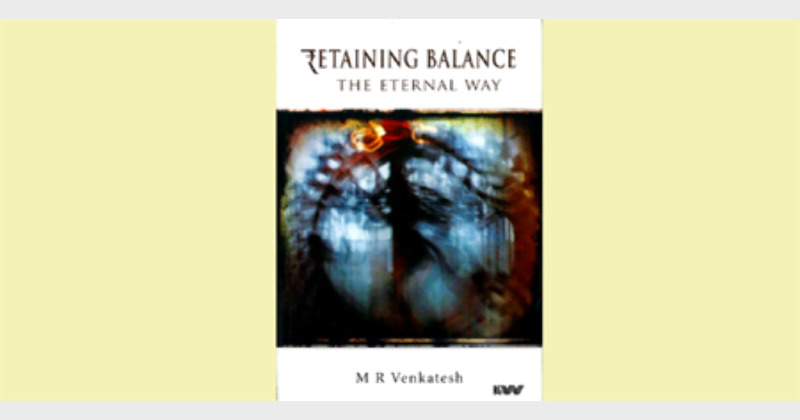
‘Retaining Balance: The Eternal Way’ ; Author Dr MR Venkatesh;  Publisher: KW Publishers  Pvt. Ltd.,  Pp 482, Rs 780.00

‘Retaining Balance: The Eternal Way’ comes handy to make sense of the happenings globally and the search for a unique non-Western model of socio-economic development with linkages to classical or oriental civilisation from Bharat 


The other day celebrated writer and former BBC India chief Sir Mark Tully referred to the possible collapse of the Washington Consensus that minimised the State’s role too much and allowed the private sector to become too influential.

Veteran journalist Mark Tully has referred to a recent G-7 panel report on liberal market economic philosophy that has been the dominant narrative in the last five decades.

Post-liberalisation, globalisation and privatisation drive and prosperity have expanded manifold but inequalities have also risen within societies, among the rich and the poor countries.

The veteran BBC hand summed up subtly that mindless liberalisation has had its pitfalls while overbearing state role in controlling lives of people was not an option anymore.

Perhaps the same day that Mark Tully’s column appeared in Hindustan Times, RSS Sarkaryawah Shri Dattatreya Hosabale at a separate gathering of intellectuals pointed out the demise of both capitalism and communism per se.

If one were to take the socio-economic and political shifts happening in both West and Eastern hemispheres, these were tumultuous in nature blurring the vast divide, diminishing, dimming and doing the vanquishing act.

In fact, this has created space for formulation of a new socio-economic policy or model that has its moorings in Bharatiya ideals and philosophy practised for millennia.

It’s in this backdrop that the book ‘Retaining Balance’ written by MR Venkatesh, renowned Delhi-based advocate on economic-criminal laws, comes handy to make sense of the happenings globally and the search for a unique non-Western model of socio-economic development with linkages to classical or oriental civilisation from Bharat.

Institutions of monogamous families that evolved as part of the Hindu society, culture and civilisation have been recognised by Shri Venkatesh as the fulcrum for sustained development, economic progress and prosperity.

Venkatesh, a keen unconventional student of economics, has a knack for looking at policy-making from people’s perspective and daily experiences. His thinking on socio-economic and development seem to have been largely influenced by veteran chartered accountant, Shri S.Gurumurthy who has been associated for several decades with Rashtriya Swayamsevak Sangh.

‘Global Imbalances & the impending dollar crisis’; ‘Sense, Sensex and Sentiments – Failure of Indian Sentinels’ as well as ‘Dr Manmohan Singh – A decade of decay’ are some of the other books written by MR Venkatesh.

The author’s extreme antipathy for polygamy practised in Islamist societies has been manifested through a lucid narrative put forth in ‘Retaining  Balance’. In fact, MR Venkatesh sticks his neck out to say that polygamy as practiced in several Islamist societies was anti-thesis to liberal democracies and the practice was the root cause for unrest, economic disorder and skewed sex ratios with uneven development as a resultant by-product.

Several polygamy groups in Western societies have actively campaigned for right to such life. Self-proclaimed Left liberal groups supported such campaigns. But then, violence and widespread social trauma for women in these countries practising polygamy cannot be ignored.

Polygamy has also been identified as the biggest culprit for war, islamists and jihadists of Boko Haram as well as Islamic State gaining hold on chunks of Nigeria, Iraq, Indonesia and Haiti leading to huge turbulence.

If one were to take the socio-economic and political shifts happening in both West and Eastern hemispheres, these were tumultuous in nature blurring the vast divide, diminishing, dimming and doing the vanquishing act. In fact, this has created space for formulation of a new socio-economic policy or model that has its moorings in Bharatiya ideals and philosophy practised for millennia

On economic policy making, the author does not spare either the free market economists or those into ‘commanding heights’ of the state pushed by classical communists that failed to convince even their own members or cadres. The surmise is that both these ideas have had wide unfilled gaps that essentially targeted destruction of families, weakening of governments and pushing countries into indebtedness with no ways to recover.

‘Retaining Balance’ argues against economic policy making that led to accumulation or distribution of wealth or measures that support welfare theories. The book does not support the conventional economic model that’s spiced with  communist theology or politicising economic development model.

Instead, MR Venkatesh thinks that a new development model should evolve from civilisational prism with emphasis on family as a sustainable unit, enterprise and promoter of cultural values.

From Keynes to Hayek, the oscillation in economic policy making was there for too long. And, there’s a case for fresh thinking, modelling of our own. ‘Retaining Balance’ abjectly rejects the Christian theology based global economic order that does not prescribe a role or accountability for the individual, family or the society.

Big poser that remains unanswered is whether the capitalist, market-driven economic model or communist alternative were designed to reject family, society and civilisation. 

K A Badarinath
K A Badarinath
Senior Journalist and Honorary fellow at Delhi-based think tank, Centre for Integrated & Holistic Studies [Read more]
Share
Tweet
SendShareSend
✮ Subscribe Organiser YouTube Channel. ✮
✮ Join Organiser's WhatsApp channel for Nationalist views beyond the news. ✮
Previous News

Around the Nation with-Vada Pav

Next News

Weaving the Bonds of Sisterhood

Related News

President Droupadi Murmu has given assent to the Gujarat UCC Bill, 2026, paving the way for its implementation in the state

Gujarat UCC Bill 2026 gets President Droupadi Murmu’s assent, legislation comes into effect across the state

SJTA plans dedicated darshan assistance for elderly and divyang devotees and restoration of 1.5 acres of temple land

Odisha: Shri Jagannath Mandir plans dedicated darshan assistance for elderly and divyang devotees

Representative image

Weekly Love Jihad Report: From fake names to fake social media accounts – Here’s how Islamists targeted Hindu women

Shivaji Park locals expressed anger against CJP protest

CJP’s Shivaji Park show fizzles in Mumbai: Low turnout, clueless crowd, angry residents and strong counter-protest

Former chief election commissioner Navin Chawla

From emergency indictment to election commission: The Navin Chawla record that Congress would rather not discuss

RSS All-India contact chief (Sampark Pramukh) Ramlal ji

Women farmers must be at forefront of policymaking: RSS Sampark Pramukh Ramlal ji

Load More

Latest News

President Droupadi Murmu has given assent to the Gujarat UCC Bill, 2026, paving the way for its implementation in the state

Gujarat UCC Bill 2026 gets President Droupadi Murmu’s assent, legislation comes into effect across the state

SJTA plans dedicated darshan assistance for elderly and divyang devotees and restoration of 1.5 acres of temple land

Odisha: Shri Jagannath Mandir plans dedicated darshan assistance for elderly and divyang devotees

Representative image

Weekly Love Jihad Report: From fake names to fake social media accounts – Here’s how Islamists targeted Hindu women

Shivaji Park locals expressed anger against CJP protest

CJP’s Shivaji Park show fizzles in Mumbai: Low turnout, clueless crowd, angry residents and strong counter-protest

Former chief election commissioner Navin Chawla

From emergency indictment to election commission: The Navin Chawla record that Congress would rather not discuss

RSS All-India contact chief (Sampark Pramukh) Ramlal ji

Women farmers must be at forefront of policymaking: RSS Sampark Pramukh Ramlal ji

AI Generated Representative Image

Swachhata Hi Seva 2026: How Bharat’s festivals are rediscovering their green dharma

27th National Conference of Akhil Bharatiya Poorva Sainik Seva Parishad Begins at Kaneri Math

27th National Conference of ABPSSP focusses on Agniveer rehabilitation & social security

PM Modi's Mann ki Baat completes 12 years

12 years of PM Narendra Modi’s radio program ‘Mann Ki Baat’: Serves as a public platform inspiring millions of Indians

Tamil Nadu: DMK faces legal heat as leaders face arrests, ED probe ahead of October 6 bypolls

Load More
  • Privacy
  • Terms
  • Cookie Policy
  • Refund and Cancellation
  • Delivery and Shipping

© Bharat Prakashan (Delhi) Limited.
Tech-enabled by Ananthapuri Technologies

  • Home
  • Search Organiser
  • Bharat
    • Assam
    • Bihar
    • Chhattisgarh
    • Jharkhand
    • Maharashtra
    • View All States
  • World
    • Asia
    • Africa
    • North America
    • South America
    • Europe
    • Australia
  • Editorial
  • Operation Sindoor
  • Opinion
  • Analysis
  • Defence
  • Culture
  • Sports
  • Business
  • RSS @ 100
  • Entertainment
  • More ..
    • Sci & Tech
    • Vocal4Local
    • Special Report
    • Education
    • Employment
    • Books
    • Interviews
    • Travel
    • Health
    • Politics
    • Law
    • Economy
    • Obituary
  • Subscribe Magazine
  • Read Ecopy
  • Advertise
  • Circulation
  • Careers
  • About Us
  • Contact Us
  • Policies & Terms
    • Privacy Policy
    • Cookie Policy
    • Refund and Cancellation
    • Terms of Use

© Bharat Prakashan (Delhi) Limited.
Tech-enabled by Ananthapuri Technologies