





Pineapple agroforestry could help tackle climate change and biodiversity loss
December 5, 2025
  • Read Ecopy
  • Circulation
  • Advertise
  • Careers
  • About Us
  • Contact Us
Android AppiPhone AppArattai
Organiser
  • ‌
  • Bharat
    • Assam
    • Bihar
    • Chhattisgarh
    • Jharkhand
    • Maharashtra
    • View All States
  • World
    • Asia
    • Europe
    • North America
    • South America
    • Africa
    • Australia
  • Editorial
  • International
  • Opinion
  • RSS @ 100
  • More
    • Op Sindoor
    • Analysis
    • Sports
    • Defence
    • Politics
    • Business
    • Economy
    • Culture
    • Special Report
    • Sci & Tech
    • Entertainment
    • G20
    • Azadi Ka Amrit Mahotsav
    • Vocal4Local
    • Web Stories
    • Education
    • Employment
    • Books
    • Interviews
    • Travel
    • Law
    • Health
    • Obituary
  • Subscribe
    • Subscribe Print Edition
    • Subscribe Ecopy
    • Read Ecopy
  • ‌
  • Bharat
    • Assam
    • Bihar
    • Chhattisgarh
    • Jharkhand
    • Maharashtra
    • View All States
  • World
    • Asia
    • Europe
    • North America
    • South America
    • Africa
    • Australia
  • Editorial
  • International
  • Opinion
  • RSS @ 100
  • More
    • Op Sindoor
    • Analysis
    • Sports
    • Defence
    • Politics
    • Business
    • Economy
    • Culture
    • Special Report
    • Sci & Tech
    • Entertainment
    • G20
    • Azadi Ka Amrit Mahotsav
    • Vocal4Local
    • Web Stories
    • Education
    • Employment
    • Books
    • Interviews
    • Travel
    • Law
    • Health
    • Obituary
  • Subscribe
    • Subscribe Print Edition
    • Subscribe Ecopy
    • Read Ecopy
Organiser
  • Home
  • Bharat
  • World
  • Operation Sindoor
  • Editorial
  • Analysis
  • Opinion
  • Culture
  • Defence
  • International Edition
  • RSS @ 100
  • Magazine
  • Read Ecopy
Home Bharat

Pineapple agroforestry could help tackle climate change and biodiversity loss

WEBDESKWEBDESK
Aug 19, 2021, 09:04 am IST
in Bharat
Follow on Google News
FacebookTwitterWhatsAppTelegramEmail

                                                                                                                                                                  Umashankar Mishra 


The study assessed the tree diversity and ecosystem carbon storage through the traditional agroforestry system practised by the local communities. 


New Delhi: Pineapple-based agroforestry, traditionally practised by ethnic “Hmar” tribe in southern Assam, can be a sustainable alternative to jhum cultivation for North East India. According to a new study, this traditional practice can provide twin solutions for climate change and biodiversity loss. The Department of Ecology and Environmental Science, Assam University, Silchar, with support from the Climate Change Program Division of the Department of Science & Technology (DST) carried this study out.


Researchers are looking for agroforestry options that would also offer high carbon storage potential and tree diversity to couple this with solutions for challenges of climate change and biodiversity loss, the DST statement said.


Jhum cultivation, also called swidden agriculture, the dominant agricultural practice in the region, has become unsustainable primarily due to the reduced fallow cycle resulting in depletion in soil fertility, severe soil erosion, and low agronomic productivity. Hence, North East India and many south Asian countries are shifting to agroforestry and high-value cropping systems from traditional jhum practices, which are considered sustainable and profitable alternatives over the past decades.


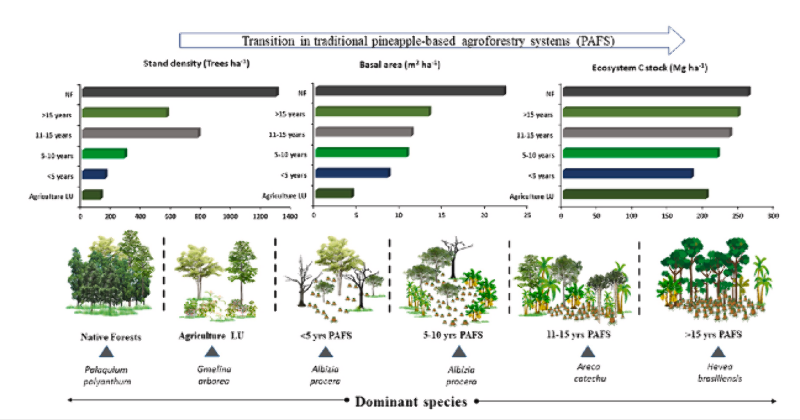
The study assessed the tree diversity and ecosystem carbon storage through the traditional agroforestry system practised by the local communities. It showed that the system they practice maintains a steady ecosystem carbon stock while reducing land-use-related carbon emission and providing additional co-benefits to the communities.

The research team, led by Arun Jyoti Nath, Associate Professor in the Department of Ecology and Environmental Science, Assam University, conducted this study in the ethnic villages in the Cachar district of Assam part of the Himalayan foothills and the Indo-Burma, centre of a global biodiversity hotspot. They explored changes in tree diversity and transition of dominant tree species from swidden agriculture through different aged PAFS. The changes in the biomass carbon and ecosystem carbon storage in tree and pineapple components from swidden

agriculture through different aged PAFS were also noted.


Researchers found that farmers apply traditional knowledge for tree selection through prior knowledge and long-term farming experience. Additionally, fruit trees such as Areca catechu and Musa species are planted on farm boundaries as live fences. The live fence reduces soil erosion and acts as a windbreak and shelterbelt. A combination of economically important trees like Albiziaprocera, Parkiatimoriana, Aquilariamalaccensis, and fruit trees like papaya, lemon, guava, litchi, and mango with pineapple caters for both home-consumption and

selling all year round. The upper canopy trees regulate light, enhance biomass inputs, and increase farm diversity, resulting in soil fertility and improved plant nutrition. The tree-related management practices promote the conservation of the farmers favoured indigenous fruit trees. In the older pineapple agroforestry farms, farmers introduce rubber trees.


The research shows that the practice can be applied for the REDD+ mechanism to add to the carbon capturing and reducing deforestation by contributing to tree cover, which may further incentivise against the carbon credit to the poor farmers.


Pineapple agroforestry systems (PAFS) are dominant land use in the Indian Eastern Himalayas and other parts of Asia and are mostly grown in association with multipurpose trees. The ethnic “Hmar” tribe in southern Assam has been cultivating pineapple for centuries. At present, they practice the indigenous PAFS for both home consumption and boosting economic benefits.


They have applied traditional knowledge to evolve a unique agroforestry system. The study published in the ‘Journal of Environmental Management’ recently can provide information about emission factors for the indigenous agro-ecosystems in North East India for mitigation purposes, facilitating the formulation of incentives for the communities. It could also equip forest managers with information for accounting for the changes in carbon storage due to deforestation and jhum cultivation.


Courtesy: India Science Wire

ShareTweetSendShareSend
✮ Subscribe Organiser YouTube Channel. ✮
✮ Join Organiser's WhatsApp channel for Nationalist views beyond the news. ✮
Previous News

‘War is not over’, says Amrullah Saleh: Taliban 2.0 – Back to Darkness, Tyranny

Next News

Film festival highlighting the role of scientists in the Indian independence movement concludes

Related News

Image for representational purpose only, Courtesy Vocal Media

Bihar to get ‘Special Economic Zones’ in Buxar and West Champaran

Thirupparankundram Karthigai Deepam utsav

Andhra Pradesh: AP Dy CM Pawan Kalyan reacts to Thirupparankundram row, flags concern over religious rights of Hindus

23rd India-Russia Annual Summit

India-Russia Summit heralds new chapter in time-tested ties: Inks MoUs in economic, defence, tourism & education

DGCA orders probe into IndiGo flight disruptions; Committee to report in 15 days

BJYM leader Shyamraj with Janaki

Kerala: Widow of BJP worker murdered in 1995 steps into electoral battle after three decades at Valancherry

Russian Sber bank has unveiled access to its retail investors to the Indian stock market by etching its mutual fund to Nifty50

Scripting economic bonhomie: Russian investors gain access to Indian stocks, Sber unveils Nifty50 pegged mutual funds

Load More

Comments

The comments posted here/below/in the given space are not on behalf of Organiser. The person posting the comment will be in sole ownership of its responsibility. According to the central government's IT rules, obscene or offensive statement made against a person, religion, community or nation is a punishable offense, and legal action would be taken against people who indulge in such activities.

Latest News

Image for representational purpose only, Courtesy Vocal Media

Bihar to get ‘Special Economic Zones’ in Buxar and West Champaran

Thirupparankundram Karthigai Deepam utsav

Andhra Pradesh: AP Dy CM Pawan Kalyan reacts to Thirupparankundram row, flags concern over religious rights of Hindus

23rd India-Russia Annual Summit

India-Russia Summit heralds new chapter in time-tested ties: Inks MoUs in economic, defence, tourism & education

DGCA orders probe into IndiGo flight disruptions; Committee to report in 15 days

BJYM leader Shyamraj with Janaki

Kerala: Widow of BJP worker murdered in 1995 steps into electoral battle after three decades at Valancherry

Russian Sber bank has unveiled access to its retail investors to the Indian stock market by etching its mutual fund to Nifty50

Scripting economic bonhomie: Russian investors gain access to Indian stocks, Sber unveils Nifty50 pegged mutual funds

Petitioner S Vignesh Shishir speaking to the reporters about the Rahul Gandhi UK citizenship case outside the Raebareli court

Rahul Gandhi UK Citizenship Case: Congress supporters create ruckus in court; Foreign visit details shared with judge

(L) Kerala High Court (R) Bouncers in Trippoonithura temple

Kerala: HC slams CPM-controlled Kochi Devaswom Board for deploying bouncers for crowd management during festival

Fact Check: Rahul Gandhi false claim about govt blocking his meet with Russian President Putin exposed; MEA clears air

Union Minister for Road Transport and Highways Nitin Gadkari (Right)

India set for highway overhaul as Union Minister Nitin Gadkari unveils nationwide shift to MLFF electronic tolling

Load More
  • Privacy
  • Terms
  • Cookie Policy
  • Refund and Cancellation
  • Delivery and Shipping

© Bharat Prakashan (Delhi) Limited.
Tech-enabled by Ananthapuri Technologies

  • Home
  • Search Organiser
  • Bharat
    • Assam
    • Bihar
    • Chhattisgarh
    • Jharkhand
    • Maharashtra
    • View All States
  • World
    • Asia
    • Africa
    • North America
    • South America
    • Europe
    • Australia
  • Editorial
  • Operation Sindoor
  • Opinion
  • Analysis
  • Defence
  • Culture
  • Sports
  • Business
  • RSS @ 100
  • Entertainment
  • More ..
    • Sci & Tech
    • Vocal4Local
    • Special Report
    • Education
    • Employment
    • Books
    • Interviews
    • Travel
    • Health
    • Politics
    • Law
    • Economy
    • Obituary
  • Subscribe Magazine
  • Read Ecopy
  • Advertise
  • Circulation
  • Careers
  • About Us
  • Contact Us
  • Policies & Terms
    • Privacy Policy
    • Cookie Policy
    • Refund and Cancellation
    • Terms of Use

© Bharat Prakashan (Delhi) Limited.
Tech-enabled by Ananthapuri Technologies







