





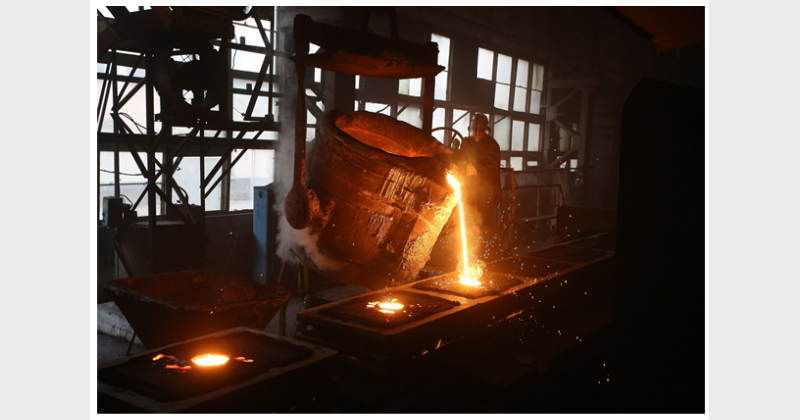
New Delhi:A ductile variety of iron is used for automative parts while cast iron is used for automative and machine parts.
Cast iron, an alloy of iron with carbon, is widely used for making machine and automobile parts. In its liquid form, it flows easily, hence can be poured into molds, offering intricate detailing in the part shape. It may be less ductile and malleable than wrought iron or less stiff than steel, but it has a lower melting point than other forms of iron and cannot be compressed easily.
A more ductile variety of cast iron, called spheroidal graphite iron, is used for making automotive parts. The speed with which the iron cools in the molds determines its ductility, hardness, and quality. In a recent study, researchers from the Indian Institute of Technology Bombay (IIT Bombay) proposed an improved model for the cooling of molten spheroidal graphite iron that can optimize the cooling process in iron manufacturing industries for better quality cast iron. John Deere India Pvt. Ltd partially funded the study, published in Metallurgical and Materials transactions B.
Spheroidal cast iron is made by extracting pure molten iron from iron ore, adding carbon, silicon, and other elements to it, and letting it cool in molds of desired shapes. A small amount of carbon is dissolved in it and, the rest is as micrometer-sized graphite nodules.
There is a problem, though—in molds of complicated shapes, the molten iron does not cool uniformly, causing non-uniform size and distribution of graphite nodules. “Non-uniformly distributed graphite nodules can make the component weaker, and the part may break during operation. Usually, smaller sized nodules, distributed uniformly, lead to better mechanical properties, such as higher ductility and strength,” says Prof Shyamprasad Karagadde of IIT Bombay, an author of the study.
Iron manufacturers can control the size and distribution of graphite nodules by tweaking various production parameters such as the surface area and depth of molds, the temperature at which molten iron is poured into it, and the cooling rate. However, optimizing these parameters requires the foresight that computer simulation models can offer. In the current study, researchers built an improved model to simulate the cooling process of molten iron and relate it with the properties of graphite nodules.
In the simulations, the researchers used a macro-model to calculate the temperature of the molten spheroidal graphite iron at short time intervals as it cooled. They tracked the growth of several graphite nodules at different temperatures using a micro-model. Broadly, the micro- model emulated three different cooling stages- graphite nodules surrounded by liquid iron, the nodules enclosed by ‘shells’ of iron, and wholly solidified iron. During the initial stage, the graphite nodules grow the fastest. Still, in previous models, researchers had not considered this stage as it is short-lived. “Introducing our mathematical model for the initial stage led to better prediction of the size and distribution of graphite,” points out Prof Karagadde.
Industry manufactured components are typically a few tens of centimeters in size, whereas graphite nodules are nearly a million times smaller and micrometer in size. It is difficult to track the growth of each graphite nodule. “So instead, our macro-micro models predict the average size and number of graphite nodules in smaller regions (say about a few millimeters long) got by dividing the entire component into many smaller volumes,” comments Prof Karagadde.
Since the macro-micro model gives average predictions, it is not very accurate. To improve the predictions, the researchers further studied a single, isolated graphite nodule. A graphite nodule grows mainly through the diffusion of carbon from liquid iron into the nodule. After the molten iron completely solidifies, the nodule grows some more as insoluble carbon from surrounding iron adds to it. The researchers simulated this growth of a single graphite nodule using a method called ‘deforming grids’- they studied diffusion in small volumes of liquid iron called grids.
“The deforming grids method, which is very accurate for a single graphite nodule, gave us a correction factor for the macro-micro model. We call this a multi-scale approach as we used information from two models of two different scales,” says Prof Karagadde.
To validate their simulations, the researchers set up an experiment. They made spheroidal graphite iron blocks in molds of different depths and rates of cooling. Deeper molds had smaller surface areas for the same mass of iron and cooled the slowest. They measured the temperatures of the cooling iron, and studied the properties of graphite nodules and compared them with predictions from their simulations.
The initial temperatures that their simulation calculated matched the observations, but the temperatures calculated post the second stage of cooling dropped about 10-15 minutes earlier than what was observed in molds that cooled slowly. According to the researchers, these deviations occurred because it is challenging to model the heat loss from molds. “Moulds made from sands like silica sand contain some moisture that evaporates when hot liquid iron is poured. These fumes and small cracks in the sand disturb the flow of heat and are difficult to model,” explains Prof Karagadde. “However, these deviations may not lead to a significant change in the final predictions of the graphite nodules,” he adds.
The researchers analyzed samples from their iron blocks for the final size and distribution of the cooled graphite nodules. Their observations and data from previous works exactly matched with their final simulation results, although their transient size predictions during the cooling deviated by about a quarter of their actual volume.
Unlike transient predictions, final predictions could be corrected using deforming grids method and were more accurate. They saw that when molten iron cools slowly like in the deeper molds – the graphite nodules are smaller and more uniformly distributed.
This study modeled all the three stages of cooling of molten iron and introduced a new multi-scale approach, giving better predictions about graphite nodules. "Our simulation models can help iron-manufacturers avoid significant material wastage and save time. We are now looking to improve the predictions in other varieties of cast iron that have a different chemical composition,” Prof Karagadde signs off.
Courtesy: India Science Wire










Comments