





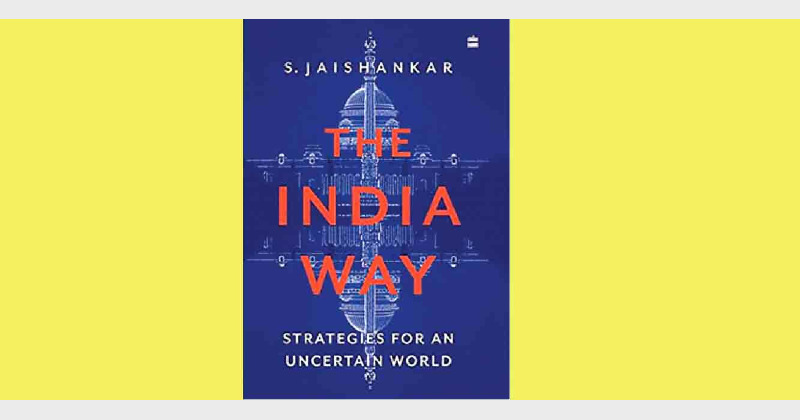
The India Way: Strategies for an Uncertain World is a book not just for practitioners or peers but for a more comprehensive discussion with people on issues of foreign policy. It also introduces the Indian take on global affairs to a foreign audience
-Dr Swadesh Singh
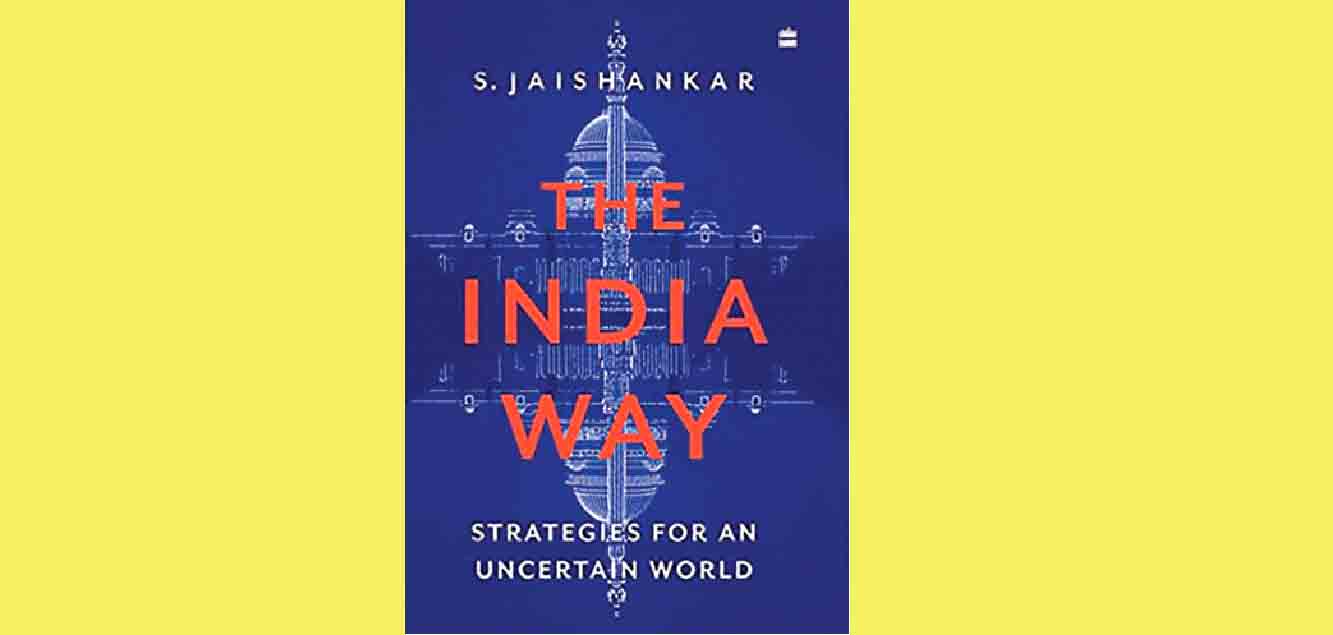
The India Way: Strategies for an Uncertain World,
S Jaishankar, Harper Collins Publisher India,
pp 240, Rs 699
It’s not every day that you get the chance to pick a brain as seasoned as External Affairs Minister S Jaishankar; his latest book offers this window. “The India Way: Strategies for an Uncertain World” is not a memoir; it is the next best thing—a practitioner’s perspective to foreign policy and diplomacy.
Jaishankar is a serving Foreign Minister who was also a career diplomat, and Ambassador to the United States and China. These two countries are central to the present global scenario. He also has a family legacy in strategic thinking and diplomacy. In his own words, he is someone who has witnessed “change beyond imagination in the course of a long career”.
The ‘India Way’ in the title of the book indicates an attempt to trace contours of foreign policy with a distinct Indian outlook. From the dilemmas of Mahabharata to principles of Arthashastra, Nehru’s Panchsheel to Gujral Doctrine or Vajpayee’s Neighbours First—an India Way has always existed. Jaishankar contemporises and invigorates it.
The book is divided into eight chapters. Change within and outside is the dominant backdrop against which the India Way is explored. The preface opens with the rumination—does change means that what went before was wrong? The sentiment resonates acutely with readers who are often grappling to reach an understanding of change.
The first chapter evokes the 1977 Satyajit Ray film ‘Shatranj Ke Khiladi’. The lesson Jaishankar wants us to remember is that strategic complacency is not an option anymore, we cannot be oblivious to change. Among the most central changes that he repeatedly alludes to through the course of the book is the full-blown arrival of China, and the US retrenchment. The implications of this for India, as for the rest of the world, are huge.
“The era of benign globalization that facilitated the dramatic rise of China has come to an end… India’s rise has been slower and will now have to navigate difficult waters. We have entered a turbulent phase where a new kind of politics is being fashioned.” (pg 15)
That China cannot be ignored in any foreign policy calculation is a given now; that, hereon, we are headed to a complex dynamics of mind-games and hardball, is something we have to come to terms with. The immutable rise of China is not something that unnerves Jaishankar, and it is something he wants you to get comfortable with.
The new world dynamics, he tells us, demand awareness of multiple and contradictory pluralities, choices that involve costs, and transition from civilisational society to a nation-state. The India Way in this sense is how India defines itself for the world.
Locating the US in a flatter world, Jaishankar dwells on parallel disruption in world affairs. “The events of 2016 were more than exceptional in their nature. That the most powerful nation of our times should change course so sharply has a significance that is hard to overstate.” (Pg. 29) The Sino-US competition, as he foresees it, is going to be long and drawn out and without any clear outcomes. It will essentially make room for more players but at the same time create a sense of chaos with no clear picture of a new global power.
The India Way in this light becomes one of clear-sighted pragmatism comprising handling of US and China and exploiting new opportunities. Jaishankar cautions that this will be a world of multi-polarities with lesser multilateralism, a world where nations will pursue self-interest with little pretence. He prepares us to look at the world without the alliance construct, a multi-polar world with weaker rulers and transactional ethos – a loud bazaar.
This is a book not just for practitioners or peers but for a more comprehensive discussion with people on issues of foreign policy. The third chapter of the book is particularly notable in this regard as it dwells on the question of what kind of power India wants to become. The answer, as Jaishankar points out, lies in its history and tradition. What differentiates the Indian tradition of statecraft is its belief in the right choices and fairness over the winner-takes-all or ends-justifies-the-means approach. Jaishankar picks anecdotes from the Mahabharata to draw stunning parallels with the emerging multi-polar world and its dilemmas.
“The best known of the dilemmas in the Mahabharata relates to a determination to implement key policies without being discouraged by the collateral consequences of the action.” (Pg51)
Jaishankar looks at Arjuna’s predicament as the predicament of the Indian state where the fear is not of inability but self-justification. Timidity cannot be a strategy; he asserts that indecision cannot be wisdom. Another interesting parallel is drawn with the famous episode where Arjuna and Duryodhana seek to enlist Krishna’s support. In Arjuna’s choosing Krishna over his army, Jaishankar sees a moral for enhancing competitiveness and understanding what lies outside the box. He also looks at Mahabharata for a long history in not playing by the rules. While that may be a foregone argument, Jaishankar pushes it a little further. He goes behind the argument to explore how far can you not play by the rules, and then, why play by the rules at all?
The book also has nuggets that are a veritable treat for the academically inclined. For example, Jaishankar outlines lessons from 70 years of foreign policy. He puts these in five baskets of need for greater realism in policy and security outlook, economic aspects, engaging multiple players, risk-taking, reading the global tea leaves right. He also discusses six phases of the evolution of Indian foreign policy since Independence till the point where India chose to turn to more energetic diplomacy.
The world Jaishankar wants to prepare his readers for is a profoundly different place. The India Way in this jigsaw, as outlined by Jaishankar, now lies in making choices and not just debating them. This is the way where terms like Indo-Pacific and SAGAR gain currency, becoming signifiers for India-centric concepts; where contradictory approaches like Russia-India-China (RIC) and Japan-USA-India (JAI) do not seem baffling; where India searches for equilibrium with China while standing ground where tested.
Under Prime Minister Narendra Modi, India is emerging as an important player on the world stage. It is time to refine and contemporise the India Way. Conversely, as India gains more and more important in global affairs, we are expected to show our unique perspective. Jaishankar emerges as the perfect candidate to nurture and voice the ‘India Way’. As India rises in the world order, it should not only visualise its interests with great clarity but also communicate them effectively, as he writes in the book. His engagement with Mahabharata gives the idiom that the Indian mind is familiar with. It also introduces the Indian take on global affairs to a foreign audience. This book is a landmark step towards defining the India Way and giving the Indian tradition of statecraft an intellectual codification.
(The writer teaches Political Science in Delhi University)





Comments