There is an overwhelming perception that by agreeing to the terms set by Pakistan, India squandered a great opportunity for which the Indian Army had sacrificed the blood of her brave soldiers. Most astoundingly, the Indian Armed Forces, that were the architects of the great victory were nowhere in the negotiation process. Many still wonder at the naivety with which the negotiations were carried out and the reason behind the same
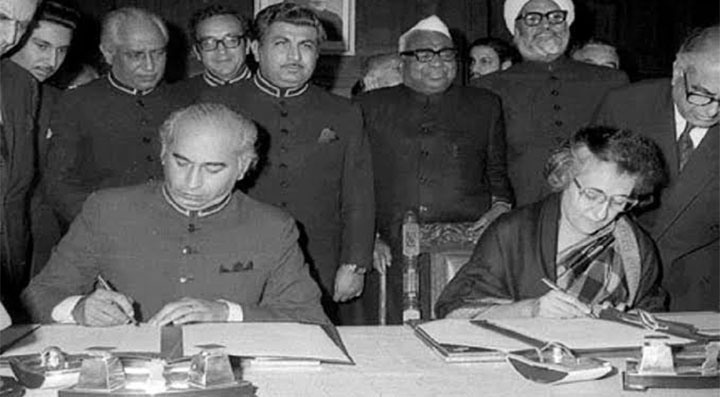
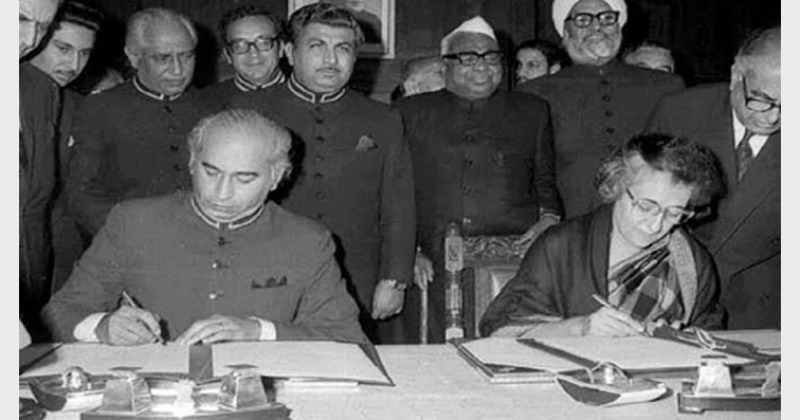
On August 29, 1972, the final agreement between India and Pakistan based on the Shimla Summit between Indian Prime Minister Indira Gandhi and Pakistani President Zulfikar Ali Bhutto was signed by the two chief negotiators, Parmeshwar Narain Haksar of India and Aziz Ahmed of Pakistan.
Prime Minister Indira Gandhi held the Shimla Summit with President Zulfikar Ali Bhutto of Pakistan on July 2, 1972. The proceedings are recorded in history as the Shimla Agreement that laid down the process for return by India of all Pakistani POWs in her custody and also return to Pakistan 13000 km of captured territory in the western theatre.
While the two leaders spelt out the overall agreement in the Summit, protracted negotiations over 19 sittings in nearly two months were held before the details were thrashed out. It is said that Prime Minister Indira Gandhi intervened several times to keep the talks going and her cabinet approved the final draft. The Government of Bangladesh too expressed satisfaction with the agreement and gave concurrence for the same. Thus came about the agreement mentioned above of August 29, 1972.
Prime Minister Indira Gandhi kept paramount the interest of Bangladesh. She succumbed to the pressure of ensuring the release of Sheikh Mujibur Rehman as also the Bengalis stuck in Pakistan. By so doing, she erred in visualising the larger strategic picture that would have been of benefit to India.
The significant portion of the agreement entailed Pakistani recognition of Bangladesh. Other issues included the repatriation of refugees in India and release of Bangladesh and Pakistani nationals stranded in the two countries. Pakistan agreed to take in an unspecified number of Bihari Muslims from Bangladesh. Pakistan also agreed to send back to Bangladesh almost 1,50,000 to 2,00,000 Bengali citizens of the new nation-state of Bangladesh.
Bangladesh dropped the demand to try for war crimes 195 Pakistani’s held in India and Pakistan in return agreed to drop charges on 203 Bengalis held for committing war crimes in erstwhile East Pakistan.
The Indo-Pakistan War, 1971 ended on December 16, 1971. It was a victory of India over Pakistan that has no parallels in annals of military history. The entire Eastern Theatre of the Pakistan Army surrendered to Indian forces. It resulted in the seceding of East Pakistan to Indian Army and resultantly creation of a new nation – Bangladesh.
The main surrender ceremony took place at Dhaka National Stadium, wherein Lt General AAK Niazi, commander of the Eastern Theatre of the Pakistan Army signed an unconditional instrument of surrender in the presence of Lt. General Jagjit Singh Arora, Army Commander of the Eastern Command of the Indian Army. This was the largest surrender witnessed in the world after World War II. The Pakistani Prisoners of War (POWs) included 54154 soldiers of the Pakistan army, 833 Pakistan airmen and 1381 seamen, 22000 Pakistan paramilitary personnel and 12000 civilian employees of the Government of Pakistan. The total number came 90368 POWs.
Pakistan lost 1, 48, 000 sq km of territory in its eastern theatre and 15, 000 sq km in the western theatre. 9, 000 Pakistani soldiers were killed, and 25, 000 were wounded. 200 tanks, 75 aircraft and 14 Naval crafts were destroyed. These included the pride of the Pakistan Navy, the Submarine Ghazi.
It is notable here that the United States had positioned their formidable 7th Fleet including the nuclear powered USS Enterprise in the Indian Ocean to pressurise India. Russia and China too exerted pressure. Despite this, India gave to the people of East Pakistan their much-needed freedom and thus did what was righteous and justified in the cause of humanity.
It goes without saying that the conclusive and historic victory was, in all measures, an ode to the bravery and professionalism of the Indian Armed Forces and especially the Indian Army. The war was meticulously planned under the aegis of the Chief of Army Staff General (later Field Marshal) SHFJ Manekshaw and executed flawlessly by the commanders on the ground and the troops. The Indian Army strengthened its position as one among the best military forces in the world.
It becomes quite clear that Bhutto used Sheik Mujibur Rehman and the nearly two lakh Bengalis stuck in Pakistan as a tool to blackmail India and the world into getting back the POWs and also the territory lost to Indian on the western front. If India had not succumbed to this pressure and instead kept her security interests paramount the negotiations could have led to a lasting solution to the Kashmir problem and other pinpricks of border and trade management with Pakistan. Sadly, India could not even negotiate the release of her own 54 POWs in Pakistani custody whose families continue to remain in despair.
The Pakistani Army, while in control of East Pakistan had committed heinous crimes including rape, torture in custody, destruction of property and outright loot. The newly created Bangladesh wanted to try Pakistani soldiers for war crimes that, effectively, would have meant their arbitrary killing. India was sensitive to this danger and was quick to transport all the POWs out of Bangladesh and into her territory. This noble act by Indians greatly displeased newly created Bangladesh. The Pakistani POWs were kept in camps across Indian and treated very well. All parameters of the Geneva Conventions on the treatment of POWs were applied in letter and spirit.
In Pakistan, the war resulted in an end to military dictatorship and ushering of democracy, however tenuous. Zulfikar Ali Bhutto of the Pakistan People’s Party (PPP) replaced General Yahya Khan as President of the country. He remained President from 1971 to 9173 and later prime minister from 1973 to 1977 before being deposed through yet another military coup.
Bhutto threatened to put Mujibur Rehman on trial and execute him as a traitor; he agreed to forego this action and even release him on an assurance that the POWs and the captured real estate would be returned to Pakistan. USA and China also put the release of all Pakistani POWs as a caveat for the recognition of Bangladesh as a sovereign country.
India had considerable urgency to see Sheikh Mujibur Rehman freed from the custody of Pakistan and installed as Prime Minister of Bangladesh. The need to repatriate nearly 10 million refugees to their new country had a lot to do with this urgency. Then there was the problem for the war-ravaged Indian economy to look after 90, 000 POWs; the cost was prohibitive.
It seems that a tacit agreement for the release of Pakistani POWs was reached sometime at the beginning of the year 1972 since Bhutto overruled the death sentence of Sheikh Mujibur Rehman on January 8, 1972. The Sheikh took over as prime minister of Bangladesh on January 10, 1972. The USA declared Bangladesh a sovereign country on April 4, 1972. Thus the ground was laid for the Shimla Agreement. However, Pakistan gave official recognition to Bangladesh on February 22, 1974, and China on August 31, 1974.
It becomes quite clear that Bhutto used Sheik Mujibur Rehman and the nearly two lakh Bengalis stuck in Pakistan as a tool to blackmail India and the world into getting back the POWs and also the territory lost to Indian on the western front.
If India had not succumbed to this pressure and instead kept her security interests paramount the negotiations could have led to a lasting solution to the Kashmir problem and other pinpricks of border and trade management with Pakistan. Sadly, India could not even negotiate the release of her own 54 POWs in Pakistani custody whose families continue to remain in despair.
There is an overwhelming perception that by agreeing to the terms set by Pakistan, India squandered a great opportunity for which the Indian Army had sacrificed the blood of her brave soldiers. Most astoundingly, the Indian Armed Forces, that were the architects of the great victory were nowhere in the negotiation process. Many still wonder at the naivety with which the negotiations were carried out and the reason behind the same.
(The writer is a geostrategic analyst, columnist and author)