





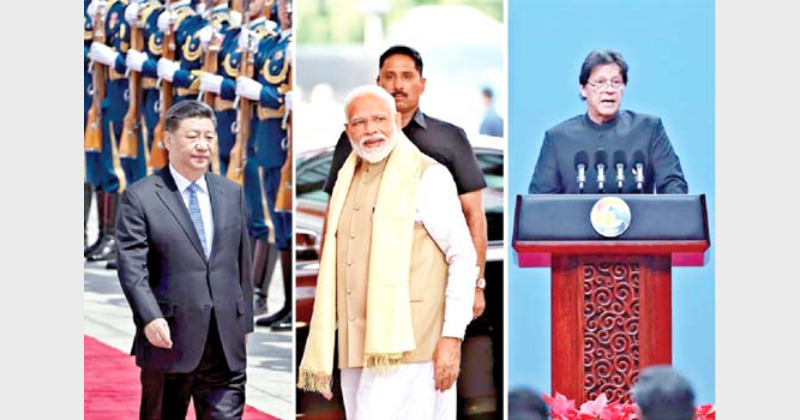
Modi government correctly comprehended that India’s China policy could not be seen in isolation to Pakistan, Beijing’s all-weather friend. To tackle the menacing dragon, it was necessary to defang Pakistan which was achieved by scrapping Article 370 and integrating Kashmir fully with India. A weakened Pakistan is not in China’s interests and has rattled the dragon to no end
-Abanti Bhattacharya
By scrapping Article 370, Modi government took away a potent tool from China which was used
to strangle India through Pakistan sponsored terrorism
Chinese incursions into the Ladakh region and attempts to change the territorial status quo by force have raised questions on China’s sudden belligerence towards India. While factors such as Beijing’s territorial irredentism coupled with the appropriation of Sun Zi’s strategy ‘to loot the house on fire’, that is to attack India when it is preoccupied with fighting against the Wuhan virus, cannot be discounted. It does not, however, explain why the Chinese leadership is upping the ante when its hands are full. Internally, the pandemic has badly hit its economy with problems of unemployment skyrocketing while anti-China protests in Hong Kong are gathering steam. Also, there is the fear of a second wave of the virus striking China. Externally too, China is almost encircled with rising anti-China voices in the West asking the country to take responsibility for the spread of Covid-19 pandemic. Clearly then, the reasons for belligerence are far deeper than meets the eye. It would be ironical to suggest that the Chinese belligerence is rooted in the Wuhan informal bilateral summit between Prime Minister Narendra Modi and President Xi Jinping in April 2018. But that’s what explains the reason for dragon blowing fire.
The Wuhan meeting was hailed as a ‘reset’ in India-China relations after the 73-day Doklam crisis between the two countries. Many analysts saw this as Modi’s appeasement policy as there were several steps that his government had adopted to placate the Chinese. These included withholding invitation to the Tibetan leader, Lobsang Sangey during Modi’s second swearing-in ceremony in 2019, backing away from official contact with the Dalai lama in 2018, allowing Chinese companies acquiring stakes in India’s telecom sector and several others. However, most analysts have failed to see the real intent behind the Wuhan diplomacy. For India, the Wuhan diplomacy was essentially a détente. It was a policy to pacify China on the northern front so that it could focus unequivocally on the Western front.
For India, major security threat emanates from Pakistan that for decades has carried out low-intensity warfare against India by sponsoring terrorism in Kashmir. In fact, Pakistan’s constant needling in Kashmir was facilitated by Article 370 that granted special status to the state of Jammu and Kashmir, allowing it to have its separate constitution. In other words, Pakistan’s support to terrorism and its occupation of the part of Kashmir both coalesced to play havoc on India’s security, sovereignty and territorial integrity. Further, it helped to bolster the China-Pakistan nexus. Since the 1960s, Pakistan’s conflict with India on Kashmir has allowed China to play the Pakistan card and keep India constrained and boxed within South Asia. It was, therefore, imperative for India to tackle the Kashmir issue upfront. In fact, the Modi government correctly comprehended that India’s China policy could not be seen in isolation to Pakistan, Beijing’s all-weather friend. To tackle the menacing dragon, it was first necessary to defang Pakistan. And Pakistan’s menace could be mitigated by scrapping Article 370 and integrating Kashmir fully with India. It was expected that with the diminishing value of the Pakistan card, the lethality of China-Pakistan nexus too would substantially reduce.
It is from this perspective, Modi had reached out to Xi in the post-Doklam phase. In fact, the very first clause of the Wuhan Informal Summit statement has underlined the salience of domestic priorities for both the countries. It stated that the two sides have met “to elaborate their respective visions and priorities for national development in the context of the current and future international situation.” Clearly, Kashmir loomed large in India’s national development priorities. Armed with the Wuhan Consensus, India scrapped the Article 370 on August 5th, 2019. This, at once integrated Kashmir to India under one constitution. More significantly, this heightened the prospects for snapping Islamabad’s terror links with the Kashmiri Jihadi groups and also dampening Pakistan’s ‘bleeding India policy’ that consisted of waging a covert war against India.
Revocation of Article 370 and full integration of Kashmir has challenged China’s BRI in POK as it has marginalised the Pakistan factor in Kashmir. The rising Chinese belligerence is a reaction to Modi’s China policy that rested upon weakening the China-Pakistan nexus
For China, the revocation of the 370 Article and creation of Ladakh as the Union Territory has been far-reaching. It brought the focus back on the disputed Aksai Chin, a territory in Ladakh that China had illegally occupied. But more than that, it had the Chinese worried on the fate of the Shaksgam Valley, approximately 20% of the Pakistan Occupied Kashmir (POK), that Pakistan had bartered away to China under the 1963 Sino-Pakistan Agreement. As the Article 6 of the Agreement says, “the two parties have agreed that after the settlement of the Kashmir dispute between Pakistan and India, the sovereign authority concerned will reopen negotiations with the government of the People’s Republic of China on the boundary as described in Article.” Clearly, by ceding the territory, Islamabad not only had Beijing a stakeholder in the occupied area but also kept the territory open to renegotiation. No wonder, Foreign Minister S. Jaishankar’s repeated assurances to Chinese counterpart, Wang Yi on the issue of re-designation of Ladakh engendering no impact on the Line of Actual Control (LAC) had failed to allay Chinese fears. Instead, China retaliated with supporting Pakistan on a closed-door informal discussion on Jammu and Kashmir at the UN Security Council in August 2019. Clearly, India’s revocation of Article 370, which is purely its internal affair has rattled the dragon to no end.
China’s core strategy, thus, has increasingly focused on deterring India from recovering the POK as part of the Bhartiya Janata Party’s long-stated goal of a unified Kashmir as well as professing continued support to its all-weather friend. Not surprisingly, China even pointed at India’s human rights violations in Kashmir when its own house in Xinjiang has been burning. In fact, with the intensification of New Delhi’s counter-terrorism operations in the Kashmir Valley, deterring India has emerged as the principal Chinese strategy under Xi Jinping. This explains China’s increased transgressions into the LAC at multiple fronts, including opening up new areas of disputes in the Galwan Valley and Naku La. To further escalate pressure on India, China has instigated Nepal to rake up the Lipulekh tri-junction issue with India, consequently increasing the spectre of a third front for New Delhi. Not to forget, deterring India has gained an utmost priority also because of Xi Jinping’s dream project- the Belt and Road Initiative, part of which covers the POK. BRI is not merely a gigantic connectivity project aimed at reinforcing the Sino-Pakistan nexus. Its success is crucially linked to the legitimacy and survival of the Chinese authoritarian government. Therefore, under no circumstances, China would allow the BRI to fall through. However, the challenge to BRI in POK has substantially increased with India’s revocation of Article 370.
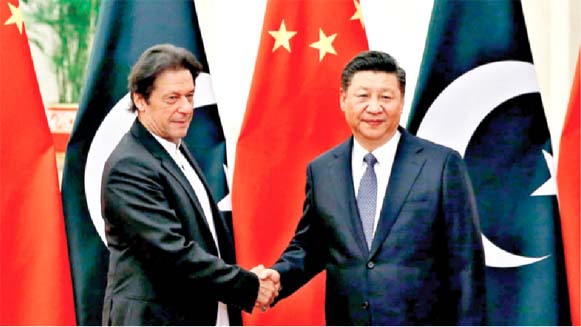
The Pakistan-China relationship solely depended on a strangulating India with terrorism but removal of Article 370 has defanged Pakistan and strengthened India
Pakistan’s support to terrorism and its occupation of the part of Kashmir both coalesced to play havoc on India’s security, sovereignty and territorial integrity as it helped to bolster the China-Pakistan nexus
China apparently realised that the Wuhan détente allowed India a free hand to tackle the Pakistan menace and successfully integrate the Kashmir valley into India. This has while marginalised the Pakistan factor in Kashmir, has also raised questions on the efficacy of the Pakistan card. Clearly, Modi outwitted the Chinese by reaching a détente that helped him to bring about the complete integration of Kashmir. Arguably then, rising Chinese belligerence is a reaction to Modi’s China policy that rested upon weakening the China-Pakistan nexus.
(The author is Associate Professor, Department of East Asian Studies, University of Delhi)








Comments