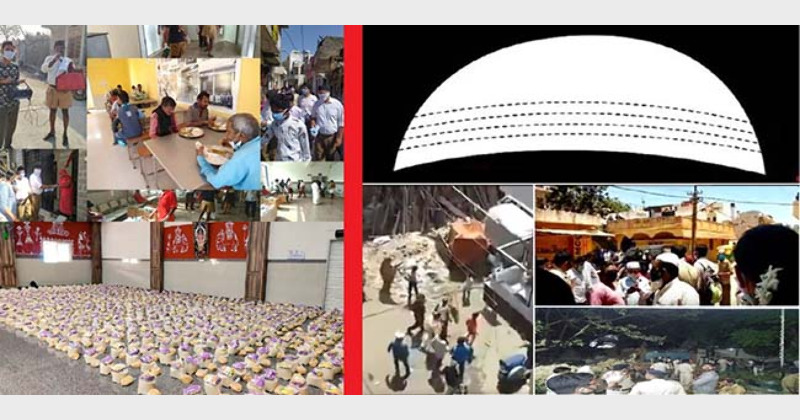
Hindus adhered to the lockdown norms immediately while RSS and other Hindu organisations, Jains and Sikhs etc. began serving the poor spontaneously after the lockdown was announced. But the second biggest community of India refuses to see the danger and has also indulged in breaking rules endangering lives of other citizens.
We are witness to an unprecedented disaster as it unravels in front of our eyes. During earlier such medical emergencies, we had a society that was less mobile, less connected. We are indeed in a globally connected world now. Above all, this wildfire disease comes with a suspicion that it is the result of unethical science.
How others responded
Having unleashed this virulent virus that seems incurable presently, how did China respond? Like any totalitarian Communist regime – it suppressed critical information, used strong-arm, highly coercive and cruel methods to contain it. Having used most inhuman methods on humans, it announces its ability to control the virus and now offers the world medical support. After it allowed with utter cynicism, its citizens from Wuhan go all over the world. It makes us wonder whether we actually need economic and scientific development that comes at such a high cost to humanity.
The Western response came from Europe, which emerged as the next epicentre of the crisis. Globalisation has brought a large number of Chinese to Italy. The foolish faux liberalism persuaded people to embrace Chinese just to show off their liberalism, despite the medical risk, leading to a tsunami of infections in Italy. Fear of quarantine led many to escape the Red hot spots of Italy and spread the pandemic across Europe.
The other type of western response saw the USA respond with a ‘devil may care’ attitude, believing its intense research will find a quick solution. Open societies are great. England tried the same openness, but we know now that a human being is not superman or superwoman, not yet at least. They refused to see the vulnerability of human beings against nature. Unfortunately, the USA became the biggest victim of Wuhan Virus. We also find that Western societies depended solely on the governments to resolve this humongous problem. There hardly seems to be any organised civil groups’ support system.
How India responded
India too fell prey to this rogue virus. The Government of India was one of the earliest countries to stop flights, visas and begin screening at the entry points. Admittedly, its medical infrastructure is poor. Yet, its proactive measures as compared to other countries saw very slow growth in Wuhan Virus. Even if we believe that the number of afflicted people could be more, the number of deaths tell us that it did not spread as dangerously as it did in other countries. This trend continued till three days back when we suddenly found ourselves in the midst of religious madness of suicidal people who flouted all the norms of pandemic control, which led to a significant spike in the infected cases.
The war against Wuhan Virus was declared the day the Prime Minister of India when he said that he would not play Holi and suggested the same to all Indians. This indication from the top leader saw nearly all meetings, conventions, public programs cancelled, including the religious gatherings. This step was in tune with the typical Hindu spirit of co-existence. Next step was the voluntary ‘Junta Curfew’. It was a dress rehearsal as he clearly indicated. As if on cue, the Delhi government declared a Lockdown a day before Junta Curfew. Punjab and Maharashtra joined immediately with lockdown, curfew etc. Every citizen of the country knew that the only way to save oneself was to follow ‘Social Distancing’ and ‘Stay at Home’. Soon we had a national lockdown. Even Tirupathi temple that was never closed for 2500 years was shut.
Differing responses of different Communities
This comparison brings us to the question – why is the response to the same problem different among different communities?
We saw above the response of different nations. It was not easy in a vast and varied country like ours that has adopted indiscipline as a way of life. We have imbibed the idea somewhere in the 1930s that discipline is not a good idea. People boast about breaking laws. But, surprisingly, the country as a whole responded wonderfully. It showed the co-operative spirit of our society in times of crises. If we were not co-operative, no forces could make a vast country with 130 Cr people to behave. The deep sense of oneness with the society and treating the nation with respect played a key role.
There was tragic chaos of migrant labour, further exacerbated by politicians and left-oriented media. It showed the brittleness of our economic development and limitations of public welfare schemes. Ultimately, it was a serious issue of survival, of anxiety, and the poor couldn’t be faulted if they got scared. Though, this problem is coming under control slowly; it brought out the horrors of poor daily wage earners, labour, vegetable vendors etc. If the best of the governments couldn’t reach them, who would take care of these people?
It was at this time that Hindu society that represents the soul of India showed its mettle and rose to the occasion. RSS, its affiliate organisations, other Hindu organisations, Jains and Sikhs etc. began serving the poor spontaneously. It started within two days of the lockdown. As of today, 10000 locations in India, about one million poor, were served by 100,000 RSS volunteers. The Jain community has become the most significant contributor to various relief agencies, totalling 2000 million INR. Every Indian industrialist, temple and individuals contributed well. Different sects of Dharmic tradition and individuals opened kitchens. The outreach of Dharmic organisations was faster than the government agencies. The majority community, overall, behaved in an exemplary manner. If there were exceptions, none supported them, in fact, criticised them. This showed unselfish love for the society and the nation.
Why don’t we see much relief work from Waqf boards? On the contrary, we see the obtuse behaviour of the second biggest community of India that refuses to see the danger that stares it in its face like any other Indian. The virus has no religion. The acts like refusal to vacate Shaheen Bagh, and similar misadventures elsewhere, show a sense of irresponsibility of the leaders who egged them on with implacable hate. Unfortunately, governments had to go to court to resolve such illegal problems. Their followers’ refusal to be tested and treated, their threats to infect others by various means added a new dimension to the grimness of the situation. It showed a revival of political veto power that had ceased to work overtly after the partition of India. A sustained campaign by most of the orthodox Muslim leadership to disobey the Lockdown, to question the very rationale of lockdown by collecting crowds and claiming that it was against their religion shows how a significant section of Indians cut off from the problem of India; as if they don’t belong here.
The irrational behaviour of these supposed thekedars of the community flies against the attitude of Muslim community leaders across the world, including proclaimed Islamic countries. So the problem lies within Indian Muslim leadership, not Islam. Refusal to integrate and follow science at the time of national disaster is matched only by Mullahs of Pakistan who refused to listen to their government, which itself is a damning comment. And how did Pakistan prepare for Wuhan Virus, by preparing a huge burial ground! And we had a Maharashtra Muslim minister turn down scientific advice to cremate all Wuhan Virus victims.
This irrational behaviour instigated by extremists has seen a significant section of our society isolated from the mainstream at such a difficult juncture. The blind hate generated by such leaders who believe they are a nation within a nation, saw them contributing nothing to alleviate the sufferings of their own community, forget that of other communities.
Unfortunately, this behaviour confirms what Dr Ambedkar had said long back, “Brotherhood of Islam is not the universal brotherhood of man. It is a brotherhood of Muslims for Muslims only. There is a fraternity, but its benefit is confined to those within its congregation.” The current imbroglio tells us that our efforts to integrate the community kept back in India on exertions of Gandhi ji and Nehru ji despite Dr Ambedkar’s suggestions of exchange of population has failed despite investing in it for seven decades. It is not that the rise of Mr Modi has undone what was done so far. It only shows that you can’t make friends by bribing someone; meeting of hearts is the crucial factor.
We are aware that there is no dearth of good leaders in the Muslim community who have worked hard to bring about a meeting of minds of this community with others in India. But, they have been marginalised by so-called secular parties. Submission to Mullah’s Islam began with Khilafat. Sidelining educated modern Muslims has been a major failing of Indian political discourse; this must change. Will the unsavoury behaviour of hateful members exposing the dark side of militant Islam be a turning point in Muslim community’s behaviour in India? Will the modern educated Muslim leadership stand up and wrest the leadership from obscurantists? Or will reformist Muslims again retreat into their shells, fearing isolation within the community? I hope not.