Always keep the house and its premises, the rooms, clothes, bed, drain, etc., clean. Do not eat stale, spoiled food; take fresh and nutritious food instead. A weak body is more susceptible to disease, writes Swami Vivekananda in his plague Manifesto
Nikhil Yadav
The medical tornado “coronavirus” being declared a pandemic by the World Health Organisation. After approximately more than 9115 deaths and 2,22,640 confirmed cases, the Wuhan originated strain has become a midpoint of news, reports, gossips, and rumours for every single one in the real and virtual world. These type of medical emergencies are not new to India or the world as a whole; the difference lies in the scale of information available with the spread of social media and technological revolution. Developing proper medicines will take a few more months, and till then, we have to use all the preventive measures possible.
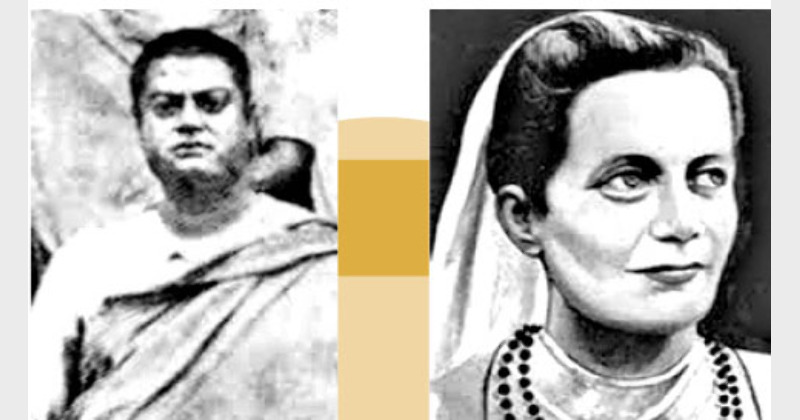
It would be appropriate to recall the 1899 Bengal Plague and Swami Vivekananda’s ‘Plague Manifesto’ here, which not only helps us psychologically and emotionally but also shows the spirit of Sanyasis of the Bharatiya tradition.
Swami Vivekananda in his letter ‘Plague Manifesto’ which was drafted in Bengali and Hindi and was reached to a significant part of the population by the hard work of Swami Sadananda and Sister Nivedita asked to remain ‘’free from fear as fear is the biggest Sin’.
Swamiji says, ‘Always keep the mind cheerful. Everyone will die once. Cowards suffer the pangs of death again and again, solely due to the fear in their minds.’ He urged to thrust aside this fear in the following words -‘’Come, let us give up this false fear and, having faith in the infinite compassion of God, gird our loins and enter the field of action. Let us live pure and clean lives. Disease, fear of an epidemic, etc., will vanish into thin air by His grace.’’ He further adds the means to remain hygienic ‘’Always keep the house and its premises, the rooms, clothes, bed, drain, etc., clean. Do not eat stale, spoiled food; take fresh and nutritious food instead. A weak body is more susceptible to disease. During the period of the epidemic, abstain from anger and from lust — even if you are householders”. He also asked not to panic and pay any heads to the rumours.
It was Sister Nivedita and other monastic disciples of Swami Vivekananda who tirelessly worked day and night to give service to the people of Calcutta. Swamiji urged “Brother, if there is no one to help you, then send information immediately to the servants of Shri Bhagavan Ramakrishna at Belur Math. There will be no dearth of help that is physically possible. By the grace of the mother, monetary help will also be possible”.
It was in March 1899 the Plague broke out in Calcutta. A committee was formed by Ramkrishna Mission with Sister Nivedita as the Secretary, Swami Sadananda as the Supervisor and Swami Shivananda, Nityananda and Atmananda as the members. The services rendered in fighting the Plague became memorable in the history of Calcutta. The relief work started on March 31, Swami Sadananda who a master in organisational work started cleaning the slums of Shambazar, Baghbazar and other neighbouring localities. He moved around with a group of sweeper-boys and took upon himself the responsibility of cleaning. On April 5, Sister Nivedita, who was coordinating this whole task made an appeal through newspapers for financial aid Sister Nivedita along with Swamiji, delivered lectures on Plague. On April 21, she spoke to the students at the classic Theatre on “The Plague and the Duty of Students ‘’. Sister Nivedita asked “How many of you will volunteer to come forward and help in the labour of cleansing huts and bustees? In such matters, we all stand and fall together, and the man who abandons his brother is taken by despair himself. The cause of the poor is the cause of all today –let us assert it by practical action. Their lectures created new enthusiasm for the work, and about fifteen students offered themselves in the work of plague service. The work was carried out in an organised manner; Sister Nivedita used to distribute the printed handbills containing the preventive measures on how to fight the Plague. One day, she started cleaning the lanes herself when there was a shortage of volunteers. Seeing her, the young men of the locality felt ashamed and supported her by taking the broomstick and cleaning the rubbish and the pathway.
Thus let us not panic, fear and spread rumours, instead accept the preventive measures issued by the state and Government of India while adhering to the cleanliness and service-related message given by Swamiji
Dr Radha Gobinda Kar, one of the eminent physicians of those days, and an eye witness to Sister Nivedita’s work says, “one day when I returned to home at noon-time in the month of Chaitra after seeing the patients, I saw a European lady sitting on a dusty chair near the door. She was Sister Nivedita. She was here to get some information”. Dr Kar on that morning had been to see a plague-stricken child in a slum at Baghbazar. Sister Nivedita inquired about the child who was in critical condition, she ran and reached the locality in no time and irrespective of the precautions informed by the doctor to her she took the child into her laps. The child’s mother had already died. Sister Nivedita temporarily moved to this hut to take care of the child. Day and night, she remained engaged in the nursing the child, ignoring the possible danger. She even white-washed the walls herself. Her nursing never slackened, even when death was a certainty. After two days, the child died in the lap of Nivedita. Before breathing its last, the child called her “Ma Ma” taking her for its own mother. A vivid description of the work about Plague is given in an article entitled “The Plague “ in her book, Studies from a Eastern Home.
This was just a single mention , her merciful presence was familiar sight in all the localities. In of her letters she wrote to an English friend, Ms Coulston, she says: “There is endless work. Only to live here is in itself work”. Sister Nivedita and her team consistently carried on their efforts for an entire month before they succeeded in controlling the disease.
Even during the Corona-Pandemic, we should support the administration by strictly following the advisories. Doctors and medical experts are doing their best, we should appreciate and wherever possible should become a helping hand. Thus let us not panic, fear and spread rumours, instead accept the preventive measures issued by the state and Government of India while adhering to the cleanliness and service-related message given by Swamiji.
(The writer is a State Youth Head at Vivekananda Kendra, Uttar Prant and is pursuing COP in Vedic Culture from Jawaharlal Nehru University)