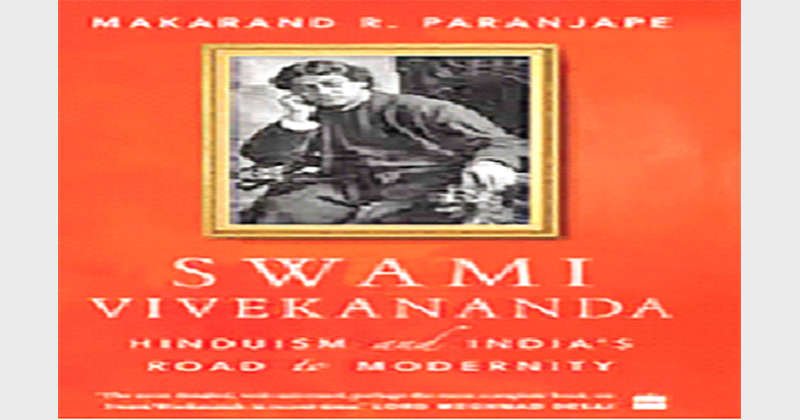
Swami Vivekananda—Hinduism and India’s Road to Modernity is ‘must-read’ for anyone interested in the revival of Hinduism in modern India, as Vivekananda revolutionised Hindu faith traditions by turning them into a repository of rational, universal philosophy. The author examines the hitherto lesser-known aspects of Swamiji’s life and his work including his contributions to practical Vedanta, universal religion, science-spirituality and inter-religious dialogue, dharmic secularism, educational philosophy, poetry, and, above all, to the problem of Indian modernity
A workshop was held at the School of Oriental and African Studies, University of London, in 1993 to mark the centenary of Swami Vivekananda’s celebrated address to the 1893 World’s Parliament of Religions in Chicago. The papers of the contributors in the workshop were later collected in a volume entitled Swami Vivekananda and the Modernisation of Hinduism, edited by William Radiace (New Delhi: Oxford University Press, 1999). The volume through an intellectual engagement with Vivekananda claimed to demonstrate how modernising trends in Indian society wrestled with traditional features of Hinduism such as caste. It then went ahead to link Vivekananda’s religious and social ideals to thinkers and theologians in the West. The book through its contributors firmly distanced Swami Vivekananda from so-called ‘chauvinist or communal misinterpretations of his work.’ Now, what these misinterpretations were, and who were these interpretators?
While examining the politics of knowledge, one must not be in a hurry to accept labels and categories on their face value. What has been called chauvinist or communal misinterpretation of Vivekananda’s work and actions, need to be contextualised and examined, at first. It requires a broad literature survey. There is no dearth of literature on Swami Vivekananda. In the last one century, hundreds of scholarly books have been written on Vivekananda, his works and his philosophy in different languages. Sister Nivedita, who was a disciple and a friend of Vivekananda, wrote two books The Master as I Saw Him (1910) and Notes of some wanderings with Swami Vivekananda (1913). Sister Gargi’s lifelong research work, a series of six volumes of books, Swami Vivekananda in the West: New Discoveries was first published in two volumes in 1957. In 1983-87 these series was republished in six volumes. Bengali scholar and critic Sankari Prasad Basu, who was a director of Swami Vivekananda Archives, Ramakrishna Mission Institute of Culture wrote several books on Vivekananda such as Vivekananda o Samakalin Bharatbarsha ((in Bengali) 7 volumes), Sahasya Vivekananda (in Bengali), Bandhu Vivekananda (in Bengali) etc. Swami Nikhilananda wrote Swami Vivekananda: A Biography which was published in 1943 by Advaita Ashrama. Advaita Ashrama publishes many important books in English and Hindi, as well as the English Journal Prabuddha Bharata which is being published since July 1896, making it the oldest running Journal by Ramakrishna Mission. Apart from these primary sources, there are hundreds of commentaries on the Swami and his teachings and the movement and mission he created. The list can be as wide as Jawaharlal Nehru to the historian RC Majumdar to Makarand Paranjape himself, who has edited readers dedicated to Vivekanand before and edited a volume around his adventures in the West. Now, one can ask, that with such a great bibliography, why one more volume on Vivekananda has been added?
The addition has to do with the timing, and secondly, to crucially examine the charges of ‘chauvinist and communal misintepretation’ which has been levelled against larger Hindutva paradigm by baiters in academia. Today, the making of a New India warrants a fresh take and re-reading of thinkers who can take the project of political and cultural refashioning to the next level. Vivekananda leads here. His greatest achievement remains the reconstruction of Hindutva which he accomplished by reforming the religion in India and changing its image in the West. Paranjape argues the Hinduism that Vivekananda expounded at the Parliament of World’s Religion in Chicago was ‘a new, progressive version of an ancient tradition, devoid of superstitions and distortions with which it had come to be associated.’ For Paranjape, ‘Vivekananda’s reconstruction of Hinduism consisted in his advocay of four theses: (1) non-sectarian and anti-ritualism, (2) social, especially caste and gender, equality, (3) national service as the soul of religion, and (4) Vedanta as the essence of Hinduism and the future of thinking humanity.’ In this light with the convergence of Vivekananda’s ideals in the political, social and cultural Hindutva today, it is apprent then that the ‘double helix’ of Indian modernity can be understood through Vivekananda’s intervention. And therefore, the appeal of this volume is its situatedness in contemporary India. The research site in this situatedness being the contentious terrains of religion, belief, science, secularism, education, modernity and Hindutva itself.
In the nine chapters, spread over some 300 pages, Paranjape offers us a kaleidoscope of intellectual history. It is perhaps a testament to how intellectual history should be done. Away from the binaries of ideas and people which modernity has bound us with, in a single volume, a well-known monk walks through the interconnected roads of science, education, and poetry. Between the poles of ‘Vivekananda’s India’ and ‘India’s Vivekananda’ we are taken to so many interesting and anecdotal detours that an intellectual biography of a nineteenth century Indian monk, seems to be the biography of ‘We, the people’ in the twenty first century. It is worth reiterating that the chapters titled ‘The Double Helix’, ‘Secular Dharma’, and ‘National Education’ makes the volume a must read for anyone who are reinventing Bharat for themselves and for others.
In the end, Paranjape provides a passage in the academic impasse over the questions and crises of modernity, by examining the category itself. Are Indians modern, anti-modern, or non-modern? Is there a distinct ‘Indian Modernity’? Is there a quest and possibility for alter-modernity? These questions are going to guide the project of social and cultural refashioning and repositionings in Bharat today. And who better to stand there for us as a guiding light but Swami Vivekananda. With Paranjape, Vivekananda talks to us in his voice which is well known, but which also needs to be heard from different ears. The volume is a ‘should be done’ reading for our times, because unlike many readings from the past, it never positions an enemy in front of Vivekananda who should be dismissed as some ‘misintepretator’. It doesn’t invent new labels to alienate our own people. It only questions the limitations of old categories to take everyone on-board, like Vivekananda wanted to.
(The reviewer is a Research Scholar at ZHCES, JNU, Delhi)
Swami Vivekananda—Hinduism and India’s Road to Modernity,
Author : Makarand R Paranjape, Published by Harper Collins, Noida, Paperback, p. xv+317, Price: ₹499