





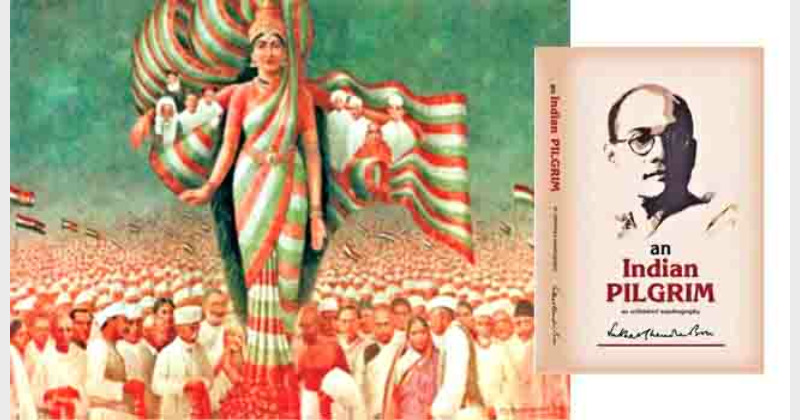
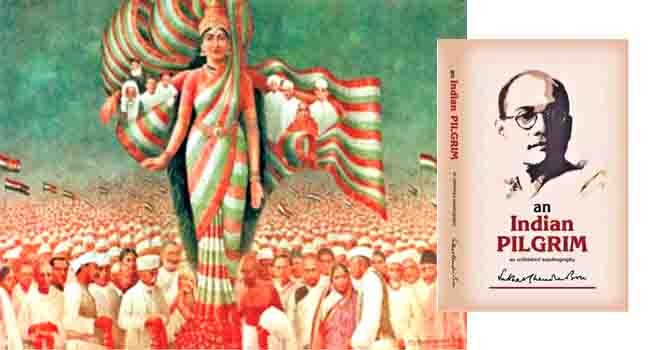
In an article entitled ‘The Call of the Motherland’, Netaji Bose appealed to all to come forward, to put on ‘Rakhi’, the symbol of brotherhood, and be initiated in the temple of the Mother with the vow that they would put an end to the shame that afflicted the Mother, re-establish India again on the pedestal of freedom and recover the lost glory of Mother India
Prof. D.D. Pattanaik
All said and done on Netaji Subhas Chandra Bose, one conspicuous dimension of him remains yet elusive, and that is his adherence to the essence of Hindu nationalism. He is being depicted as secular, modern, leftist and what not. But all these epithets hardly compromise his subscription to Hindu identity of India. Mere practising Hinduism does not provide cognisance to Hindu nationalism, but it (Hindu nationalism) is to be interpreted esoterically so much so that Hindu foundation of Indian nationalism is imperative to it.
Let us trace out the psychological makeup of Bose out of some of his expressions of his early life. In a letter to his mother, Bose regretted: “Mother, it is not only the country which is in pitiable condition……How holy and eternal the Hindu religion was and how degraded our religion is now! Think of the Aryans who hallowed this earth by their presence and look at their fallen descendants. Is the eternal faith going to be extinct? Look how atheism, lack of faith and bigotry have become rampant leading to so much sin and so much misery for the people. Look how the descendants of the deeply religious Aryans have become irreligious and atheistic! …..Will not any son of the Mother India in distress, in total disregard of selfish interests dedicate his whole life to the cause of the Mother? ….Our religion is suffering the pangs of near death – does that not stir our hearts? …..How many selfless sons of the Mother are prepared, in this selfish age, to completely give up their personal interests and take the plunge for the Mother? …..so many mothers have lived for the sake of Mother India and have, when the need arose, sacrificed their lives for here. Think of Ahalya Bai, Meera Bai, Durga Bai – there are so many……”
In another letter to Hemanta Kumar Sarkar, Bose regretted that “pure Aryan blood no longer flows in our veins. Slavery of ages – so much adulteration…..The Hindu race no longer has that pristine freshness – that youthful vigour and these unmatched human qualities…..”
While admitted for his primary education in Missionary School at Cuttack, Bose could sense the existence of two worlds. In school days he often used to wear ‘dhoti’, traditional Indian attire. This mindset continued as evident from an incident in Presidency College of Calcutta in 1916. One Philosophy Professor, E.F. Oaten, ridiculed Indian culture in the class, which was protested by the students. Yet the Professor repeated, and he was manhandled while climbing down the staircase. Bose, when interrogated, neither conceded his role nor divulged name of any mate. As a sequel he was expelled from the College. Of course, he got admitted one year later in the Scottish Church College with cooperation of the then Vice Chancellor Sir Ashutosh Mukherjee.
Bose, in his unfinished autobiography ‘An Indian Pilgrim’ mentioned influence of Ramakrishna, Swami Vivekananda and Bankim Chandra in his life. He was enamoured in the way Bankim Chandra asked the ‘sanyasis’ to dedicate their lives for the sake of the nation. He escaped to the Himalayas in search of a ‘guru’ in his youth, but failed to find a befitting one sensing that dedication at the alter of the motherland was the only path. He was swayed by the action-oriented interpretation of Bhagawat Geeta by Swami Vivekananda and Lokmanya Tilak. Spiritually, he was struck with ‘Advaita’ thought-structure of Ramakrishna and Vivekananda.
To continue the words of Bose, “India is God’s beloved land. He (God) has been in this great land in every age in the form of saviour for the enlightenment of the people in every Indian heart. He has come into being in many centuries in human form, but not so many times in any other country – that is why I say India our motherland, is God’s beloved land…..in the Deccan I see the Godavari, with her pure and sacred waters reaching its way entering to sea, a holy river indeed! To see her or think of her at…..resounding all the while with the voice of the great sage, chanting the ‘mantra’ from the holy Vedas. Every little things in the Ramayana is so noble…..alas, accessible to everything else even in our national life. We are now a weak, servile, irreligious and cursed nation…..O’ Lord – where is the eternal religion that your chosen men established here? The religion and the nation that our ruins…..What happened to our hoary past? Where are our precious lives in the service of Mother India? How our religion is now? ……Shall we continue to turn a deaf ear to the wailing of our nation? Does that not stir our hearts? How long can one sit with folded arms and watch this state of our country and religion?….”
In 1925, in an article entitled ‘The Call of the Motherland’ Bose appealed to all to come forward, to put on ‘Rakhi’, the symbol of brotherhood, and be initiated in the temple of the Mother with the vow that they would put an end to the shame that afflicted the Mother, re-establish India again on the pedestal of freedom and recover the lost glory of Mother India”. Perfect instance of cultural nationalism indeed!
Bose was inspired with the cult of motherland popularised by Bankim Chandra in the form of ‘Bharat Mata’. To Bankim, Bharat was ‘Jagaddhatri’, symbolising glorious past; ‘Kali’, symbolising devastating present; and ‘Durga’, symbolising the resurgent future. He felt that a nationalist awakening in India in most was heralded by a cultural renaissance. In his Presidential address to the All India Youth Congress in 1938, Bose expressed: “We must take our stand on our past. India has a culture of her own which must continue to develop along with her distinct channels”. In another occasion Bose exhorted the audience thus: “There is something in India’s culture which is essential for the fullest development of human civilisation…..The songs of India kept the lights of learning burning through ages and ages of darkness. As their descendants, how can we lie before we have fulfilled that high purpose of our race.”
In his Tokyo University speech in November 1943, Bose submitted that if a nation does not find its continuity there is no hope for it. He added, “We want modern India based of course on the past…..We want to build up a new and modern nation on the basis of our old culture and civilisation”. In his work ‘The Indian Struggle’, Bose praised the pristine glories and achievements of India in every walk of life. He also underscored the underlying fundamental cultural unity cutting across caste, language and regional barriers. This is significant since the secular establishment of India always hasten to disown the past and ridicule its achievements as romantic.
In his personal life too, Bose was trying to reinforce the same yardstick. Illustratively, he got married to one German woman, Emilie Sehnki, in 1941. He found out one priest in Germany and got married as per the traditional Vedic way. Bose was a ‘Shakta’ – worshipper of power goddess. His daily life unfailingly began with recitation of ‘chandi path’ with meditation. His letters began with the heading “Mother Durga be with us”. It is testified that he founded the Provisional Government of India on October 21, 1943, i.e., the day of Vijaya Dashami; and it was being regularly celebrated by the Azad Hind Fauz. He always carried a small copy of Bhagawat Geeta within the breast pocket of his field uniform. With this kind of aptitude he sought application of violence and non-violence in proper perspective in the course of freedom struggle; and this was his defining difference from Mahatma Gandhi.
Bose was instrumental in the publication of the fourth edition of ‘The War of Indian Independence’ authored by V.D. Savarkar in France in 1936. This work earned applause by the rank and file of the Provisional Government. He corroborated the first chapter of the said work which entitled “Struggle for Swaraj and Swadharma”. For this reason Bose also appreciated the tone and course of the Swadeshi Movement (1905-10), which widely employed Hindu symbols and idioms.
Like a typical nationalist, Bose believed: “A nation’s life, like that of a man, requires a harmonious development in all its spheres and a new spirit invigorates the body polity of a nation if its growth is quick as it is sure”. He studied the existence of a soul or ‘idea’ of a nation, what is termed as ‘chiti’ in Vedanta, spirit by Hegel and Elan Vital (Vital Impulse) by Bergeson. The soul causes the shaping of the national character of a given nation. That is why Bose corroborated the spiritual enlightenment by Sri Aurobindo. His organic idealist concept of a nation tinged with mysticism, historical continuity and its latent genius constitute the nation distinct message to the world. Further, his determined bid to synthesise religion and nationalism in Sankhyan mode is also thoroughly Indic. All these compounded together smack of inclination to Hindu nationalism.
Bose was amazed by the fact that believers in Christianity and Islam built empires and converted large numbers of that faith. So he ventured to chalk out a plan for spreading Hinduism in Africa as one part of making India a great nation to reckon with. Leonard Gordon, one American biographer of Bose, sums up that “In his (Bose’s) concept of nationalism Hinduism was essential part of Indianness”.
Bose made a distinction of Indian nationalism from the Western paradigm. In Lohore Students Conference he had said, “India has something original to contribute to the culture and civilisation of the world in every department of human life”. “Our emphasis was not on civilisation but on culture, not in the material side of life, but on intellectual and spiritual…..Owing to our superior thought power, we could hold our own against invaders from outside even when we were vanquished physically for the time being……while ancient Egypt went down before the Arab invaders and disappeared altogether.”
Bose disagreed with the view that Indian unity was a gift of British suzerainty over India. According to him Indian nationalism is neither the product of geographical condition nor of Britain’s imperial politics like evolution of state nationalism of the West. “Our nationalism is basically cultural and spiritual in concept. It developed as emotional process of synthesis and harmony in the long history of our organic growth”. He never accepted the theory of multinational nationality of India.
Bose stated in one context: “Indian nationalism is inspired by the highest ideals of human race, viz., “Satyam, Shivam, Sundaram”. Asking the people to uphold inherent Indian culture, Bose recalled Sri Krishna in Gita, “It is better to die for one’s conviction”. He learnt that whatever is foreign to one’s nature is always source of danger. If the people go against native genius of the race, he felt, they would be guilty of committing suicide.
After the Bolshevik Revolution the Indian students studying abroad were impressed with the apparent socio-economic transformation of the Soviet Union. Bose was no exception to it. But later he realised its irrelevance in India on the grounds that communism was materialist and denationalised in Indian perspective; that it could hardly cope with the cultural heritage of India.
In a letter to Lord Linlithgow in December 1940 on the contemporary outbreak of communal frenzy, obviously from Presidency jail, Bose wrote: “……today a wave of communalism is spreading over Hindu Bengal, as an inevitable reaction to Muslim communalism. On the face of this communal vortex with unending eddies, those who believe in Nationalism are looking on helplessly.”
Bose tried to convince Jawaharlal Nehru to accept ‘Vande Mataram’ as the national song, which had been disowned by the Congress since its Kakinada session in 1923. He popularised the greeting ‘Jai Hind’, and argued in placing the ‘Ashok Chakra’, i.e., the Wheel of Dharma, at the centre of the national flag.
So, abundant expressions, acts and behavioural outpour of Bose constitute profound his nearest approximation and vindication to Hindu identity of India which constitute the recipe for national rejuvenation and consequent “national reconstruction” (the words dear to Bose).
(The writer is a Member of Indian Council of Social Science Research, New Delhi)




![A Representative image [ANI Photo]](https://organiser.org/wp-content/uploads/2025/12/representative-image-e1765612818961-120x70.webp)

Comments