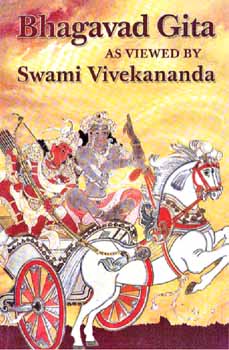
Geeta has been flooded with aspersions of historicity, particularly by those who want to show it in poor light whatever great Bharat offers. Swami Vivekananda silenced these vacuous critics by turning the question to an understanding of ideas
The Bhagavad Geeta is a unique text that has been translated into many languages, the number being very high for a religious text, second only to the Bible. However, the Bible has a missionary machinery behind its dissemination, which the Geeta does not have. While we celebrate the glory of this text, it would be pertinent to remind ourselves that till the eighth century this text was not much known. It was the genius of Adi Shankaracharya, who brought out this hitherto non-descript text from the wilderness of Mahabharata by writing a masterful commentary on it and by setting the path for later thinkers to gloss and comment upon this text.
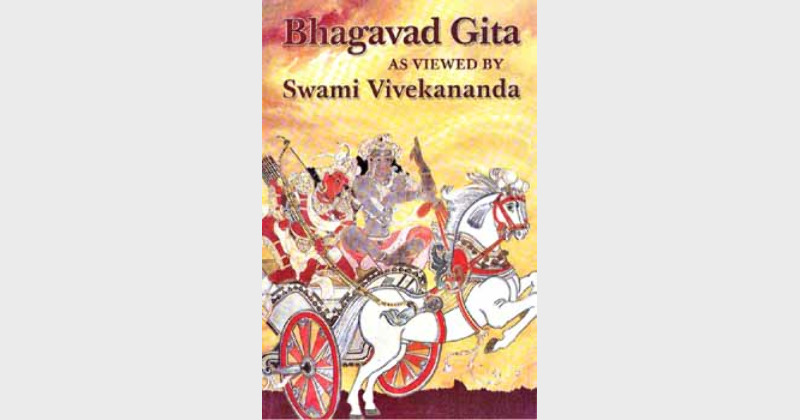
While Adi Shankaracharya gave a unique identity to Geeta, Swami Vivekananda churned the ocean of this text and brought out the nectar of four yogas: Raja Yoga, Bhakti Yoga, Karma Yoga, and Jnana Yoga. These were the paths of meditation, devotion, action, and knowledge, taught by Sri Krishna in the Geeta to attain moksha. Not only did Swami Vivekananda bring the focus of everyone to these texts, he gave lucid lectures on each one of them, which were later published into books. These books have been translated into many languages and have practically become the staple diet for every sadhak. This bringing out of the four yogas from the Geeta is one of the great contributions of Swami Vivekananda.
Geeta has been flooded with aspersions of historicity, particularly by those who want to show it in poor light whatever great Bharat offers. Swami Vivekananda silenced these pompous critics by turning the question into an understanding of ideas. He said even if there was no historical person of Sri Krishna—this was said merely for argument sake, Swami Vivekananda had realised the historicity of Sri Krishna, both intellectually and experientially—one could not deny that the ideas of the Geeta were true in black and white, for all to see. He said the brain that came up with these sublime thoughts is more than worthy of our respect and adoration, and that is the brain of Sri Krishna.
The other idea of the Geeta that Swami Vivekananda clarified was the apparent conflict between work and knowledge. I say apparent, because understood in proper light, there is no conflict between work and knowledge in spiritual life. Swami Vivekananda brought out the non-theistic path of self-realisation, the path of Karma Yoga, that is given by Sri Krishna in the Geeta, who makes it crystal clear that the paths of knowledge and action as spiritual disciplines are not different, both lead to the same goal, and it is only fools who cry hoarse that these are paths are in conflict.
Swami Vivekananda elaborated this point and emphasised that when Sri Krishna talks about Karma Yoga, he is talking about selfless actions, not actions propelled by desires. Swami Vivekananda boldly echoed the teachings of Sri Krishna when he said that a person who practises Karma Yoga, would attain the same state and realisation as the person who practises Jnana Yoga. Swami Vivekananda also brought our attention to Sri Krishna’s challenge that there was no one in the world, who could remain without work, even for a moment. Swami Vivekananda took this broad definition of work, which included even thinking, and reiterated that it was impossible to remain without action.
This repositioning of Karma Yoga by Swami Vivekananda made Geeta, a manual for life, as much as it is a manual for spirituality. Most people had given Geeta the label of a religious text and had conveniently forgotten that it was not told in a temple or an Ashram, but in the heart of conflict, in a battlefield. Swami Vivekananda brought out this aspect of the Geeta and stressed that the truths contained in this profound text could be, rather should be, put to use in our daily lives. It should be put to use to find sublime solutions for every problem that we face. It should be put to use to get a meaningful and purposeful life out of our existence.
Swami Vivekananda said that non-attachment was the main idea of the Geeta. In the mad polarising times of ours, it would do us tremendous good to revisit this observation. Swami Vivekananda said that the message of ‘work for work’s sake’ is one of the central messages of the Geeta. If only we tried to follow this message of Sri Krishna, we would be building wholly-formed individuals, families, societies, and nations. Swami Vivekananda wanted everyone to have a harmonious and syncretic personality reflecting the holistic combination of the head and the heart. He took this message from the Geeta, which according to him displayed a ‘wonderful heart’ and an ‘exquisite language’.
It was Swami Vivekananda, who bluntly told the world that the plight of most of us human beings was no different from that of Arjuna at a crossroads in the battlefield. It is interesting to note that faced with a despondent Arjun, Sri Krishna preferred to give the emboldening and encouraging message of the real and eternal Atman that does not get affected by the repeated births and deaths of the body. Swami Vivekananda liked this message and this manner of awakening those in slumber and he did exactly that in awakening the masses of India, who were bound by the shackles of a foreign rule.
Swami Vivekananda believed that much in the fashion of the Geeta, an ailing person does not need to be told about his illness but about the strength that she or he has forgotten. That message of strength is a summary of Swami Vivekananda’s life and teachings. So is it a summary of Sri Krishna’s life and teachings. And what better sample of Sri Krishna’s teaching than his magnum opus, the Geeta!
Sri Krishna removed the cobwebs both from Arjuna’s brain and also from the millennia-old religious customs and traditions. The same work was left for Swami Vivekananda in the modern age, who accomplished this unenviable task by first removing the cobwebs from innumerable editions of the Geeta acquiring dust in bookshelves and altars, and asked us to read them and partake of the energy that it contained.
Swami Vivekananda pointed out that one of the core messages of the Geeta was self-reliance. He said: ‘It is a tremendous error to feel helplessness. Do not seek help from anyone. We are our own help. If we cannot help ourselves, there is none to help us.’ Swami Vivekananda was the modern Adi Shankaracharya and he echoed Sri Ramakrishna, who was the modern Sri Krishna. That is why the British police found in the possession of most Indian freedom fighters, a copy of Swami Vivekananda’s teachings and a copy of the Geeta.
(The writer is a monk of Ramakrishna Mission and currently
the editor of ‘Prabuddha Bharat’)