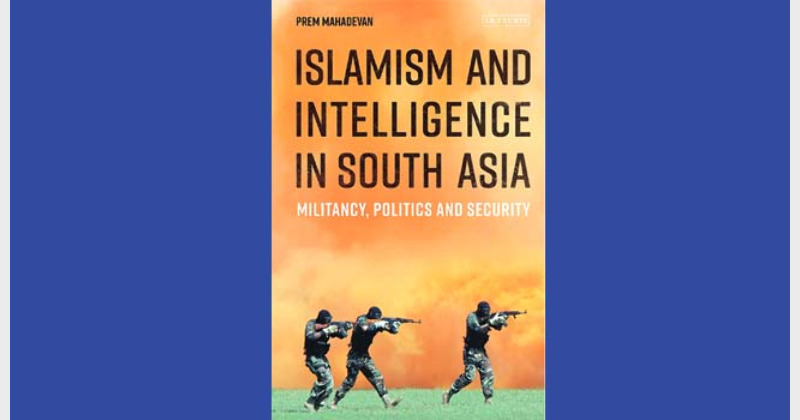
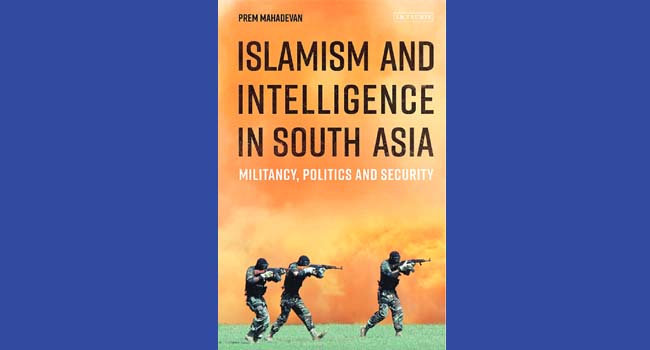
Islamism And Intelligence In South Asia: Militancy, Politics and Security
Author : Prem Mahadevan, Published by I.B. Tauris & Co Ltd, Year of Publication: April 2018 Hardback , Pages: 288
The author demystifies how Islamic terror organisations like Al-Qaeda, the Taliban and others Pak-based terror networks work to destabilise India
Nidhi Bahuguna
Prem Mahadevan is a senior researcher with the Center for Security Studies at the Swiss Federal Institute of Technology in Zurich. The book is fascinating and engrossing, brimming with hitherto unknown facts, giving perspective to known incidents and giving the reader a deep insight into the complex world of Islamism and Pakistan-sponsored terrorism.
The forward, preface and introduction are must read, as they put in context the reason for writing the book. The introduction explains how the book is written, showcasing theoretical models to explain how terrorism works. The graphic showing Statelessness to state capture is chilling, as it explains how terrorist organisations like Al-Qaeda and ISIS work.
Part 1 takes the reader to the history of Jihad. It analyses how Jihad started in 1857, yes! To the uninitiated reader like me, this indeed was an unknown perspective to the war of 1857 and how Jihad was turned into a political weapon, subsequently. The Author explains the rise of Dar-ul Uloom (Deobandi) and Contrasts it with Aligarh Muslim University. He analyses how Dar-ul Uloom believed in Loyalty to nation, while Aligarh Muslim University propagated a Pan Islamic view. This perspective has never been discussed in mainstream and helps the reader to understand rise of Islamism in India. The Author contends “When ‘terrorism’ attempts to masquerade as a popularly supported and religiously sanctioned ‘jihad’, the result is a peculiar hybrid called ‘jihadism’.”
The chapter on Launching of Jamaat-e-Islami in 1941 by Maulana Maududi analyses how Jamaat believed in capturing Institutions as a way to come to power. “To understand JeI and its peculiarly conspiratorial approach to seizing power, one has to understand Bolshevism.” The Chapter on Pan-Islamism opens one’s eyes to the Role of Pakistan as a beacon of pan Islamism. It explains the Pakistanisation of Al Qaeda and role of other Terror organisations and their networks. The Chapter on Sectarianism within Muslim groups is very educative and helps to understand existing Faultlines in Pakistan.
Part 2 of the book deals with how Islamism works from Information Denial, to Information Manipulation. The author explains in detail how terror organisations are set up, how they have different layers-those involved in propaganda and collecting funds, to the inner most layer which plans terror activities. The reader understands how Al Qaeda, Jamaat-ul-dawa, LeT, Lashkar-e-Jhangavi etc work on the principal of deniability while indulging in terror activities.
The present state of affairs in Pakistan is brought out vividly. Karachi presents a frightening picture of various areas captured by various sectarian groups. The role of ISI, the Deep State is brought out chillingly. The relationship between the US and Pakistan is analysed based on past and present incidents. The capture of all institutions by the Deep State, its functioning and modus operandi is well analysed and explained. The helplessness of Pakistan police and the vulnerability of even powerful politicians is brought out very well with incidents and news reports.
The chapter on Information Collection and Information Manipulation is an illuminating read. “jihadism is a multi-generational threat. It relies on historical forces to achieve its aim. Newer generations of militants learn from their predecessors’ tactical and strategic mistakes. If, as with some Pakistani groups, they are backed by a professional intelligence service, they can develop a sophisticated understanding of their operating environment and strike for long-term,”. Prem Mahadevan explains how state support strengthens long term planning of Jehad. The chapter also explains the co-relation between corruption, privatisation of violence and rise of Islamisation.
Islamism in the Indian sub-continent has been understudied by the Western scholars. This is a pity, because pre-1857 India was the third cultural centre of Islam worldwide, after Arabia and Persia
Chapter on Information manipulation is a must read to understand how ISI works. It puts many present incidents in India in perspective. An interesting observation by the author is thought-provoking, “Democracy has been a great enabler for both militant Islamists and the Deep State, by allowing them to hold up ‘public opinion’ as a post-hoc legitimating factor for their transgressions.
Deception over Afghanistan chapter is very relevant in the present context.
Part 3 of the book deals with reflections and conclusions. Under chapter on regional impact, Afghanistan, Bangladesh and India are assessed individually. The author observes “A US official once explained America’s failure to stabilize the AfPak region with a simple aphorism: ‘Pakistan was the real issue, not Afghanistan”. Pashtunistan makes for engrossing reading, as the region is in news for Pashtun protests against Pakistan.
Resurrection of Jamaat-e-Islami and rise of Pan-Islamism in Bangladesh is a very sobering reading. Regarding India, the author has this interesting observation “The accommodative nature of Islamic practice in India forced even political Islam to evolve in keeping with the requirements of democracy and secularism.” The role of SIMI, ISI are very illuminating. In the section “Ripe for Revolt? Or may be a few decades more?” Prem Mahadevan makes very interesting observations.
To conclude, in the Introduction, the author explains why the book was written: “Islamism in the Indian sub-continent has been understudied by Western scholars. This is a pity, because pre-1857 India was the third cultural centre of Islam worldwide, after Arabia and Persia. The modern Pakistani state attempted to inherit this status, by forging a narrative about its own origins lying in a Muslim conquest of India from 711CE onwards. The conquest allegedly continued for a millennium until the death of Mughal Emperor Aurangzeb in 1707 CE….shared connections between Islamists in both these parts of the Muslim world have stronger implications for international security than hitherto recognized”
The Book is extremely well researched, with 65 per cent of references being of Pakistani origin. The book has to be read to understand the underlying politics behind Islamism, the geopolitical significance of Jihad and the present scenario in South Asia.
(The writer is senior research fellow at Asia-Eurasian Human Rights Forum)