Time to Uncover the Hidden Facts
June 6, 2026
  • Read Ecopy
  • Circulation
  • Advertise
  • Careers
  • About Us
  • Contact Us
Android AppiPhone AppArattai
Organiser
  • ‌
  • Bharat
    • Assam
    • Bihar
    • Chhattisgarh
    • Jharkhand
    • Maharashtra
    • View All States
  • World
    • Asia
    • Europe
    • North America
    • South America
    • Africa
    • Australia
  • Editorial
  • International
  • Opinion
  • RSS @ 100
  • More
    • Op Sindoor
    • Analysis
    • Sports
    • Defence
    • Politics
    • Business
    • Economy
    • Culture
    • Special Report
    • Sci & Tech
    • Entertainment
    • G20
    • Azadi Ka Amrit Mahotsav
    • Vocal4Local
    • Web Stories
    • Education
    • Employment
    • Books
    • Interviews
    • Travel
    • Law
    • Health
    • Obituary
  • Subscribe
    • Subscribe Print Edition
    • Subscribe Ecopy
    • Read Ecopy
  • ‌
  • Bharat
    • Assam
    • Bihar
    • Chhattisgarh
    • Jharkhand
    • Maharashtra
    • View All States
  • World
    • Asia
    • Europe
    • North America
    • South America
    • Africa
    • Australia
  • Editorial
  • International
  • Opinion
  • RSS @ 100
  • More
    • Op Sindoor
    • Analysis
    • Sports
    • Defence
    • Politics
    • Business
    • Economy
    • Culture
    • Special Report
    • Sci & Tech
    • Entertainment
    • G20
    • Azadi Ka Amrit Mahotsav
    • Vocal4Local
    • Web Stories
    • Education
    • Employment
    • Books
    • Interviews
    • Travel
    • Law
    • Health
    • Obituary
  • Subscribe
    • Subscribe Print Edition
    • Subscribe Ecopy
    • Read Ecopy
Organiser
  • Home
  • Bharat
  • World
  • Operation Sindoor
  • Editorial
  • Analysis
  • Opinion
  • Culture
  • Defence
  • International Edition
  • RSS @ 100
  • Magazine
  • Read Ecopy
Home Bharat

Time to Uncover the Hidden Facts

Research into the 1857 War of Independence has revealed some startling facts most of which were unknown until recently. It also questions the death of Tatya Tope and Rani Lakshmibai. Prof. Kapil Kumar is a renowned thinker and historian. He is presently Professor at IGNOU. His research into the 1857 War of Independence against the British has revealed some startling facts most of which were unknown until recently. The role of common women of the country in this war has seldom been narrated except for the h

Archive ManagerArchive Manager
May 22, 2019, 02:05 pm IST
in Bharat
Follow on Google News
FacebookTwitterWhatsAppTelegramEmail
Research into the 1857 War of Independence has revealed some startling facts most of which were unknown until recently. It also questions the death of Tatya Tope and Rani Lakshmibai
Prof Kapil Kumar is a renowned thinker and historian. He is presently Professor at IGNOU. His research into the 1857 War of Independence against the British has revealed some startling facts most of which were unknown until recently. The role of common women of the country in this war has seldom been narrated except for the heroism of Queens like Rani Lakshmibai or Kittur Chennamma. Prof. Kumar’s research also questions the narrative regarding the death of Tatya Tope and Rani Lakshmibai. Similarly, many such facts have been presented here with a view to educate the reader and make them think about what we have been taught hitherto on the 1857 War of Independence.
From 1770 to 1857 there were 235 revolts against the British which culminated in the 1857 war for Independence.
 
The origin of Vande Mataram can be traced to Bengal’s Sanyasi Andolan of 1770. It was during the Sanyasi Andolan that more than 150 Hindu Sanyasis were gunned down by the British troops. Mohan Giri, Devi Choudhrani, Dheeraj Narayan along with farmers, saints and fakirs united and opposed the British hegemony. The British took nearly 30 years to curb their protests. The foundation of Indian nationalism was laid in this Andolan. Before 1857, farmers, local tribals and the common man fought against the atrocities of the British.
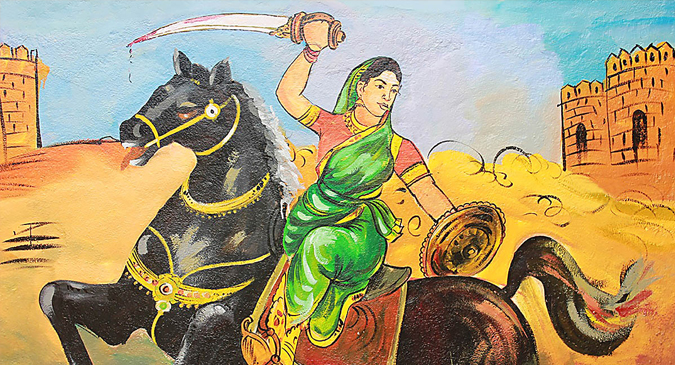
 
 
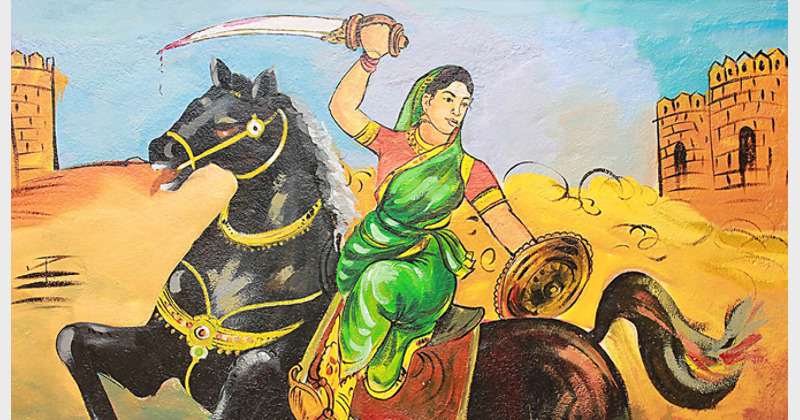
Kithuru Rani Chennamma 
 
The heroic woman of India played a major role. During the period of the war, 50 women were hanged to death. The trees on which they were hanged are worshipped even today in Baghpat village. There are many instances during the 1857 war and after, where women fought and defeated the British troops showcasing their valour. Prominent examples we come across are of Jhalkari Bai and Motibai who safeguarded Rani Lakshmibai. They formed an army of women and used to pour hot oil from the pots on the British troops from the terraces. They also cared for and protected the queen. We have many instances of such valour of our womenfolk from Muzaffarnagar, Shamli and Meerut. A prominent fact in these women-led revolts was that women from the various denominations fought the British unitedly. Gujjars, Jats, Brahmins, dalits, as well as Muslim women, were part of the revolt.
 
There are records of instances where after the men left for Delhi after fighting in Meerut, women of the household took over the reins of the battle. It is in this context we recall Avantibai’s name. Then there are instances where women worked as informers, where women from Madhya Pradesh used to go to the British camp and while dancing used to pass on information to the Indian soldiers in the form of a chit.


Lotus, roti and letters were circulated throughout the country in an organised way. British authorities themselves have written how in one night things were circulated for 200 to 300 miles. At that time the watchmen played a very vital role as they did not open their mouths to what is the meaning behind circulating the lotus, rotis and the barks of the tree. They were circulated to every nook and corner of the country in a very planned manner right from Peshawar to Belgaum and from Dimapur to Shivsagar, Panchmahal and Sholapur.
There are records of instances where after the men left for Delhi after fighting in Meerut, women of the household took over the reins of the battle. It is in this context we recall Avantibai’s nameA new work on Tatya Tope by Parag Tope who is from the family of Tatya Tope narrates the meaning being the circulation of lotus, rotis and barks of the trees. The meaning is as follows: 
 
If a red lotus had 25-30 petals in it, it meant that there were only about 25-30 soldiers in the British platoon and the message to our soldiers was to revolt.
 
The Roti conveyed the message that in the coming days there might be an acute shortage of food and hence the present supplies may have to be rationed. Hence the Indian soldiers did not face difficulty in managing their supplies through the war.
 
Peels of the tree barks were meant to motivate our soldiers by conveying to them that just as the tree dies if the roots are eaten away, we too have to fight against the British who were eating the roots of our country.
The letters that were circulated from Peshawar to Bengal were in a secret coded form. It was in this coded letter that Nanasaheb had written to the king of Jammu asking for help in the 1857 war to which he agreed. This shows that everything was very well planned and executed.
 
There was not even a single thesis on the 1857 War of Independence that came out of the history departments of JNU, Aligarh Muslim University or Hyderabad Universities. Ironically, these are considered as the hub of historical research. One or two theses came from Delhi University only after the government announced that this was indeed a war of Independence.
 
Prof Kumar says that when he was constituting a panel for Tatya Tope’s museum, he came across the fact that it was on January 1, 1859 that Tatya Tope passed away. The cremation was done on January 6. Then I came across a report which says on 6th April he was arrested from the forests and within the month of June, he was hanged to death after a court case in Shivpuri. But in 1864 a letter was found in which the District Magistrate states that he has gathered 40,000 troops and will be going to find the real Tatya Tope.
 
“Based on these findings, I wish to raise a question—Did Rani Lakshmibai die in Gwalior as told to us? We know that the British came to know about the Rani’s death only after seven days and nearly 782 Sanyasis gave up their lives while protecting Rani Lakshmibai. The Sanyasis had told that the Rani was injured and they sent her to Nana Saheb to recuperate. The one who actually succumbed while fighting was Jhalkari Bai whose cremation was done and they told the Britishers that it was Rani Laxmibai who is dead only to save her. The remains of Jhalkari Bai was shown to the British and that too after a week as that of Rani Lakshmibai. This revelation shows that the remains showed to the British were not of Rani of Jhansi and she did not die while fighting. This calls for further research to find out the truth,” Prof Kumar says.
 
Likewise, there are several such instances in our history which have not come into the light and the interested students should come forward to do further research on this. 

ShareTweetSendShareSend
✮ Subscribe Organiser YouTube Channel. ✮
✮ Join Organiser's WhatsApp channel for Nationalist views beyond the news. ✮
Previous News

Opposition crying over EVMs is a sure case of sour grapes

Next News

RSS stands with Cyclone-hit Odisha

Related News

Inspired by Bhagwan Shiva's teachings, this ancient breathing practice helps calm the mind and reduce stress

Ancient Yogic Breathing for Modern Stress: How the Shiva method cultivates peace & self-awareness

The Vedic age saw remarkable women sages, known as Rishikas, who composed hymns and shaped India's spiritual and philosophical heritage

Rishikas of Vedic Age: How Gargi, Maitreyi & other women shaped ancient India’s spiritual and philosophical tradition

Police in AAP-Ruled state of Punjab lathi charge sit-in protesters

Punjab: ITI candidates seeking jobs lathi-charged outside PSPCL HQ; opposition slams AAP Govt over police action

From constables to DGP, India's police system follows a structured chain of command that governs law enforcement across the country

From Constable to DGP: Understanding India’s police hierarchy, powers & recruitment system

The terracotta dice that challenges historical assumptions and highlights India's millennia-old civilisational heritage

How a 4,500-year-old terracotta dice is reviving the debate on India’s civilisational continuity & Vedic heritage

The Porumamilla inscription and the ancient science behind a reservoir that survived 650 years

India’s 655-Year-Old Water Policy: The Porumamilla inscription that turned stone into a manual of hydrology

Load More

Latest News

Inspired by Bhagwan Shiva's teachings, this ancient breathing practice helps calm the mind and reduce stress

Ancient Yogic Breathing for Modern Stress: How the Shiva method cultivates peace & self-awareness

The Vedic age saw remarkable women sages, known as Rishikas, who composed hymns and shaped India's spiritual and philosophical heritage

Rishikas of Vedic Age: How Gargi, Maitreyi & other women shaped ancient India’s spiritual and philosophical tradition

Police in AAP-Ruled state of Punjab lathi charge sit-in protesters

Punjab: ITI candidates seeking jobs lathi-charged outside PSPCL HQ; opposition slams AAP Govt over police action

From constables to DGP, India's police system follows a structured chain of command that governs law enforcement across the country

From Constable to DGP: Understanding India’s police hierarchy, powers & recruitment system

The terracotta dice that challenges historical assumptions and highlights India's millennia-old civilisational heritage

How a 4,500-year-old terracotta dice is reviving the debate on India’s civilisational continuity & Vedic heritage

The Porumamilla inscription and the ancient science behind a reservoir that survived 650 years

India’s 655-Year-Old Water Policy: The Porumamilla inscription that turned stone into a manual of hydrology

India’s Permanent Representative to the United Nations Ambassador Harish Parvathaneni

India slams Pakistan at UNSC for peddling false narratives on Jammu & Kashmir

Keralam: Pathanamthitta temple property occupied beyond lease period reclaimed by devotees

A series of high-level engagements signals New Delhi's growing focus on building interoperable security networks across the Indo-Pacific

India strengthens Indo-Pacific security architecture with new defence and maritime partnerships

Prime Minister Narendra Modi

“Makes every Indian proud”: PM Modi hails India’s 7.7 per cent GDP growth in FY 2025-26

Load More
  • Privacy
  • Terms
  • Cookie Policy
  • Refund and Cancellation
  • Delivery and Shipping

© Bharat Prakashan (Delhi) Limited.
Tech-enabled by Ananthapuri Technologies

  • Home
  • Search Organiser
  • Bharat
    • Assam
    • Bihar
    • Chhattisgarh
    • Jharkhand
    • Maharashtra
    • View All States
  • World
    • Asia
    • Africa
    • North America
    • South America
    • Europe
    • Australia
  • Editorial
  • Operation Sindoor
  • Opinion
  • Analysis
  • Defence
  • Culture
  • Sports
  • Business
  • RSS @ 100
  • Entertainment
  • More ..
    • Sci & Tech
    • Vocal4Local
    • Special Report
    • Education
    • Employment
    • Books
    • Interviews
    • Travel
    • Health
    • Politics
    • Law
    • Economy
    • Obituary
  • Subscribe Magazine
  • Read Ecopy
  • Advertise
  • Circulation
  • Careers
  • About Us
  • Contact Us
  • Policies & Terms
    • Privacy Policy
    • Cookie Policy
    • Refund and Cancellation
    • Terms of Use

© Bharat Prakashan (Delhi) Limited.
Tech-enabled by Ananthapuri Technologies