Records of historical supernova found in Karnataka
August 16, 2026
  • Read Ecopy
  • Circulation
  • Advertise
  • Careers
  • About Us
  • Contact Us
Android AppiPhone AppArattai
Organiser
  • ‌
  • Bharat
    • Assam
    • Bihar
    • Chhattisgarh
    • Jharkhand
    • Maharashtra
    • View All States
  • World
    • Asia
    • Europe
    • North America
    • South America
    • Africa
    • Australia
  • Editorial
  • International
  • Opinion
  • RSS @ 100
  • More
    • Op Sindoor
    • Analysis
    • Sports
    • Defence
    • Politics
    • Business
    • Economy
    • Culture
    • Special Report
    • Sci & Tech
    • Entertainment
    • G20
    • Azadi Ka Amrit Mahotsav
    • Vocal4Local
    • Web Stories
    • Education
    • Employment
    • Books
    • Interviews
    • Travel
    • Law
    • Health
    • Obituary
  • Subscribe
    • Subscribe Print Edition
    • Subscribe Ecopy
    • Read Ecopy
  • ‌
  • Bharat
    • Assam
    • Bihar
    • Chhattisgarh
    • Jharkhand
    • Maharashtra
    • View All States
  • World
    • Asia
    • Europe
    • North America
    • South America
    • Africa
    • Australia
  • Editorial
  • International
  • Opinion
  • RSS @ 100
  • More
    • Op Sindoor
    • Analysis
    • Sports
    • Defence
    • Politics
    • Business
    • Economy
    • Culture
    • Special Report
    • Sci & Tech
    • Entertainment
    • G20
    • Azadi Ka Amrit Mahotsav
    • Vocal4Local
    • Web Stories
    • Education
    • Employment
    • Books
    • Interviews
    • Travel
    • Law
    • Health
    • Obituary
  • Subscribe
    • Subscribe Print Edition
    • Subscribe Ecopy
    • Read Ecopy
Organiser
  • Home
  • Bharat
  • World
  • Operation Sindoor
  • Editorial
  • Analysis
  • Opinion
  • Culture
  • Defence
  • International Edition
  • RSS @ 100
  • Magazine
  • Read Ecopy
Home Bharat

Records of historical supernova found in Karnataka

The inscription describes sage Charukeerthi Bhattacharya, who was instrumental in the installation of the statue as ?like a nishapathi in the Ksheerambudhi

Archive ManagerArchive Manager
Mar 22, 2019, 06:03 pm IST
inBharat
Follow on Google News
Facebook
Twitter
WhatsAppTelegramEmail
 
 
The inscription describes sage Charukeerthi Bhattacharya, who was instrumental in the installation of the statue as “like a nishapathi in the Ksheerambudhi
 
Dr B S Shylaja
 
Bangalore, March 22 (India Science Wire): Imagine walking at dusk under a blue sky that is gradually turning black. Twinkling stars are beginning to appear here and there. And suddenly you discover new star dazzling that was not there the previous night. Could it be Venus or perhaps a comet?
 
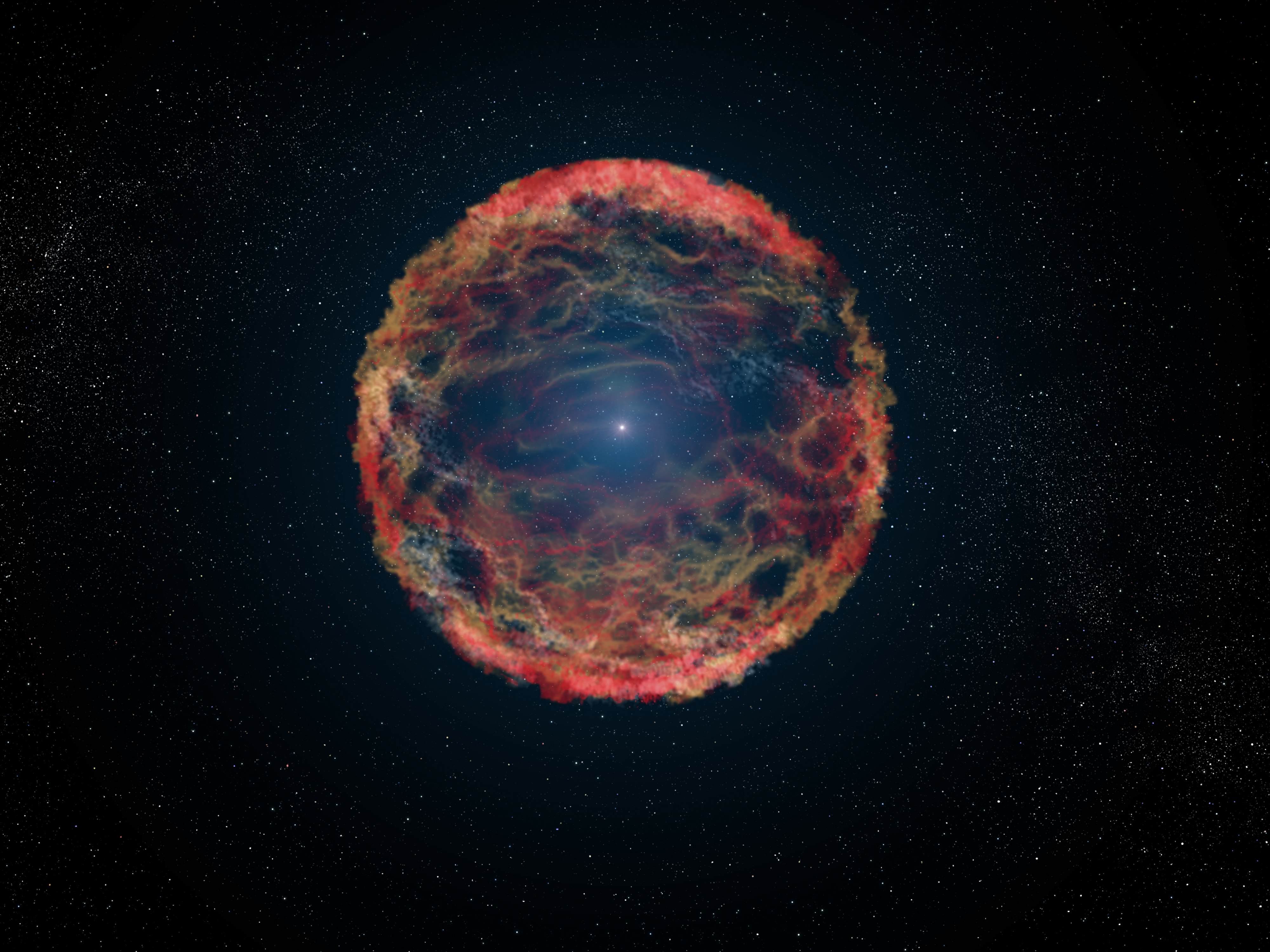
That is what Tycho Brahe, Danish astronomer and writer, thought when he saw a new star in the sky on 11 November, 1572. He coined the term ‘nova’ meaning a new star. Another nova appeared 12 years later. This time it was seen by LodovicodelleColombe, an Italian scholar. The new star had appeared amidst the celestial river `Milky Way’ in the constellation of Ophiuchus.
 
The two novae remained visible to the naked eye for more than a year and opened up a debate questioning the Aristotelian concept of stars that they are eternal with no death or birth. Many astronomers recorded the position of these novae which are now technically christened as supernovae.
 
Such events are indeed very rare. An earlier event happened in July 1054 and was chronicled by Chinese observers as a ‘guest star’. Astrophysicists have linked the event to the famous Crab Nebula, thanks to Chinese astronomers who recorded the date and the position of the `guest star’. The expanding nebula was noted nearly 700 years later, in 1731, and got the first entry into the famous list of Messier.
 
It has always been a big puzzle for historians as to why these events have not been recorded in India even thoughit has had distinguished accomplishments in astronomy and mathematics. Many texts and documents in these areas date back to 5th – 6th century CE. Astrophysicist Prof Jayant V. Narlikar and Sanskrit and Prakrit scholar Prof SarojaBhate had studied these texts but could not find any references to the sighting of novae.
 
In recent years, however, some evidence has emerged in the form of stone inscriptions. A tradition of penning edicts on stones is widespread all over South and South East Asia. The language used in these inscriptions, which date back to the first millennium, was Sanskrit, rendering it easy to decode the meanings. The inscriptions are rich in astronomical details such as eclipses and planetary conjunctions.
 
An inscription in Cambodia describing the installation of a Shivalinga by an ascetic is relevant here. One of the adjectives used to describe Lord Shiva is “Shukrataara Prabhaavaaya”, which translates as one who can create (or influence) a star as bright as Venus. The literal meaning of word Shukra is `very bright’ and is generally used for Venus. Clearly, the inscription is describing a star as bright as Venus and attributes its appearance for praising the God. It indicates that the supernova was indeed observed around the time it was written.
 
There is another stone inscription, which talks about the installation of a Baahubali statue in the Venuru town in Karnataka, which was once a seat of Jainism and capital of the Ajila Dynasty. The inscription is written in Kannada script, though the language is Sanskrit. The information regarding the date is complete with year, month and day. The inscription refers to the supernova of 1604.
 
The inscription describes sage Charukeerthi Bhattacharya, who was instrumental in the installation of the statue as “like a nishapathi in the Ksheerambudhi”. The word nishapathiis generally used for moon. However it has another meaning: camphor. Ksheerambudhi is interpreted as implying Belagola (which means ‘white lake’ in Kannada) town in Karnataka while it can also mean Akashaganga or the Milky Way. Itprobably signifies something burning like camphor in the Milky Way. The 1604 supernova was indeed in constellation Sagittarius, which is part of the Milky Way.
 
There is yet another record of the 1604 supernova in astrolabes, which are small handy metallic gadgets that served as portable calculators for navigation. Its specially designed rotatable star dial called rete has small pointers corresponding to bright stars. These instruments were introduced in India around 13th century by Arabs. The construction of the rete needed an astronomer well versed with the sky.
 
Historian Prof. S R Sarma has studied astrolabes available in museums all over the world and has prepared an exhaustive catalogue. One particular astrolabe is dated 25th December 1605. It has a star by name Dhanusharagra to the South of another star called Dhanukoti. While Dhanukoti is found in almost all astrolabes (and is identified with a bright star called α Oph, Arabic name Rasalhague), Dhanusharagra is exclusive to this astrolabe and its position matches with that of the 1604 supernova. Thus we find that 1604 supernova has found its place in two records.
 
A record of the 1572 supernova, which occurred in the northern branch of the Milky Way in the constellation of Cassiopeia, has also been found in a book of Sanskrit grammar of the 16th Century. AppayaDikshita (1520-1593) was well-knownexpositor and practitioner of Advaita vedanta school of philosophy and his books on alankaras(simile and metaphor) are used as text books.
 
His work ‘Kuvalyananda’ has an example for what is termed as Apahnuti, which means using a denial character for describing a thing/event. There are two verses. The first verse is: “what is that inVyomaganga? It is a lotus. Not the moon.” This is followed by: “It is not the moon because it is quite bright; not the sun because it is night; it is the internal fire in the water/ocean”.
 
In both verses the word Vyomaganga refers to the Heavenly River Akashganga. The description matches with the sighting of supernova. Thus, we notice that supernova attracted the interest of non-astronomers too.
 
It may be worth searching such records in the literary works of other Indian languages. From all this, it is clear that criticism of western scholars that great celestial events of supernovae had gone unnoticed in India in totally unfounded. (India Science Wire)
 
[The writer is former director of the Jawaharlal Nehru Planetarium, Bangalore]

Share
Tweet
SendShareSend
✮ Subscribe Organiser YouTube Channel. ✮
✮ Join Organiser's WhatsApp channel for Nationalist views beyond the news. ✮
Previous News

From maternity leave to LPG connections: How Narendra Modi made women partners in the new India story

Next News

450 School Service Commission Candidates on Indefinite Hunger Strike in West Bengal

Related News

UGC NET Opens Portal to Challenege the Provisional Answer keys

UGC NET June 2026 answer key released by NTA; Know how to check, raise objections, result date and more

Grain now available 24x7 in Chhattisgarh with ‘Annapurti Grain ATMs’

From Ration Queues to Digital Convenience: Grain now available 24×7 in Chhattisgarh with ‘Annapurti Grain ATMs’

Kuki Militants kill Naga Farmer in Manipur

Manipur: Suspected Kuki militant attack on Naga farmers working on paddy field; One killed, 3 sustained injuries

The Modi government wiped out impossible left-wing Maoism, but urban maoists persist

How Narendra Modi’s government dismantled red terrorism while the challenge of urban Maoism continues to loom

Onam is Kerala’s harvest festival, celebrated in the Malayalam month of Chingam

Onam 2026: History, Hindu heritage, traditions and cultural significance of Kerala’s harvest festival

Remembering Atal Behari Vajpayee on his death anniversary

Death Anniversary of Atal Behari Vajpayee: Remembering a legacy of humility, patriotism and statesmanship

Load More

Latest News

UGC NET Opens Portal to Challenege the Provisional Answer keys

UGC NET June 2026 answer key released by NTA; Know how to check, raise objections, result date and more

Grain now available 24x7 in Chhattisgarh with ‘Annapurti Grain ATMs’

From Ration Queues to Digital Convenience: Grain now available 24×7 in Chhattisgarh with ‘Annapurti Grain ATMs’

Kuki Militants kill Naga Farmer in Manipur

Manipur: Suspected Kuki militant attack on Naga farmers working on paddy field; One killed, 3 sustained injuries

The Modi government wiped out impossible left-wing Maoism, but urban maoists persist

How Narendra Modi’s government dismantled red terrorism while the challenge of urban Maoism continues to loom

Onam is Kerala’s harvest festival, celebrated in the Malayalam month of Chingam

Onam 2026: History, Hindu heritage, traditions and cultural significance of Kerala’s harvest festival

Remembering Atal Behari Vajpayee on his death anniversary

Death Anniversary of Atal Behari Vajpayee: Remembering a legacy of humility, patriotism and statesmanship

J-K’s Doda Unfurls 100-Ft Tricolour on Independence Day

J&K: 100-Ft Tiranga soars high at Doda stadium on Independence Day

Muslim League anchored planned atrocities against Hindus on Direct Action Day in Calcutta

Decoding the horrors of Direct Action Day; Revisiting the forgotten lessons from the streets of Calcutta

Punjab: NHRC member Priyank Kanoongo flags no I-Day Celebrations at schools near India-Pak border; questions AAP Govt

Great Calcutta Killings 1946

Great Calcutta Killings in August 1946: Urban pogrom and the teleology of partition in colonial Bengal and India

Load More
  • Privacy
  • Terms
  • Cookie Policy
  • Refund and Cancellation
  • Delivery and Shipping

© Bharat Prakashan (Delhi) Limited.
Tech-enabled by Ananthapuri Technologies

  • Home
  • Search Organiser
  • Bharat
    • Assam
    • Bihar
    • Chhattisgarh
    • Jharkhand
    • Maharashtra
    • View All States
  • World
    • Asia
    • Africa
    • North America
    • South America
    • Europe
    • Australia
  • Editorial
  • Operation Sindoor
  • Opinion
  • Analysis
  • Defence
  • Culture
  • Sports
  • Business
  • RSS @ 100
  • Entertainment
  • More ..
    • Sci & Tech
    • Vocal4Local
    • Special Report
    • Education
    • Employment
    • Books
    • Interviews
    • Travel
    • Health
    • Politics
    • Law
    • Economy
    • Obituary
  • Subscribe Magazine
  • Read Ecopy
  • Advertise
  • Circulation
  • Careers
  • About Us
  • Contact Us
  • Policies & Terms
    • Privacy Policy
    • Cookie Policy
    • Refund and Cancellation
    • Terms of Use

© Bharat Prakashan (Delhi) Limited.
Tech-enabled by Ananthapuri Technologies