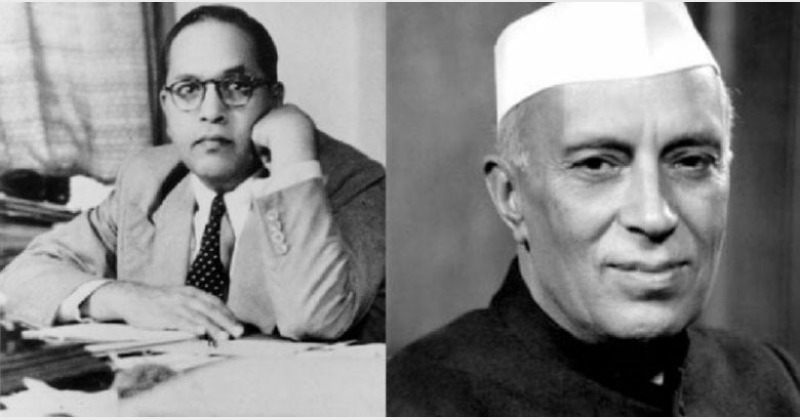
How Nehru and Congress prevented Dr B R Ambedkar from giving his best for the country
Jawaharlal Nehru had a deep contempt for intellectual superiority and those who had a different ‘Idea of India’ than his. Nehru tried hard to push Bhimrao Ramji Ambedkar into twilight of history, but Ambedkar bounced back because Bharat needed him more, and not Nehru. We contextualise five reasons, which are five points about different ‘idea of India’ which made Nehru loathe Babasaheb.
1. Nehru was a Casteist
For Nehru, Ambedkar was not at all a key player in the contemporary politics of the freedom struggle. As late as 1942-45, when Nehru completed him The Discovery of India, he didn’t find it crucial to mention Ambedkar even once. Flip through the pages of the index in the book, and one doesn’t find a single entry for Ambedkar. If a key leader like Nehru doesn’t engage with Ambedkar during the freedom struggle, it simply means that for Nehru, caste and social dimensions was not an issue at all.
It is strange that how someone like Nehru who presented himself as a true democrat never found it important to have a single dialogue with Ambedkar, who was the most accepted leader of SCs, and more people. Why do we only read about the dialogues and disagreements between Ambedkar and Gandhi, and not of Ambedkar and Nehru? The simple reason which can be placed into historical complexities is this. Nehru was afraid of intellectual superiority, and therefore, he never engaged those, who he felt could belittle his presence. Ambedkar was intellectually superior to Nehru, he had a better understanding of the Indian society and scenario, and thus he was always neglected by Nehru.
2. On Muslim Question
Babasaheb Ambedkar and the Congress leaders like Nehru had serious differences over the modalities of the partition of the country. In his book, “Pakistan or the partition of India”, Dr Ambedkar wrote that the partition without exchange of population would not solve the Hindu-Muslim problem in the country.
He also doubted whether Muslims could make suitable compatriots in democratic governance. He stated that “Islam is a system of social self-government and is incompatible with local self-government because the allegiance of a Muslim does not rest on his domicile in the country which is his but on the faith to which he belongs. To the Muslim ibi bene ibi patria [Where it is well with me, there is my country] is unthinkable. Wherever there is the rule of Islam, there is his own country.” (Ibid. p.330) Remarkably, this observation also explains the tendency of Muslims to vote as a block. They cannot think outside their religious bracket, and therefore, they have failed to represent themselves democratically in the contemporary history of Bharat.
Dr Ambedkar, in his lifetime, could see that Muslims could only be represented through the Mullah and those parties like, Congress which provide patronage to the inward-looking medievalist clerics. He has categorically stated that “The Muslims have no interest in politics as such. Their predominant interest is in religion … Muslim politics is essentially clerical and recognises only one difference, namely, that existing between Hindus and Muslims. None of the secular categories of life has any place in the politics of the Muslim community and if they do find a place – and they must because they are irrepressible – they are subordinated to one and the only one governing principle of the Muslim political universe, namely, religion.” (Ibid. p. 232)
3. Negligence of Merit
Babasaheb realised that Nehru was only interested in nepotism and not promoting and utilising the merit of men. Even though Babasaheb was considerate in joining the Nehru’s cabinet on Gandhiji’s request, he couldn’t stay there for long. In his resignation letter dated September 27, 1951, Ambedkar revealed two other issues with Nehru.
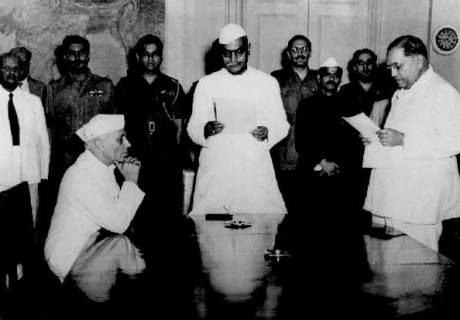 Dr Ambedkar being sworn in as the Minister of Law in Nehru’s cabinet
First was of personal nature in the sense that Nehru never trusted him and scrupulously avoided giving him important portfolios, even though “Many Ministers have been given two or three portfolios so that they have been overburdened….I was not even appointed to be a member of main Committees of the Cabinet such as the Foreign Affairs Committee, or the Defence Committee. When the Economics Affairs Committee was formed, I expected, given the fact that I was primarily a student of Economics and Finance, to be appointed to this Committee. But I was left out.”
4. Ambedkar was disillusioned by Nehru’s Foreign Policy
In the same resignation letter, Ambedkar also wrote that he was thoroughly disillusioned with Nehru’s foreign policy. “On 15th of August, 1947 when we began our life as an independent country, there was no country which wished us ill. Every country in the world was our friend. Today, after four years, all our friends have deserted us. We have no friends left. We have alienated ourselves. We are pursuing a lonely furrow with no one even to second our resolutions in the U.N.O (United Nations). When I think of our foreign policy, I am reminded of what Bismarck and Bernard Shaw have said. Bismarck has said that ‘politics is not a game of realising the ideal. Politics is the game of the possible.’ Bernard Shaw not very long ago said that good ideas are good, but one must not forget that it is often dangerous to be too good. Our foreign policy is in complete opposition to these words of wisdom uttered by two of the world’s greatest men.”
5. Nehru was against the democratic Ambedkar
Dhananjay Keer, one of the Ambedkar’s earliest biographers, showed that Ambedkar was included in the cabinet through the collective efforts of Sardar Patel, SK Patil and Acharya Donde.
But in 1952, Nehru made sure Ambedkar lost elections and kept him out of his cabinet. Kajrolkar who won elections against Ambedkar later confided to President Rajendra Prasad that Ambedkar lost the election because he did not get the Socialists’ support. Ambedkar was subsequently elected to the Rajya Sabha in 1952. But he was defeated in his second attempt to enter the Lok Sabha through a 1954 by-election from Bhandara constituency. It was very sure that Nehru wanted to keep Ambedkar away since he could not digest the fact of his growth in India.