The Inhuman Neglect
September 12, 2026
  • Read Ecopy
  • Circulation
  • Advertise
  • Careers
  • About Us
  • Contact Us
Android AppiPhone AppArattai
Organiser
  • ‌
  • Bharat
    • Assam
    • Bihar
    • Chhattisgarh
    • Jharkhand
    • Maharashtra
    • View All States
  • World
    • Asia
    • Europe
    • North America
    • South America
    • Africa
    • Australia
  • Editorial
  • International
  • Opinion
  • RSS @ 100
  • More
    • World Hindu Congress 2026
    • Op Sindoor
    • Analysis
    • Sports
    • Defence
    • Politics
    • Business
    • Economy
    • Culture
    • Special Report
    • Sci & Tech
    • Entertainment
    • G20
    • Azadi Ka Amrit Mahotsav
    • Vocal4Local
    • Web Stories
    • Education
    • Employment
    • Books
    • Interviews
    • Travel
    • Law
    • Health
    • Obituary
  • Subscribe
    • Subscribe Print Edition
    • Subscribe Ecopy
    • Read Ecopy
  • ‌
  • Bharat
    • Assam
    • Bihar
    • Chhattisgarh
    • Jharkhand
    • Maharashtra
    • View All States
  • World
    • Asia
    • Europe
    • North America
    • South America
    • Africa
    • Australia
  • Editorial
  • International
  • Opinion
  • RSS @ 100
  • More
    • World Hindu Congress 2026
    • Op Sindoor
    • Analysis
    • Sports
    • Defence
    • Politics
    • Business
    • Economy
    • Culture
    • Special Report
    • Sci & Tech
    • Entertainment
    • G20
    • Azadi Ka Amrit Mahotsav
    • Vocal4Local
    • Web Stories
    • Education
    • Employment
    • Books
    • Interviews
    • Travel
    • Law
    • Health
    • Obituary
  • Subscribe
    • Subscribe Print Edition
    • Subscribe Ecopy
    • Read Ecopy
Organiser
  • Home
  • Bharat
  • World
  • Operation Sindoor
  • Editorial
  • Analysis
  • Opinion
  • Culture
  • Defence
  • International Edition
  • RSS @ 100
  • Magazine
  • Read Ecopy
Home Bharat

The Inhuman Neglect

The book under review is a new study on Gilgit-Baltistan which successfully attempts to lift the veil of ignorance for the popular readers relating to this sensitive geo-political issue  Alok Bansal, Gilgit-Baltistan and its saga of Unending Human Rights Violations{New Delhi: Pentagon Press LLP for Asian Eurasian Human Rights Forum (AEHRF), 2018}pp. 291, Price: ₹ 795.‘Ignorance of facts is a curse that Nation and its people will pay for heavily in terms of security, strategy and overal

Archive ManagerArchive Manager
Oct 22, 2018, 03:12 pm IST
inBharat
Follow on Google News
Facebook
Twitter
WhatsAppTelegramEmail
The book under review is a new study on Gilgit-Baltistan which successfully attempts to lift the veil of ignorance for the popular readers relating to this sensitive geo-political issue
– Nidhi Bahuguna 
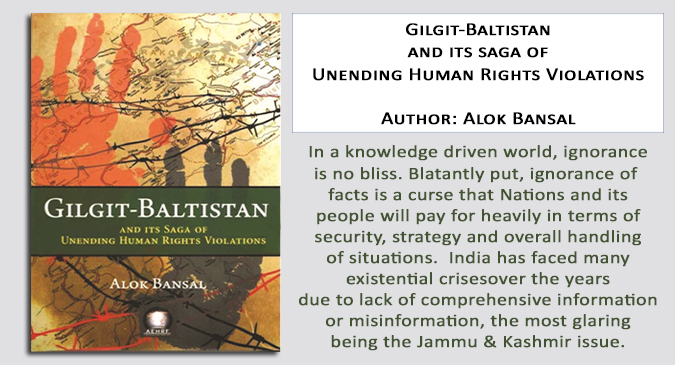
 
 Alok Bansal, Gilgit-Baltistan and its saga of Unending Human Rights Violations

{New Delhi: Pentagon Press LLP for Asian Eurasian Human Rights Forum (AEHRF), 2018}
pp. 291, Price: ₹ 795.
 
‘Ignorance of facts is a curse that Nation and its people will pay for heavily in terms of security, strategy and overall handling of situations’ says the author and the book aims to clear the all-pervasive ignorance about Gilgit-Baltistan, the most significant part of Pakistan occupied Jammu and Kashmir (PoJK). The Book attempts to lift the veil of ignorance of the common man and succeeds in doing so.
 
The author establishes ancient cultural and historical linkages of the region with rest of the country, especially other parts of Jammu and Kashmir quite conclusively, backed with archeological and documentary proofs. The reader is transported to the era of ancient trade routes when the region was the centre of a thriving Bharat. Archeological monuments establish firmly the Hindu and Buddhist past of this part of India occupied by Pakistan. One question that comes readily to mind is—Why were we never taught this in our schools and colleges?
 
The Chapters on Geography and the Ethnic Inhabitants are fascinating full of in-depth research that shows in great detail the unique geographical features and the fascinating tribes of this region. Ethnic and linguistic diversities of the inhabitants open our eyes to all that India has lost by the occupation of Gilgit-Baltistan by Pakistan. Cultural and genetic links of various tribes to Ladakh and other regions of Jammu and Kashmir have painstakingly been established and made for interesting reading.
 
Events leading up to independence, subsequent invasion by Pakistan army under the guise of tribal raid, accession of J&K to India and the occupation of Gilgit-Baltistan by Pakistan, have been explained very well, backed up by deep research and legal documents. The chapter on Jammu & Kashmir’s accession to India is very succinctly written and should be in school text books and college reference books. Numerous fake narratives that are in vogue regarding the accession and the status of Gilgit-Baltistan are successfully demolished in the book. The truth that Gilgit-Baltistan was an integral part of Jammu and Kashmir and thus of India has been firmly established. All the lies of Pakistan claiming that Gilgit was never under Maharaja Hari Singh have also been countered effectively.
Gilgit Baltistan has been under Pakistani Control for over seven decades. The State of its residents, who are constitutionally Indian citizens is extremely distressing. The book explains and contextualises the extreme Human Rights violations perpetuated by the Pakistani State. Alok Bansal firmly establishes the legal status of Gilgit-Baltistan as part of India, not Pakistan and documents the nefarious designs of Pakistan in trying to merge the occupied areas. The impact of Karakoram Highway on the deteriorating condition of the ethnic inhabitants has been explained well, as also the impact of the upcoming China Pakistan Economic Corridor (CPEC).
 
The ‘hapless’ citizens of Gilgit-Baltistan have been deprived of basic rights and have no say in their own governance. The removal of State Subject Rule, which had been promulgated by Maharaja Hari Singh to maintain the unique character of the State, has led to huge migration of outsiders to the region threatening the unique demographic composition of this remote region. Archaic, British era Frontier Crimes Regulation (FCR), that prescribed collective punishments and mandated every resident to report to the local police station monthly and restricted free movement was retained in Gilgit-Baltistan.
 
Sectarian violence is at its peak, the book delves deep into the reasons for the present state of sectarian violence. The attempts by President Zia ul Haq to introduce Sunni Deobandi Islam in a region inhabited predominantly by Shia Muslims, have been enumerated and its impact on the social, cultural and political paradigm is assessed and analysed.
 
Researched All-Round
The book is well researched and well referenced. A number of colour photographs add to the value of the book and show the enormous scenic beauty and pre-Islamic legacy of this exotic region. Maps supplement the information content of the book. It is a treasure trove for researchers and human rights students with large number of pages dedicated to references and Appendices including the gem like the petition of Gilgit Scouts to the erstwhile Maharaja of Jammu and Kashmir. However, to a casual reader some of these huge appendices may seem to be a drag.
To conclude, human rights violations are continuing unchecked in a part of India occupied by Pakistan. There has been a conspiracy of silence by the Indian establishment and media which has put a veil around this whole region. This region has been a blind spot in our national discourse for decades until PM Modi mentioned the region in his August 15, 2015 speech. The book answers all the questions raised in the mind of Indians about the region after that historical speech. The book is a must have for libraries and students, as a reference material for countering international lies on Gilgit Baltistan.
 
(The writer is a social media activist working with Jammu Kashmir Study Centre)

Share
Tweet
SendShareSend
✮ Subscribe Organiser YouTube Channel. ✮
✮ Join Organiser's WhatsApp channel for Nationalist views beyond the news. ✮
Previous News

Readers Forum

Next News

RSS Pathsanchalan in Imphal and Kishtwar

Related News

The Quiet Part of BRICS 2026: “The Plumbing, Not the Currency” — What You Need to Know About the BRICS Currency (AI generated image)

The Quiet Part of BRICS 2026: “The Plumbing, Not the Currency” — What You Need to Know About the BRICS Currency

AI Generated Representative Image

BRICS Summit 2026 | Bajra, Ragi & Rajma: Food served to leaders reflect India’s millets, spices & culinary heritage

Andhra Pradesh: Sadiq Khan admits cyanide killing of Sowjanya’s husband; property motive eclipses Islam conversion

BRICS Summit 2026: New Delhi Declaration to be issued today; India seals diplomatic win amid West Asia crisis

Deoria Horror: Hindu Youth Manish ‘Monu’ Singh allegedly lured to death by Islamist China Ansari

PM Modi holds series of bilateral meetings;(From Left to Right): Malaysia PM Anwar Ibrahim, Ethiopian PM Abiy Ahmed Ali and Iran President Masoud Pezeshkian

BRICS Summit: PM Modi flags maritime security, seafarers safety with Iran President; Holds series of bilateral talks

Load More

Latest News

The Quiet Part of BRICS 2026: “The Plumbing, Not the Currency” — What You Need to Know About the BRICS Currency (AI generated image)

The Quiet Part of BRICS 2026: “The Plumbing, Not the Currency” — What You Need to Know About the BRICS Currency

AI Generated Representative Image

BRICS Summit 2026 | Bajra, Ragi & Rajma: Food served to leaders reflect India’s millets, spices & culinary heritage

Andhra Pradesh: Sadiq Khan admits cyanide killing of Sowjanya’s husband; property motive eclipses Islam conversion

BRICS Summit 2026: New Delhi Declaration to be issued today; India seals diplomatic win amid West Asia crisis

Deoria Horror: Hindu Youth Manish ‘Monu’ Singh allegedly lured to death by Islamist China Ansari

PM Modi holds series of bilateral meetings;(From Left to Right): Malaysia PM Anwar Ibrahim, Ethiopian PM Abiy Ahmed Ali and Iran President Masoud Pezeshkian

BRICS Summit: PM Modi flags maritime security, seafarers safety with Iran President; Holds series of bilateral talks

The shifting economic weight of G7 and BRICS reflects the emergence of a more multipolar global order.

G7 and BRICS: How the global economic balance is shifting from western world to a rising global south

Mukul Kanitkar, senior RSS Functionary at Makhanlal Chaturvedi National University of Journalism and Communication on the occasion of a special lecture to commemorate Swami Vivekananda’s historic Chicago address

Modernity belongs to tools and technology, not culture; culture moves through continuity: Mukul Kanitkar

Ganeshotsav 2026: Majestic Lalbaugcha Raja unveiled, setting Mumbai aflutter with devotion

Speaking at the BRICS Business Forum, Putin took a sharp swipe at G7

BRICS Summit 2026: President Putin takes swipe at G7; BRICS drives 40% of Global GDP while west contributes only 18%

Load More
  • Privacy
  • Terms
  • Cookie Policy
  • Refund and Cancellation
  • Delivery and Shipping

© Bharat Prakashan (Delhi) Limited.
Tech-enabled by Ananthapuri Technologies

  • Home
  • Search Organiser
  • Bharat
    • Assam
    • Bihar
    • Chhattisgarh
    • Jharkhand
    • Maharashtra
    • View All States
  • World
    • Asia
    • Africa
    • North America
    • South America
    • Europe
    • Australia
  • Editorial
  • Operation Sindoor
  • Opinion
  • Analysis
  • Defence
  • Culture
  • Sports
  • Business
  • RSS @ 100
  • Entertainment
  • More ..
    • Sci & Tech
    • Vocal4Local
    • Special Report
    • Education
    • Employment
    • Books
    • Interviews
    • Travel
    • Health
    • Politics
    • Law
    • Economy
    • Obituary
  • Subscribe Magazine
  • Read Ecopy
  • Advertise
  • Circulation
  • Careers
  • About Us
  • Contact Us
  • Policies & Terms
    • Privacy Policy
    • Cookie Policy
    • Refund and Cancellation
    • Terms of Use

© Bharat Prakashan (Delhi) Limited.
Tech-enabled by Ananthapuri Technologies