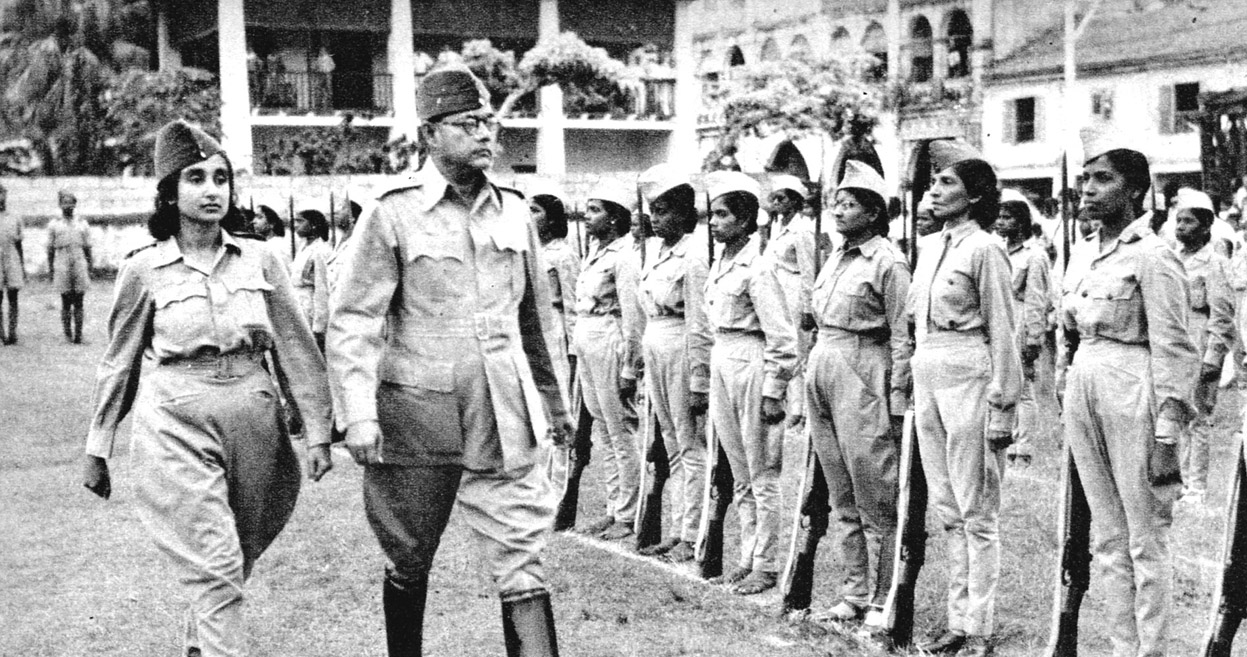
Netaji Subhash Chandra Bose taking guard of honour, Captain Lakshmi Sehgal is marching beside him
When most of the Congress party members were locked down in a blink of eye by the Colonial State in 1942, one great leader was struggling in the foreign lands to end India’s enslavement. Subhash Chandra Bose’s long journey through Afghanistan, Soviet Russia and Germany, culminated in the Tokyo visit
Bose arrived in Tokyo on June 13, 1943, and declared his intent to make an assault against the Eastern provinces of Bharat in an attempt to oust the British from control of the subcontinent. He moved to Singapore on July 2, and on October 21, 1943 formally announced the establishment of the Provisional Government of Free India. In defining the tasks of this new political establishment, Netaji declared: “It will be the task of the Provisional Government to launch and conduct the struggle that will bring about the expulsion of the British and their allies from the soil of India.”
Bose, taking formal command of the demoralised and undermanned Indian National Army from Rash Behari Bose, turned it into a professional army with the help of the Japanese. He recruited Indian civilians living in Japanese-occupied territories of South-east Asia, and incorporated vast numbers of Indian POWs from British forces in Singapore, Malaya and Hong Kong to man the brigades of the INA.
A Natural Leader
Rightly called ‘Netaji’, Subhash Bose was a leader whom India wanted the most. Someone with a clear vision of how things must take shape in the future, he never compromised on the virtues and magnificence of the Indic civilisation.
In the words of Col SC Dhillon (INA), “Undoubtedly, Netaji’s personality was our greatest strength which could sustain us inspite of our deficiencies in numbers, weapons and resources.” In an article, ‘The Last Straw That Broke the Back of British Empire’, Col Dhillon continues, “I remember an after dinner conversation with him in August 1944 after Imphal had been lost to us. As he was reviewing the war situation, I asked him that as war appeared to have been lost to us and to our allies and we had little hope of taking over the offensive again, what exactly was left for us to fight or what were we fighting for. Netaji’s reply was quick, “To pay the price of India’s liberty.”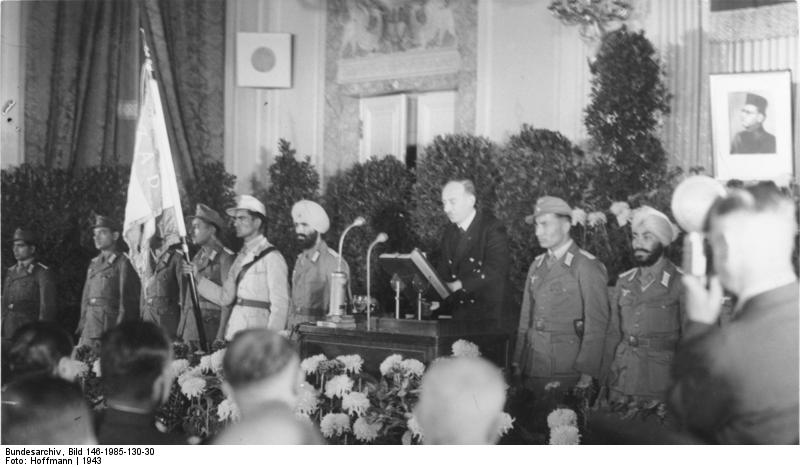
National celebration at the founding of the Provisional National Indian government at the Free India Center,
Berlin, with Secretary of State Wilhelm Keppler speaking, on 16 November 1943
Netaji had written a letter to Col Dhillon from Rangoon dated March 21, 1945, when Dhillon was fighting on the front, he repeated the same concept stating that “Whatever happens to us individually in the course of this heroic struggle, there is no power on earth that can keep India enslaved any longer. Whether we live and work or whether we die fighting, we must, under all circumstances have complete confidence that the cause for which we are striving is bound to triumph. It is the finger of God that is pointing the way towards India’s freedom. We have only to do our duty and to pay the price of India’s liberty. Our hearts are with you and with all who are with you in the present struggle which is paving the way to our national salvation.”
Contextualising Events
Jawaharlal Nehru, who went on to rule India, all he did manage was a ‘transfer of power’. A transfer that came loaded with ‘colonisation’ of new kinds. However, the real liberator of India, who was ready to die for her ‘complete independence’ believed that the ‘finger of God… is pointing the way towards India’s freedom’. He didn’t believe in half-baked romantic literary metaphors like ‘tryst with destiny’. Netaji believed in action and karma, and that’s what he kept doing till the last moment, people saw him.
Netaji could have easily stayed in some Ahmednagar Fort; he may have embarked on writing a good piece of prose like Nehru did. But why did he choose to fight a mega-battle almost single-handedly? Because that’s what leaders do! They don’t sit idle when the world affairs are on a high. They collaborate, they find new allies, they open new diplomatic channels, and they strive to change the course of history. Netaji was a leader, Nehru was not.
As the first Indian Head of the State, Netaji actively worked to get legitimisation of the world stage. In war-time international politics, though he could manage recognition only from a few nation-states, but he did manage some. Azad Hind was recognised as a legitimate state by only a small number of countries limited solely to Axis powers and their allies. Azad Hind had diplomatic relations with nine countries: Nazi Germany, the Empire of Japan, Italian Socialist Republic, Independent State of Croatia and Wang Jingwei Government, Thailand, the State of Burma and a few others. This Government participated as an observer in the Greater East Asia Conference in November 1943. The same night that Bose declared the existence of Azad Hind, the Government took action to declare war against the United States and Britain.
Greater East Asia Conference in November 1943, participants left to right- Ba Maw,
Zhang Jinghui, Wang Jingwei, Hideki Tojo, Wan Waithayakon, José P. Laurel, Subhas Bose
As the first Indian Head of the State, Netaji actively worked to get legitimisation of the world stage. In war-time international politics, though he could manage recognition only from a few nation-states, but he did manage some. Azad Hind was recognised as a legitimate state by only a small number of countries limited solely to Axis powers and their allies. Azad Hind had diplomatic relations with nine countries: Nazi Germany, the Empire of Japan, Italian Socialist Republic, Independent State of Croatia and Wang Jingwei Government, Thailand, the State of Burma and a few others. This Government participated as an observer in the Greater East Asia Conference in November 1943. The same night that Bose declared the existence of Azad Hind, the Government took action to declare war against the United States and Britain.
Greater East Asia Conference in November 1943, participants left to right- Ba Maw,
Zhang Jinghui, Wang Jingwei, Hideki Tojo, Wan Waithayakon, José P. Laurel, Subhas Bose
By the end of Greater East Asia conference, Azad Hind had been given a limited form of governmental jurisdiction over the Andaman and Nicobar Islands, which had been captured by the Imperial Japanese Navy early on in the war. Once under the jurisdiction of Azad Hind, the islands formed the government’s first claims to territory. The islands themselves were renamed “Shaheed” and “Swaraj”, meaning “martyr” and “self-rule” respectively. Almost all of the territory of the Provisional Government lay in the Andaman Islands, although the Provisional Government was allowed some authority over Indian enclaves in Japanese-occupied territories. Provisional Government civil authority was never enacted in areas occupied by the INA; instead, Japanese military authority prevailed and responsibility for administration of occupied areas of India was shared between the Japanese and the Indian forces.
Despite all the limitations, compulsions of the World War, advances, retreat, victory and defeat, Netaji and his Azad Hind Fauj managed to establish the first provisional Government. The Government was free, sovereign, had recognition from other sovereigns, was nationalist and worked harder than anyone else to achieve ‘complete independence’. There should be no difficulty to accept and recognise Netaji Subhash Chandra Bose as the first head of the Indian State, and not Nehru.