Jijnasa: The Art of Knowing
December 11, 2025
  • Read Ecopy
  • Circulation
  • Advertise
  • Careers
  • About Us
  • Contact Us
Android AppiPhone AppArattai
Organiser
  • ‌
  • Bharat
    • Assam
    • Bihar
    • Chhattisgarh
    • Jharkhand
    • Maharashtra
    • View All States
  • World
    • Asia
    • Europe
    • North America
    • South America
    • Africa
    • Australia
  • Editorial
  • International
  • Opinion
  • RSS @ 100
  • More
    • Op Sindoor
    • Analysis
    • Sports
    • Defence
    • Politics
    • Business
    • Economy
    • Culture
    • Special Report
    • Sci & Tech
    • Entertainment
    • G20
    • Azadi Ka Amrit Mahotsav
    • Vocal4Local
    • Web Stories
    • Education
    • Employment
    • Books
    • Interviews
    • Travel
    • Law
    • Health
    • Obituary
  • Subscribe
    • Subscribe Print Edition
    • Subscribe Ecopy
    • Read Ecopy
  • ‌
  • Bharat
    • Assam
    • Bihar
    • Chhattisgarh
    • Jharkhand
    • Maharashtra
    • View All States
  • World
    • Asia
    • Europe
    • North America
    • South America
    • Africa
    • Australia
  • Editorial
  • International
  • Opinion
  • RSS @ 100
  • More
    • Op Sindoor
    • Analysis
    • Sports
    • Defence
    • Politics
    • Business
    • Economy
    • Culture
    • Special Report
    • Sci & Tech
    • Entertainment
    • G20
    • Azadi Ka Amrit Mahotsav
    • Vocal4Local
    • Web Stories
    • Education
    • Employment
    • Books
    • Interviews
    • Travel
    • Law
    • Health
    • Obituary
  • Subscribe
    • Subscribe Print Edition
    • Subscribe Ecopy
    • Read Ecopy
Organiser
  • Home
  • Bharat
  • World
  • Operation Sindoor
  • Editorial
  • Analysis
  • Opinion
  • Culture
  • Defence
  • International Edition
  • RSS @ 100
  • Magazine
  • Read Ecopy
Home Bharat

Jijnasa: The Art of Knowing

Self-realisation is the last uncovering of the knowing. Before that, jijivisha and jijnasa have to go on till the individuals know themselves

Archive ManagerArchive Manager
Aug 13, 2018, 05:01 pm IST
in Bharat
Follow on Google News
FacebookTwitterWhatsAppTelegramEmail
Self-realisation is the last uncovering of the knowing. Before that, jijivisha and jijnasa have to go on till the individuals know themselves
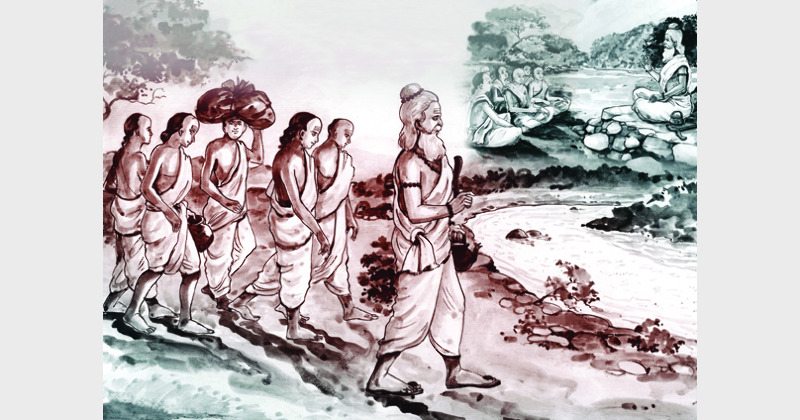
Desires drive human beings to action. It is the desire that propels a person to make or mar something. These desires come in varied hues and forms. The desire to live on is called jijivisha in Sanskrit. To live on, one needs food, clothing, and shelter. However, a life that does not look upwards to an ideal soon becomes enveloped by existential angst that makes one as hollow as an air pipe, from either end of which issue mere empty guffaws. Since no greatness is found in such a life, the person projects as great, the very basic needs of sustenance, food, clothing, and shelter. To merely survive becomes a great accomplishment. To breathe becomes a marvel.


To merely live on is not even a challenge; any living being does so. To lead a life in pursuit of higher and higher ideals is indeed a tall order. To live such a life, one’s ideas about truth, nature, and other things need to evolve constantly. This is brought about by the faculty of jijnasa, the desire to know. An insatiable desire for knowledge, knowledge that liberates, leads one to effortlessly evolve, scaling greater and greater heights of morality, unselfishness, and spiritual accomplishments that have their external result in the welfare of human beings.
 
A spiritually illumined person always possesses this jijnasa, and the very presence of such a soul benefits those who come in contact with that person. The Vedas, the basic scriptures of Sanatana Dharma, have this vision of knowledge. This process of knowing is not something that leads one to acquiring what one does not have to begin with, but it is a systematic process of unfolding one’s own being leading to the realisation that all knowledge is within and therefore was always within oneself from the beginning.
 
Knowledge and Wisdom
 
Upanishads, the knowledge section of the Vedas, poignantly present this ethos of knowing. According to the Vedas, to know that there is nothing to know through the medium of sense organs is the ultimate knowledge. Any knowledge that takes one to this ultimate truth is true knowledge, while others are not. In the famous anecdote from the Chhandogya Upanishad, Rishi Uddalaka tells his son Shvetaketu that true wisdom makes one speechless as it cannot be expressed. And so, the true knower is silent whereas the ignorant is caught up in the mire of words. Uddalaka further says that arrogance is not a virtue of wisdom but a sign of ignorance.
Jijnasa or the quest for knowledge takes a course that is determined by one’s value systems. If one is obsessed with wars, one would like to know about weapons
Humility characterises wisdom. He asks Shvetaketu to try to know that ‘knowing which, the unheard is heard, the unseen is seen, and the unknowable is known’. It is towards this paradoxical understanding that the Vedas lead us. The whole exercise of knowing is to go beyond the paradigm of knowledge that involves the triad of the knower, the known, and the process of knowing. This process of knowing the unknowable is accomplished using instruments that are all material—the sense organs and the mind. Uddalaka shows Shvetaketu how the mind merely matters, by not feeding him for sixteen days, at the end of which Shvetaketu is unable to conceive any thought whatsoever
 
What kind of knowledge is to be sought after according to the Vedic tradition? Is there any source of knowledge that has to be preferred over the others? What are the conditions that a source of knowledge has to meet before one can get knowledge from that source? The universality of the Vedas can be well understood by the famous Rig Veda statement, ‘Aa no Bhadra kratavo yantu Vishwanath; let noble thoughts come to us from all directions’. Here, the source of knowledge is a matter of least importance. There is no hierarchy of knowledge systems in the Vedas.
 
The famous imagery of the Dakshinamurti Stotra, where the guru is young, and the disciple is older, gives a backseat to the conventional hierarchical understanding of seniority, and places known as the only ground for merit. In the Vedic society, the order in which respect was accorded to a person, went in the descending order of the spiritually wise, the intellectually wise, the guru of the king, the king, the teacher, the army, and the rest. When a person was respected based on qualities, the order of respect went in the descending order from one having wisdom, one having wealth, one having power, and finally, one who is older. So, age was the last factor based on which a person was respected, knowledge being the first. Knowledge by itself was considered the solution.
 
Who could seek the knowledge offered by the Vedic tradition? The catholicity of the Vedas is seen in this aspect also. In the Chhandogya Upanishad, we find the story of Satyakama Jabala. As a boy, he has this insatiable desire for knowledge, and in search of it, he approaches Rishi Haridrumata Gautama and prays to him to accept him as a disciple. The Rishi wants to know Satyakama’s ancestry. Satyakama, not knowing an answer to this, goes to his home and asks his mother who his father was. She replies that since she had served many men, she too does not know who his father is. Satyakama returns to Rishi Gautama and repeats what he had heard from his mother. Hearing this, the rishi is pleased with Satyakama’s honesty and tells him that such great honesty is the defining character of a brahmana. By this logic, Satyakama was a brahmana, and so was entitled to be Rishi Gautama’s disciple. This incident shows without a doubt that the criteria for determining one’s varna, caste, was one’s qualities and actions.
 
Jijnasa or the quest for knowledge takes a course that is determined by one’s value systems. If one is obsessed with wars, one would like to know about weapons. If one is concerned with treating patients, one would be interested in medicine. 
 
ShareTweetSendShareSend
✮ Subscribe Organiser YouTube Channel. ✮
✮ Join Organiser's WhatsApp channel for Nationalist views beyond the news. ✮
Previous News

Tirtha and ?Crossing Over?

Next News

Justice Kemal Pasha is a man of great courage and outspoken personality living for justice

Related News

Muhammad Yunus, Chief Advisor of the Interim administration of Bangladesh

Unmasking Muhammad Yunus: Series of lies etched with corruption, plagiarism, shadow deals & ultimate thirst for power

Bhattacharya, IAS (Retd.),

Telangana: Retired IAS officer turns economics lecture into anti-Hindu tirade; FIR filed at IPE Hyderabad

The Tamil Community in Moreh

Tamil footprints on the Indo-Myanmar frontier: A civilisational saga from Rangoon to Moreh

Duff performance in front of Chennakeshava temple, Mangaluru cancelled after opposition from Hindu organisations

Karnataka: Performance of Duff in front of Chennakeshava temple cancelled due to opposition from Hindu organisations

Modi–Putin diplomacy triumphs as Congress drowns in its own confusion

Bangladesh national elections scheduled for February 12

Bangladesh elections on Feb 12; First since the topple of Hasina regime, Set to decide political course of the country

Load More

Comments

The comments posted here/below/in the given space are not on behalf of Organiser. The person posting the comment will be in sole ownership of its responsibility. According to the central government's IT rules, obscene or offensive statement made against a person, religion, community or nation is a punishable offense, and legal action would be taken against people who indulge in such activities.

Latest News

Muhammad Yunus, Chief Advisor of the Interim administration of Bangladesh

Unmasking Muhammad Yunus: Series of lies etched with corruption, plagiarism, shadow deals & ultimate thirst for power

Bhattacharya, IAS (Retd.),

Telangana: Retired IAS officer turns economics lecture into anti-Hindu tirade; FIR filed at IPE Hyderabad

The Tamil Community in Moreh

Tamil footprints on the Indo-Myanmar frontier: A civilisational saga from Rangoon to Moreh

Duff performance in front of Chennakeshava temple, Mangaluru cancelled after opposition from Hindu organisations

Karnataka: Performance of Duff in front of Chennakeshava temple cancelled due to opposition from Hindu organisations

Modi–Putin diplomacy triumphs as Congress drowns in its own confusion

Bangladesh national elections scheduled for February 12

Bangladesh elections on Feb 12; First since the topple of Hasina regime, Set to decide political course of the country

Thirupurakundram Hill (L) - Dr Moahn Bhagwat, Sarsanghchalak- RSS (R)

Hindu Unity in Tamil Nadu Enough to Secure Favourable Resolution on Thiruparankundram: Dr Mohan Bhagwat

Hussain brothers from Rotherham running a network of sexual terrorism

Grooming gangs of Pakistan wreak havoc in UK; Transcript expose chilling fact on trafficking & rape by Hussain brothers

Hanuman's murti found during excavation (ETV Bharat Kota)

Ancient Hanuman murti found inside 300-year-old tree in Kota, Rajasthan; Devotees flock to witness miracle

Matsya 6000 made by India (Left)

Indian Deep Ocean Mission advancement through science, strategy and seabed resources

Load More
  • Privacy
  • Terms
  • Cookie Policy
  • Refund and Cancellation
  • Delivery and Shipping

© Bharat Prakashan (Delhi) Limited.
Tech-enabled by Ananthapuri Technologies

  • Home
  • Search Organiser
  • Bharat
    • Assam
    • Bihar
    • Chhattisgarh
    • Jharkhand
    • Maharashtra
    • View All States
  • World
    • Asia
    • Africa
    • North America
    • South America
    • Europe
    • Australia
  • Editorial
  • Operation Sindoor
  • Opinion
  • Analysis
  • Defence
  • Culture
  • Sports
  • Business
  • RSS @ 100
  • Entertainment
  • More ..
    • Sci & Tech
    • Vocal4Local
    • Special Report
    • Education
    • Employment
    • Books
    • Interviews
    • Travel
    • Health
    • Politics
    • Law
    • Economy
    • Obituary
  • Subscribe Magazine
  • Read Ecopy
  • Advertise
  • Circulation
  • Careers
  • About Us
  • Contact Us
  • Policies & Terms
    • Privacy Policy
    • Cookie Policy
    • Refund and Cancellation
    • Terms of Use

© Bharat Prakashan (Delhi) Limited.
Tech-enabled by Ananthapuri Technologies