





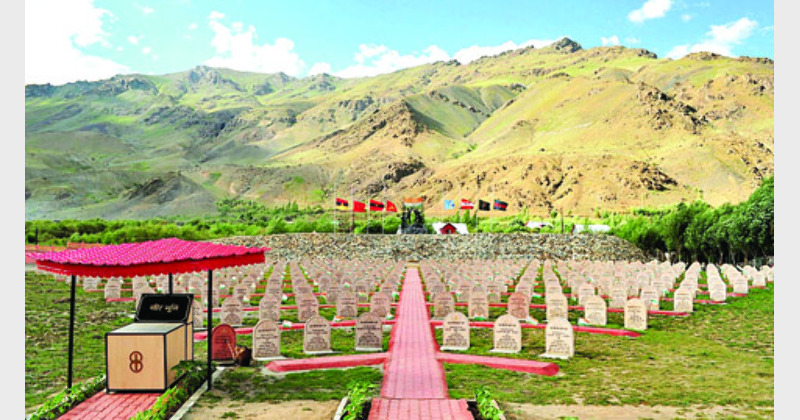
Kargil war was not the first time when Pakistan initiated a war, and we must not assume that it would be the last time. Bharat will remain vulnerable to such threats along its disputed borders unless it builds a credible will and capability to deter and dissuade likely adversaries
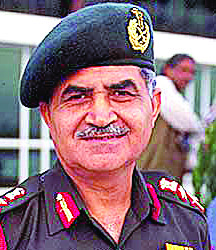
General (Retd) V P Malik
A war in the new strategic environment requires close political oversight and politico-civil-military interaction. It is essential to keep the military leadership within the security and strategic decision-making loop After throwing out Kashmiri Pandits from the Valley, the hardcore Islamists have had a free run for so long. Our intelligence agencies failed to assess the situation and its adverse impact on our national security
strategically conscious nation commemorates its historical national security events for three reasons: to remember and pay homage to those who sacrificed their lives for the nation’s future, to recall lessons that emerged from that event, and to pledge for a safer and better future. When the nation celebrates the 19th anniversary of the Kargil War, it is an appropriate occasion to recall its important lessons and our capability to meet future security challenges.
Kargil War can be remembered for its strategic and tactical surprise, the self-imposed national strategy of restraint keeping the war limited to the Kargil-Siachen sector, military strategy and planning, in keeping with the political mandate, and the dedication, determination and daring of our soldiers and junior leaders despite several deficiencies in weapons and equipment.
In fiercely fought combat actions, on difficult terrain that gave an immense advantage to the enemy holding mountain-tops, we were able to evict Pakistani troops from most of their surreptitiously occupied positions. Pakistani leadership was forced to sue for a ceasefire and seek withdrawal of its troops from the remaining areas.
Operation Vijay (codename for the war) was a blend of determined political, military and diplomatic actions, which enabled us to transform an adverse situation into a politico-military victory.
Lessons from the Kargil
Several lessons emerged from the war, which required a holistic national security review as well as re-thinking on the nature of the conflict in the new strategic environment and conduct of wars. There may be remote chances of a full-scale conventional war between two nuclear weapon states but as long as there are territory-related disputes (currently we have them with China and Pakistan) the adversary can indulge in a proxy war (of the type we face in J & K today), a limited conventional along the border war, or both.
Despite the political and public mandate ‘not to lose an inch of our territory’, there is reluctance in India to adopt a pro-active strategy. This invariably leads us to a reactive military situation. It is, therefore, essential to have credible strategic and tactical intelligence and assessments, effective surveillance, and close defense of the border. A conventional war may remain limited because of credible deterrence and escalation dominance. Such deterrence may prevent a war. It will also give more room for manoeuvre in diplomacy and in conflict.
The successful outcome of a border war depends upon our ability to react rapidly. The new strategic environment calls for faster decision making, versatile combat organisations, rapid deployment and synergy amongst all elements involved in the war effort, particularly the three services. This is possible only we have a direct, continuous, and meaningful dialogue between the political authority and service chiefs.
A war in the new strategic environment requires close political oversight and politico-civil-military interaction. It is essential to keep the military leadership within the security and strategic decision-making loop. Information operations are important due to the much greater transparency of the battlefield. The political requirement of a military operation and to retain moral high ground (and deny that to the adversary) needs a comprehensive media and information strategy.
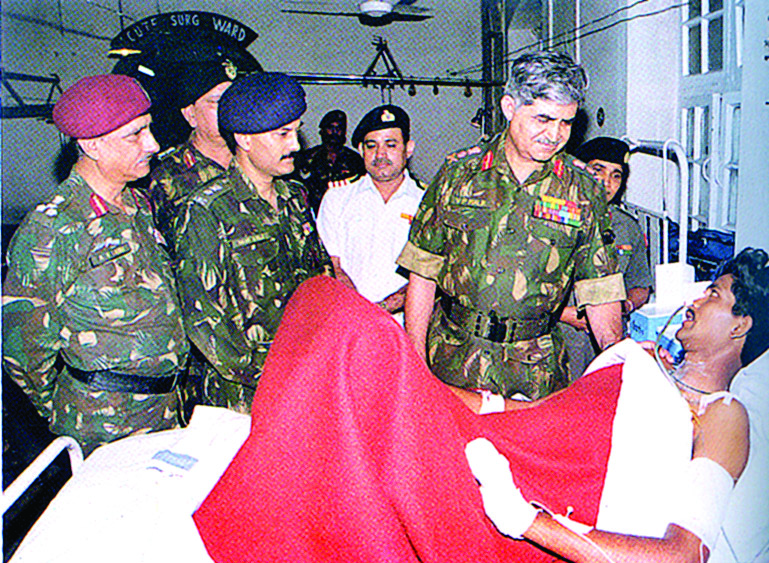
A file photo of Gen VP Malik meeting with injured Indian Jawans (Courtesy : Kargil from Surprise to Victory, Gen VP Malik
Follow Up By Military
The war had highlighted gross inadequacies in our surveillance capability. Some action has been taken to improve all-weather surveillance and closer defense of border along the Line of Control (LoC). This capability along the LAC, however, has not improved to the desired level. The revised joint services doctrine has left many grey areas. We need much more jointmanship. More Special Forces units have been added to the strength of each service. We need more of them.
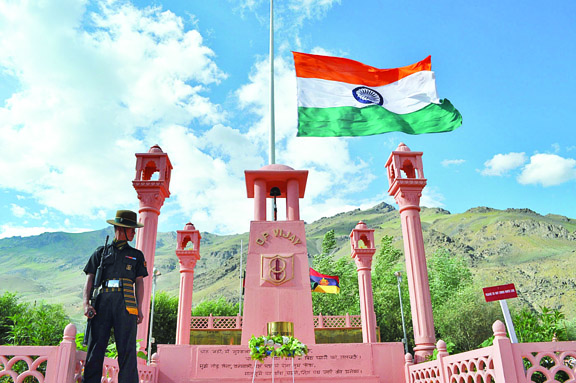
The Kargil War Memorial, built by the Indian Army, is located in Dras, in the foothills of the TololingHill. The memorial, ;ocated about five km from the city centre across the Tiger Hill commorates the martyrs with a poem “Pushp Ki Abhilasha” which is inscribed on its gateway.
Higher Defense Management
After the war, the Government had carried out a National Security Review in 2002. This Security Review, and the Naresh Chandra Committee later, had recommended the creation of the post of CDS to provide single point military advice to the government and to resolve substantive inter-service doctrinal, planning, policy and operational issues. This is necessary because, in India, turf wars, inter-service rivalries, bureaucratic delays and political vacillation in decision making become major hurdles in defense planning which is tardy, competitive and thus uneconomical.
Due to the lack of political will, and inter-service differences, this important recommendation has not been implemented to date. Selective and cosmetic implementation of recommendations, without changing the rules of business, has ensured a status quo in the higher defense control and its decision making processes. In the new strategic environment of unpredictability, enhanced interactivity and much faster planning and decision making, a face to face politico-military dialogue and its continuity are critical to success in strategic and operational issues. Only that can enable the required synergy and optimize defense and operational planning. Unfortunately, our political leaders remain inhibited in discussing security and defense policy issues with military leaders directly. They feel more secure behind a bureaucratic curtain and advice. As a result they are not adequately conversant with military purposes, capabilities, constraints, and effects, and in peacetime, when the military leadership has to do defense planning, force structuring and prepare for war contingencies-remains out of the strategic decision-making loop. The national security framework is not in sync with the needs of new security challenges or healthy civil-military relations.
Deficiencies in Weapons/Equipment & Modernisation
When Kargil war broke out, our holdings and reserves of weapons, ammunition, and equipment were in a depleted state due to continuous lack of budgetary support, tedious procurement system, and raising of units without sanctions for weapons and equipment. When questioned by the media on this issue, I had to say, “We will fight with whatever we have”. This was more of helplessness-no bravado- an attempt to keep up the morale of my troops.
The poor state of existing arms and equipment and inability to modernize forces has been conveyed recently by the three services to the Standing Committee of the Parliament. It is obvious that the governments have failed to rectify this chronic problem which has dogged the nation for decades.
The present Government’s ‘Make in India’ effort and desire that private sector invests in the defense industry and higher technology has not succeeded so far. Due to vested interest of the defense public sector and its bureaucratic control, the Ministry of Defense has failed to provide a level playing field to the Indian and foreign private sectors
Tackling Turmoil in Kashmir
Major proxy war and insurgency problems that we face today are in J & K. There are two elements and reasons for the worsening of this situation. Firstly, Pakistan Army (external element) cannot swallow peace in J & K or any sign of growing friendship between elected governments of India and Pakistan. It continues to encourage and support terrorist groups outside and inside J & K.
Secondly, our own weakness (internal element) to govern and administer the State politically is also responsible. The PDP-BJP coalition could not work effectively in the State. Both parties remained keen to appease their vote banks instead of working in the strategic interest of the state and the country. Even the Unified Command was not working satisfactorily.
The Government failed to deal firmly with the ideologue Separatists. In the last two decades, the elected governments in J & K (even the Centre) have given them more and more space; even allowed them to run the Valley- its institutions, commerce, stone pelters and other anti-national elements. The NDA government said in the Parliament that ‘Key Separate leaders in Kashmir receive instructions and financial support from the Pakistani establishment.’ Yet no effective action has been taken to stop this external support to them.
After throwing out Kashmiri Pandits from the Valley, the hardcore Islamists have had a free run for so long. Our intelligence agencies failed to assess the situation and its adverse impact on our national security. My past experience of such operation in North East, Punjab and J & K are that internal element is more important than external. Political sagacity, good governance, winning the hearts and minds are far more important. While we can, and should, deal with Pakistan on the LoC and international border firmly, priority must be given to the internal situation in J & K.
We must also realise that the military alone cannot resolve such internal conflicts. Its task is to create a law and order situation wherein the political leaders, civil services and society can engage, govern and resolve the conflict politically. Conflict resolution here requires a holistic approach: political, economic, social, perceptual, psychological, operational and diplomatic. All aspects require equal and simultaneous attention. We require a comprehensive and balanced approach to handle the situation. The solution to the J & K problem ultimately lies in the political domain; within the existing national Constitution, and if required, by modifying the Constitution.
There is no point talking about a revolution in military affairs, information systems, and net-centric warfare if we cannot induct relevant weapons and equipment in time. Efforts towards modernisation of the armed forces have not borne fruit primarily due to the absence of holistic and long-term defence planning.In Kargil war, we were able to inflict a humiliating defeat to the Pakistan Army and ensure the sanctity of our territory. But due to political constraints and lack of deterrence, we were unable to stop Pakistan’s proxy war in J & K. Since then, the situation has become worse due to poor politics and governance of the state.
Kargil war was not the first time when Pakistan initiated a war, and we must not assume that it would be the last time. India will remain vulnerable to such threats along its disputed borders unless it builds a credible will and capability to deter and dissuade likely adversaries. An enduring lesson of Kargil war, indeed most wars, is that for national security, sound defense enables sound domestic and foreign policies.
(The writer is the former Chief of the Army Staff, Bharat)










Comments