Book Review : Battle forUnity
August 16, 2026
  • Read Ecopy
  • Circulation
  • Advertise
  • Careers
  • About Us
  • Contact Us
Android AppiPhone AppArattai
Organiser
  • ‌
  • Bharat
    • Assam
    • Bihar
    • Chhattisgarh
    • Jharkhand
    • Maharashtra
    • View All States
  • World
    • Asia
    • Europe
    • North America
    • South America
    • Africa
    • Australia
  • Editorial
  • International
  • Opinion
  • RSS @ 100
  • More
    • Op Sindoor
    • Analysis
    • Sports
    • Defence
    • Politics
    • Business
    • Economy
    • Culture
    • Special Report
    • Sci & Tech
    • Entertainment
    • G20
    • Azadi Ka Amrit Mahotsav
    • Vocal4Local
    • Web Stories
    • Education
    • Employment
    • Books
    • Interviews
    • Travel
    • Law
    • Health
    • Obituary
  • Subscribe
    • Subscribe Print Edition
    • Subscribe Ecopy
    • Read Ecopy
  • ‌
  • Bharat
    • Assam
    • Bihar
    • Chhattisgarh
    • Jharkhand
    • Maharashtra
    • View All States
  • World
    • Asia
    • Europe
    • North America
    • South America
    • Africa
    • Australia
  • Editorial
  • International
  • Opinion
  • RSS @ 100
  • More
    • Op Sindoor
    • Analysis
    • Sports
    • Defence
    • Politics
    • Business
    • Economy
    • Culture
    • Special Report
    • Sci & Tech
    • Entertainment
    • G20
    • Azadi Ka Amrit Mahotsav
    • Vocal4Local
    • Web Stories
    • Education
    • Employment
    • Books
    • Interviews
    • Travel
    • Law
    • Health
    • Obituary
  • Subscribe
    • Subscribe Print Edition
    • Subscribe Ecopy
    • Read Ecopy
Organiser
  • Home
  • Bharat
  • World
  • Operation Sindoor
  • Editorial
  • Analysis
  • Opinion
  • Culture
  • Defence
  • International Edition
  • RSS @ 100
  • Magazine
  • Read Ecopy
Home Bharat

Book Review : Battle forUnity

Battle of Saraighat (1671) is the history of the spectacular triumph of Ahom army led by Lachit Borphukan over the might of the Mughals. The ascendancy of Mughals was challenged and overturned by Ahom people repetitively. The renown ingrained

Archive ManagerArchive Manager
Jan 17, 2018, 12:59 pm IST
inBharat
Follow on Google News
Facebook
Twitter
WhatsAppTelegramEmail

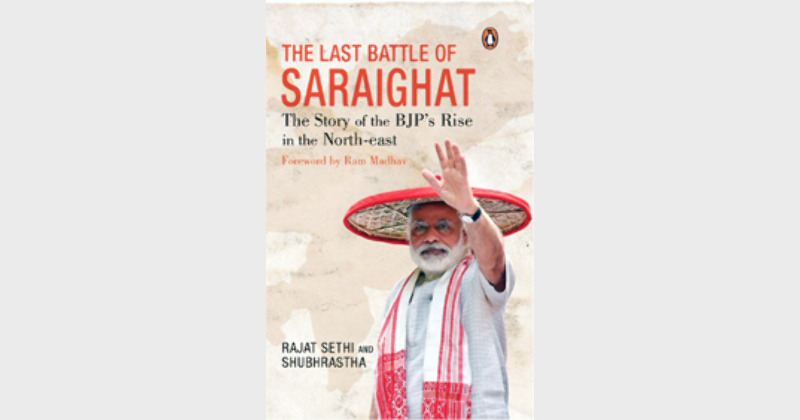
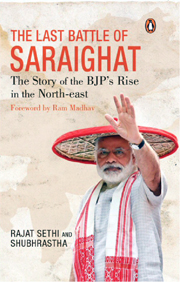
The Last Battle of Saraighat—The Story of the BJP’s Rise in the North East (Hardcover)
;
Rajat Sethi and Shubhrastha;
Penguin Random House; Pp 182; Rs 599

Shaan Kashyap

Battle of Saraighat (1671) is the history of the spectacular triumph of Ahom army led by Lachit Borphukan over the might of the Mughals. The ascendancy of Mughals was challenged and overturned by Ahom people repetitively. The renown ingrained in this historical fact, no doubt, has persisted as trope of heroism in modern Assam. Thus, significant political battles in modern days must intensify by enacting themselves in the space of the cultural past. Rajat Sethi and Shubhrastha have shown the dexterity of situating an Assembly Election in the continuity of Assam’s past.
The book recounts the historical landslide victory of the BJP in Assam Assembly elections, but anatomy of the subject treatment is heedful to the North-East as a whole. The book is divided in six chapters with rich anecdotal evidence and hard facts. The foreword by Ram Madhav avails the oblivious readers to the much needed standpoint about the affairs in North-East!
The book commences by building upon the metaphor of the Saraighat. The readers are then introduced to the ‘history of political blunders’ as committed and commissioned under a long Congress rule. Taking cues from the political impropriety of the Congress, the authors have delineated the rise of BJP.
Five Decades of the Sangh
The significance of the book lies in the fact that it succinctly maps the growth of Rashtriya Swayamsevak Sangh (RSS) in Assam. It thus, becomes a brief history of the long struggle and vital efforts of RSS in the state.
We are told that, “The RSS started its first seva in Assam in 1946 to help the ailing men and women suffering the brutalities of the riots of violence.” (p. 62) The Sangh held its first shakha in Guwahati on 28 October 1946. Thereafter, Sangh’s involvement in the socio-cultural storyline of Assam persisted and grew with issues. Guruji Golwalkar visited Assam in 1950, we are told, when the state was facing the affliction of an earthquake. Guruji established an organisation called ‘Bhukamp Peedit Sahayata Samiti’ which was received with much admiration. (p.63)
Sangh provided with the ideological force committed to its revered objective of a unified Bharat Mata. This was an alternative to the staunch and militant approach of ULFA. The RSS, we are told, esteemed the glory of the ancient past in Assam by tracing its history way back in time of Pragjyotishpur and Kamrupa. (p.65) The accomplishment of Sangh in “creating a counter- narrative in an atmosphere of vitiated political and intellectual environment has been one of the greatest achievements.” (p. 67)
We are told that by 1975, all districts in Assam had Sangh shakhas. This extensive growth also resulted in creating narratives which became the issue of prominence in 2016 Assembly elections. In the wake of Assam movement, the RSS played the crucial role in transforming the anti-bahiragat agitation to anti-videshi movements. Bahiragat referred to those who came to Assam from outside. The category was turned to the challenges posed by foreigners and the crucial difference between Hindus and Muslims was accentuated. Authors state that after a series of meetings, in 1980, Sangh stated that ‘Hindus were sharanarthis (asylum seekers) and Muslims were anupraveshkaaris (infiltrators) in Assam.’ (p.71)
How Sangh attempted to unify and integrate Axomiya conscience with that of Bharat is fascinating. The burning identity questions in post-colonial Assam were redressed by going back to the “religious, historical, quasi-historical and mythological accounts of Hinduism and India” to foreground the shared cultural liaisons. For example, the teachings of Srimanta Sankardeva were used by Sangh to integrate Assam with Bharat, both culturally and socially.
Writing on the Wall
Since both the authors have been an integral part of the local electoral campaign in Assam, their analysis is more substantial than merely intuitive. They have successfully mapped the rise of the BJP historically and the long struggle has not been blown away in the contemporaneity of the events.
Overall, the book is a welcome addition to the growing corpus of political commentaries on the rise of the BJP. The biggest takeaway in this case, however, is that the alertness of past has not been left compromised. As Ram Madhav rightly puts it that authors’ experience “would be of immense value to… not just the BJP in the North-East but also the North-east itself.”     n

Share
Tweet
SendShareSend
✮ Subscribe Organiser YouTube Channel. ✮
✮ Join Organiser's WhatsApp channel for Nationalist views beyond the news. ✮
Previous News

60 years of NBT : We are transferring traditions in modern ways

Next News

Corporate : Corporatestake to Integral Humanism

Related News

Great Calcutta Killings 1946

Great Calcutta Killings in August 1946: Urban pogrom and the teleology of partition in colonial Bengal and India

Independence Day 2026: World leaders wish India, hail its global rise & growth story; Signals deeper strategic ties

Kerala: Halal Fayida Islamic Banking Cooperative Society depositors stranded as crores remain unaccounted for

Abusive language used during recent protest in Delhi cannot be the language of Bharatiya youth. It is time to introspect yourself where are we making mistakes in guiding our future generation

80th Independence Day: Youth and Nation – Change begins with responsibility

The Tiranga embodies India’s freedom, unity and values, inspiring us to turn patriotism into responsible action

From Tiranga in Every Home to Tiranga in Every Heart: Turning national pride into everyday patriotism

Atul Limaye, Sah Sarkaryavah, RSS, while addressing at an Akhil Bharatiya Vidyarthi Parishad (ABVP), the student wing of the RSS, event held in Chhatrapati Sambhajinagar in Maharashtra, on August 2

Independence Day 2026: Youth and Nation – The Anarchic alternative

Load More

Latest News

Great Calcutta Killings 1946

Great Calcutta Killings in August 1946: Urban pogrom and the teleology of partition in colonial Bengal and India

Independence Day 2026: World leaders wish India, hail its global rise & growth story; Signals deeper strategic ties

Kerala: Halal Fayida Islamic Banking Cooperative Society depositors stranded as crores remain unaccounted for

Abusive language used during recent protest in Delhi cannot be the language of Bharatiya youth. It is time to introspect yourself where are we making mistakes in guiding our future generation

80th Independence Day: Youth and Nation – Change begins with responsibility

The Tiranga embodies India’s freedom, unity and values, inspiring us to turn patriotism into responsible action

From Tiranga in Every Home to Tiranga in Every Heart: Turning national pride into everyday patriotism

Atul Limaye, Sah Sarkaryavah, RSS, while addressing at an Akhil Bharatiya Vidyarthi Parishad (ABVP), the student wing of the RSS, event held in Chhatrapati Sambhajinagar in Maharashtra, on August 2

Independence Day 2026: Youth and Nation – The Anarchic alternative

Keralam: CM Satheeshan omits Vande Mataram on Independence Day at govt offices; BJP events render full version

Decolonisation saw nations across Africa and Southeast Asia reclaim their cultures, languages and identities after independence (This image is generated by AI)

From Colonial Rule to Cultural Revival: How African and Southeast Asian nations shed their colonial legacies

Rashtriya Swayamsevak Sangh (RSS) Sarsanghchalak Dr Mohan Bhagwat went viral by adopting the Gen Z slang phrase "clock it" and making the corresponding hand gesture during a youth conference in Mumbai on August 6

Independence Day 2026: Anarchy vs Freedom – Revisiting Ambedkar on protest in democracy

The Pakistan-Saudi Arabia-Türkiye defence pact faces an early test amid rising regional tensions and security challenges

Pakistan-Saudi Arabia-Turkiye Defence Pact: A shaky beginning and growing questions over its strategic credibility

Load More
  • Privacy
  • Terms
  • Cookie Policy
  • Refund and Cancellation
  • Delivery and Shipping

© Bharat Prakashan (Delhi) Limited.
Tech-enabled by Ananthapuri Technologies

  • Home
  • Search Organiser
  • Bharat
    • Assam
    • Bihar
    • Chhattisgarh
    • Jharkhand
    • Maharashtra
    • View All States
  • World
    • Asia
    • Africa
    • North America
    • South America
    • Europe
    • Australia
  • Editorial
  • Operation Sindoor
  • Opinion
  • Analysis
  • Defence
  • Culture
  • Sports
  • Business
  • RSS @ 100
  • Entertainment
  • More ..
    • Sci & Tech
    • Vocal4Local
    • Special Report
    • Education
    • Employment
    • Books
    • Interviews
    • Travel
    • Health
    • Politics
    • Law
    • Economy
    • Obituary
  • Subscribe Magazine
  • Read Ecopy
  • Advertise
  • Circulation
  • Careers
  • About Us
  • Contact Us
  • Policies & Terms
    • Privacy Policy
    • Cookie Policy
    • Refund and Cancellation
    • Terms of Use

© Bharat Prakashan (Delhi) Limited.
Tech-enabled by Ananthapuri Technologies