Chola Dynasty was the one that utilised cultural links with South East Asian countries for trade enhancement. Prime Minister Narendra Modi is reinventing that legacy
SN Aiyer
Long back, circa 1,000 years ago to be a bit more precise, Indian kings of the Chola Dynasty set about in earnest to establish India’s presence and interest in South East Asia. This is quite well documented by historians who have noted how this campaign brought much benefit to both sides, but more so to maritime linkages with the Southern parts of India. A similar and possibly much greater positive impact awaits particularly South India from Prime Minister Narendra Modi’s recent visit to the region.
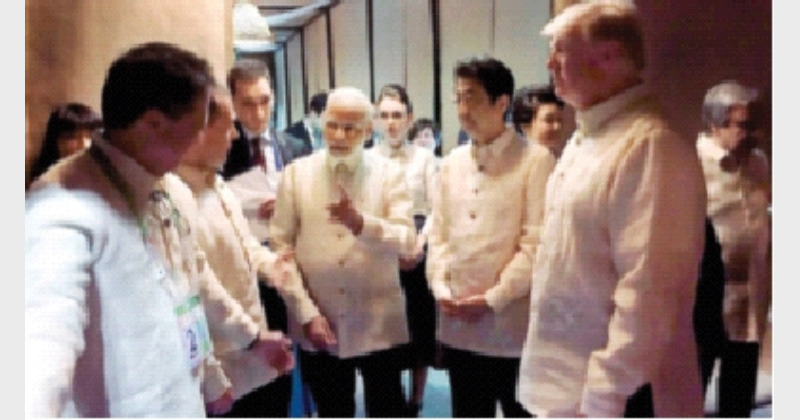
Several key events occurred during the three-day hectic visit, which commenced from November 12, noteworthy from India’s strategic and long term viewpoint. Firstly, this was the PM’s first ever bilateral visit to Philippines, which is an important country in the region and as PM Modi himself has noted, “There is a lot that India and Philippines share in common”. Both are pluralistic societies and vibrant democracies, being two of the fastest growing economies in the world, with large, young and aspiring populations that are innovative and enterprising and are global service providers on a huge scale.
Secondly, the occasion itself was highly important (and not just symbolic) as it was not just marking the Special Celebrations of the 50th anniversary of ASEAN. As the PM has rightly pointed out, it also was the 25th anniversary of the ASEAN-India dialogue partnership itself, which was being celebrated under the befitting theme of ‘Shared Values, Common Destiny’. ASEAN, acronym for Association of South-East Asian Nations comprises Indonesia, Singapore, Philippines, Malaysia, Brunei, Thailand, Cambodia, Lao PDR, Myanmar and Vietnam. Observers have traditionally given the ASEAN regional grouping much strategic importance for even the USA owing primarily to the “big brother” attitude of China. However, as PM refreshed the memory of all concerned, this region is extremely important for India, being so close to its borders, straddling the vital sea routes and above all, being home to millions of expatriate Indians. Not surprisingly therefore, while reiterating and strengthening the “Act East Policy”, PM also noted that India has a lot of affinity with these ASEAN countries, affirming that there was “a natural affinity for them, with some kind of emotional bonding”. In fact, it was PM Modi who at the 12th ASEAN-India Summit and the 9th East Asia Summit held in Myanmar, in November, 2014, formally enunciated the Act East Policy. This has today matured into what is acknowledged in the diplomatic community as a “dynamic and action oriented” one, ever since up-gradation of the relationship into a Strategic Partnership in 2012.
Economic Cooperation
On the front of economic cooperation too, as the Ministry of External Affairs (MEA) avers, India-ASEAN trade and investment relations have been growing steadily, with ASEAN being India's fourth largest trading partner. India's trade with ASEAN has increased to US$ 70 billion in 2016-17 from US$ 65 billion in 2015-16. India’s export to ASEAN has increased to US$ 30 billion in 2016-17 from US$ 25 billion in 2015-16. Investment flows are also substantial both ways, with ASEAN accounting for approximately 12.5 per cent of investment flows into India since 2000. FDI inflows into India from ASEAN between April 2000 to May 2016 were about US$49.40
billion, while FDI outflows from India to ASEAN countries, from April 2007 to March 2015, as per data maintained by DEA, were about US$38.672 billion. The ASEAN-India Free Trade Area has been completed with the entering into force of the ASEAN-India Agreements on Trade in Service and Investments on July 1, 2015.
Then, lastly, the visit paved the way for the PM’s high level participation in Summits with Heads of State/Government under the multilateral formats such as the ASEAN-India and East Asia Summits as also the Regional Comprehensive Economic Partnership (RCEP) Leaders’ Meeting and ASEAN Business and Investment Summit. This, as the PM’s statement prior to his departure had noted, “symbolises India’s commitment to continue deepening relationship with ASEAN Member States, in particular, and with the Indo-Pacific region, in general”.
Key Takeaways
However, the main takeaway from PM Modi’s highly successful visit was beyond all the above achievements. It was the quiet but immensely well-thought out programme for PM to visit the International Rice Research Institute (IRRI) in Philippines. IRRI is a premier research organisation dedicated exclusively to just study of what scientists call as rice science, along with improving the health and welfare of rice farmers and consumers and protecting the rice growing environment for future generations. As is his vaunt, which he now does with aplomb, PM Modi gets a great deal done diplomatically, with the least of fuss. Here too, judging by all the media accounts, PM Modi managed to get much mileage for India and Indian farmers particularly for the rice growing (and rice eating!) States like West Bengal, Andhra and Tamil Nadu. For the record, PM Modi spent much time discussing agriculture innovations and research advances for the rice sector but obviously this brings to mind his abiding concern to kick-start the next Green Revolution, which he has time and again, been abundantly hinting, has to come from the East (and maybe the South thrown in).
Rice (or paddy) is the second largest produced cereal in the world, India’s pre-eminent crop, and is the staple food of the people of the eastern and southern parts of the country. Rice is for instance, the major constituent accounting for 85.2 per cent of the total food grains production in the state of Tamil Nadu. For years, efforts have failed in the State to raise the productivity/yield and improve the conditions of the farmers, mostly women being involved in the intensely laborious transplanting and harvesting work. China incidentally, has less area under paddy cultivation than India but its production is far higher. By the way, MEA spokesman has also noted IRRI assistance to 2 lakh women farmers in Odisha, for capacity building and improved agriculture technology.
PM’s visit also enabled to focus attention of the IRRI on problems for rice farmers from their lands being prone to flooding. Crop losses from flooding affect rice farmers every year, increasing the burden of poverty they must bear. In India and Bangladesh alone, more than 5 million hectares of rice field are flooded during most of the planting seasons. For this reason, a new laboratory—possibly to be named after PM Modi himself will concentrate, it has been announced during the visit, on developing rice varieties that can be successfully grown in flood and salinity prone areas, decreasing risks for farmers involved in rice production in some of the poorest regions of India. Incidentally, on July 12 this year, the Cabinet had also approved a proposal for IRRI to set up its South Asia Regional Centre at Varanasi, its first ever outside its headquarters in the Philippines. The Varanasi Centre would help increase farmers’ income by enhancing and supporting rice productivity, reducing cost of production, value addition, diversification and enhancement of farmers’ skills. All this will no doubt enable the South/East India to reap a rich harvest with a huge bonanza for the South if trade and political-security ties improve with ASEAN. Clearly, PM Modi’s work will see the good days of the Chola Kings back again!
(The writer is a freelancer based in New Delhi)