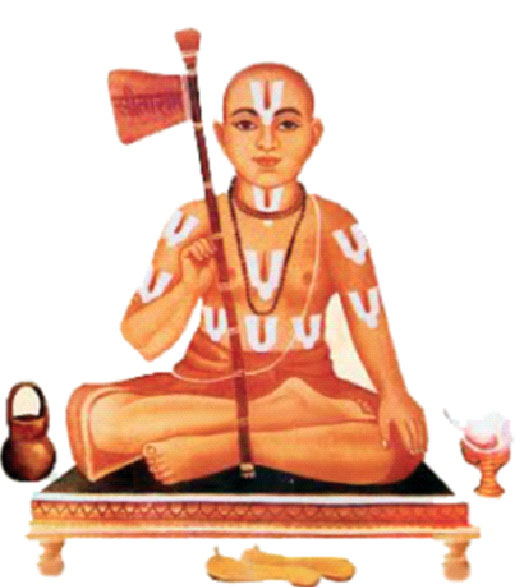
 The tradition of Gurus in the Bharatiya culture has in many ways been a vital sustenance force. Guru Purnima on July 9 is a celebration of it
Rajesh Pathak
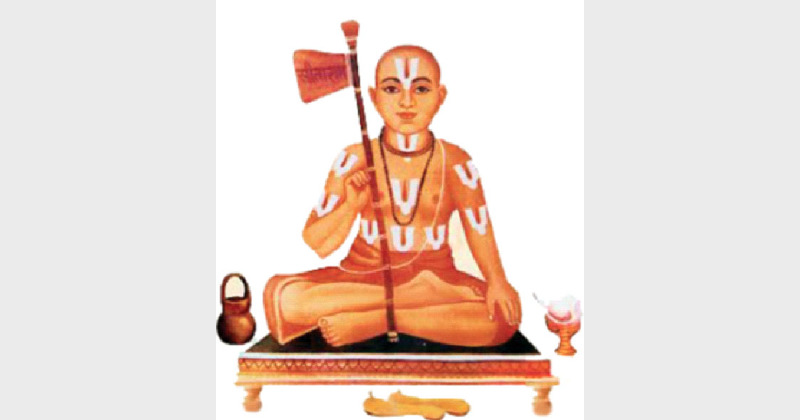
Though there has been no dearth of gurus but there are only a few who have truly realised and emulated the great verse of the Vedas i.e. Sarva Khalvindam Brahma (One super being pervades in every being) and they are only still being reverently remembered by people at large. Shri Ramanujacharya and Ramananda are two great gurus of this kind in the medieval period. It was during the Bhakti Movement that the birth of an individual was related to his guna (trait) and karma (action). Its first proponent in South India was Shri Ramanujacharya; and later it was Ramananda Swami who spread it in North India.
Ramanuja earned the knowledge of different schools of Dharma from five different acharyas. But living in the proximity from whom he learnt Ramayana was Shri Nambi (Ghosthipoorna), who was born in an untouchable family. When Ramanuja went to him to seek his blessings, Nambi asked him, “Hailing from low-descent, how could I teach a Brahmin like you.” At this Ramanuja answered , “Does one get to be Brahmin merely by putting yagyopavit (sacred thread)?” He who has devotion to God, is only a true Brahmin. Great aalvar saints belonged to different castes other than Brahmin, but they all were Bhagvad bhaktas. We all know well that by the virtue of his abilities low caste born Tiruppan Aalvar became worshipful to many Brahmins. And, most of all, despite being a Kshatriya, Yudhisthir used to worship low-caste born Vidur. Another spiritual master of Ramanuja was Shri Periar Nambi (Mahapoorna). He too belonged to low caste. From him Ramanuja learned the knowledge of Vedas and Nalayir Prabandham (Tamil Vedas). It was Shri Periar Nambi who initiated Ramanuja into Vaishnav faith, and from here only Ramanuja later rose as a successor to the supreme seat of Vaishnavism. In Vaishnav cult Tiruvaimouli is considered to be the basic scripture of bhakti and philosophy, the writer of which was Nammalvar, who belonged to an untouchable caste. Ramanuja inspired one of his disciples to write a treatise on Tiruvaimouli.
Born at Prayag, Ramananda Swami was the first great Bhakti saint of North India. He opened the door of Bhakti to all without any distinction of birth, caste, creed or sex. He was a worshipper of Sri Ram and believed in two great principles, namely as perfect love for God and human brotherhood. Most prominent among those who got initiated or inspired in one way or the other in the realm of religion from Ramananda were none other than Guru Nanak Dev, Kabir, Dhanna, Sen, Pipa, Padmavati and Ravidas, all non-Brahmins.
A disciple of Ramananda, Kabir’s mission was to preach a religion of love which would unite all castes and creeds. He emphasised the unity of God whom he call by several names, such as Ram, Hari, Allah, etc. He strongly denounced Hindu and Muslim rituals and the caste system, especially the practice of untouchability. However, he was not a social reformer, his emphasis being reform of the individual under the guidance of a true guru. His dohas and sakhi (poems) are found in the Bijak. After Kabir’s death, his Muslim disciples organised themselves in Maghar, and the Hindu disciples were organised into an order by Surat Gopala, with their centre at Banaras.
Suppressed by ruling class, the Hindus, at the time of Guru Nanak, were not only depressed in spirit but had lost all sense of honour and self respect. But instead of unitedly resisting this maltreatment due to their faiths in multiple deities, they were quarrelling among themselves and spreading hatred among different castes and classes damning and condemning, those who did not belong to their own self-created higher castes, as Sudras, untouchables and Melechhas or Yavanas. Guru Nanak therefore visualised that there could be no social revolution in India without a frontal attack on the caste system which was destroying human dignity. Therefore, he strongly and unequivocally denounced the caste system. Guru Nanak stood for the wellbeing of all human beings and not of any person belonging to a particular caste or creed. At the time of Guru Nanak’s birth society was going through an era of corruption and spiritual decay. Guru Nanak’s task was to restore the reign of truth, justice and Human Rights and rekindle the light of love and goodwill among members of all communities through his message of equality of all mankind.
Narayana Guru also raised voice against untouchability. Born into a family of the Ezhava caste in an era when people from such communities, which were regarded as Avarna, faced much injustice in the caste-ridden society of Kerala, Narayana Guru led a reform movement in Kerala. He rejected casteism, and promoted new values of spiritual freedom and social equality. He stressed the need for the spiritual and social uplift of the downtrodden by their own efforts through the establishment of temples and educational institutions. In the process, he denounced the superstitions that clouded the fundamental Hindu cultural
convention of caste. Deeply influenced by Vedanta and by ideas of social equality and social and religious reform, he taught religion and Sanskrit to local children and studied yoga with notable ascetics such as Chattampi Swami. In the course of his wanderings in search of enlightenment, Narayana Guru visited Aruvippuram, where he and his followers erected a temple dedicated to Shiva in 1888, defying the tradition that this was done by Brahmins alone. As a youth, Narayana Guru turned away from the temple rituals of his local village and travelled widely, living an ascetic lifestyle and seeking religious understanding. He eventually became a school teacher and then a religious reformer. In 1913, Narayana Guru founded the Advaita Ashram at Aluva, dedicating it to the principle of Om Sahodaryam Sarvatra (universal brotherhood).
And in modern period we can see the reflection of such gurus in the life of Baba Saheb Ambedkar. Being himself born in an ‘untouchable’ caste of Mahars in Maharashtra, Ambedkar was a social outcast in his early days. Even in his school, he was treated as an ‘untouchable’. His schoolmates would not eat beside him, his teachers did not touch his copies as he came from a family that was considered ‘unclean’ by the orthodox Hindus. Yet such instances are also not a few when such persons who viewed untouchability as a stigma on humanity rose to the occasions and offered their assistance to Ambedkar. Bheemrao Ambedker is the first Indian to have done PhD in Economics from London School of Economics. It was Sayaji Rao Gayakwad the King of Baroda State who financially assisted Ambedkar and sent him to London. And it was Krishnaji Arjun Kaluskar who inspired Sayaji for this humanitarian work In 1907 a function was organised to honour Bheemrao for being the first student of the Mahar Community to have passed matric exam. In the function one who was invited as a main speaker was also none other than Kaluskar. On the occasion Kaluskar presented a booklet on Gautam Buddha written by him as a gift to Ambedkar. It is said that it was this book that sowed the seed of Buddhism in the mind of Bheemrao, and later inspired him to embrace Bodh dharma.