 How could these temples be built in a straight line about 3000 years ago?
Prashant Pole
The five elements (Panch Mahabhutas) have a special place in the Hindu philosophy. Even the western world have accepted this concept. A popular writer like Dan Brown mentions this concept and writes a novel based on it.
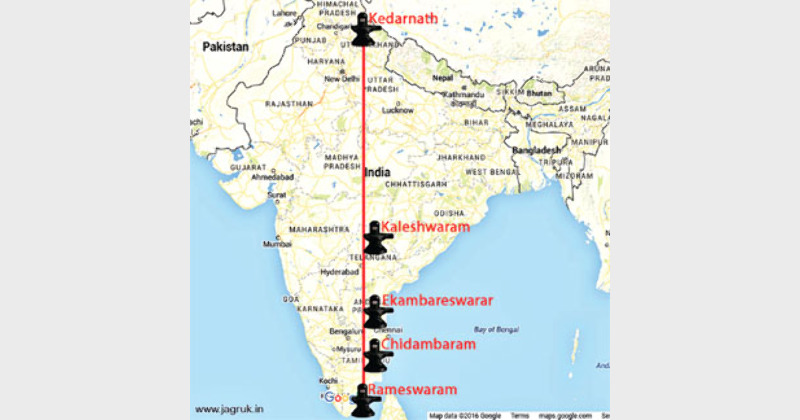
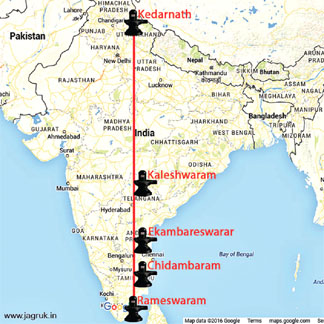
These five elements are water, air, ether (space), earth and fire. It is believed that our whole life cycle is woven around these five elements. How many of us know that there are grand and unique temples of these five elements in our country? Just a handful. The temples of five elements are essentially Shiva temples, the temples dedicated to Mahadev. However, that is not a great singularity or mystery in it. The uniqueness or the mystery of these five temples of five elements is that three of them, which are hundreds of kilometres of away from each other, are in a straight line.
These three temples are –
- Shri Kalhasti Temple
- Shri Ekambareswarar Temple, Kanchipuram
- Shri Thilai Natraja Temple, Tiruchirappalli (Trichanapalli)
The longitude of all the three temples is 79.41 E. It means that all of them are in one straight line. The Kalhasti and Shri Ekambareswarar temples are 125 kilometres away
from each other, while Shri Ekambareswarar and Shri Thilai Natraja Temples are 175 kilometres away. No one can tell as to when these three temples were built. The references are found that Pallav, Chola etc. kings, who ruled this part of the country, renovated the temples. However, one can easily tell that these temples must be more than 3000 years old.
Now, this is the real mystery. How could these temples be built in a straight line so far away from each other about 3000 years ago?
Was the cartography so advanced in those times that they had the knowledge of latitudes and longitudes? However, they must have needed the knowledge of contour map besides the perfect knowledge of latitudes and longitudes to build so lateral temples! Or did they utilise some other method?
Interestingly, when these three temples in a lateral line are connected with other two temples, they create specific angles.
One of the temples of five elements is in Andhra Pradesh while remaining four are in Tamil Nadu. Of these, Shri Kalhasti Temple, which represents the air element, is in the Chittoor district of AP, about 35 kms from Tirupati. This temple is situated on the bank of a small river, Swarnmukhi.
Even though this temple is very ancient, the inner sanctum sanctorum of the temple was built in 5th century while the outer part, of the Gopuras, was built in 11th century. References are found that Pallava, Chola and later Vijayanagar kings repaired and did some constructions in the temple. References are also found about Adi Shankaracharya having visited this temple. Adi Shankaracharya himself mentions this temple and the Bhakt Kanappa from here in his Shivanand Lahari.
This temple represents the air element of the five elements. The Shivaling in the temple is white and it is considered to be swayambhu. This Shivaling is never touched (as it is of air element). Even the priests of the temple never touch it. A separate Utsav Linga is kept there for abhisheka and worship. The amusing fact is that a lamp burns in the sanctum sanctorum of the temple forever and it is constantly flickering. One has to understand this a bit, because the sanctum sanctorum of the temple is very small and it has no place for the air to enter. The flickering of the lamp continues even when the priest closes the door. Why does the lamp flickers when there is no air…? No scientific explanation has been found for this till date. However, the people here say that the lamp always flickers because the Shivaling is of air element.
About 125 kilometres to the south from here another of the five elements temple is situated in a lateral position – Shri Ekambareswarar Temple. It stands at the famous Kanchipuram in Tamil Nadu and represents the Earth element.
Since it is of earth element, it is made of soil. It is believed that Parvati did penance below a mango tree to get Mahadev and that was before a earthen Shivaling. Thus, it is called Ekambareswarar as Ekambareswar means the god of mango tree in Tamil. Even today, an ancient mango tree stands in the premise of the temple. It is reported that carbon dating has shown the antiquity of this tree as 3000 years. This tree is considered as the symbol of four Vedas. It is said that the tree bears mangoes of four different tastes. The temple stands in the Kanchipuram city that is famous for Kanchipuram sarees.
In the lateral position to these two temples to the south stands third of the five elements temple – Thilai Natraja Temple. This temple, representing the ether element, is in the Chidambaram city of Tamil Nadu. This is a very ancient temple founded by Rishi Patanjali himself. It is difficult as to exactly when it was built. However, references are found that Pallava and Chola kings carried out repairs in the temple in 5th and 6th centuries. The 108 different facets of Bharat Natyam are carved on the stone pillars of the temples. This also means that an advanced dance form of Bharat Natyam existed even thousands of years ago…! However, not a single icon or facet of Natraja is carved anywhere on the pillar even though there are many facets of Mahadev. The idol is in the sanctum sanctorum.
Lord Mahadev is in the form of Natraja here, accompanied by Shivkami or Parvati. However, there is a little empty space beside the Shiva idol in the form of Natraja, that is called “Chidambara Rahasyam”. This empty space is decorated with the garland of gold plates. According to a belief here, this is not an empty space but is the (formless) ether element. It is believed that Shiva and Parvati, in the form of Kali, danced here.
About 40 kms from the Chidambaram, the Kaveri river meets the sea. The Chola kings had built the port for ships in this area in 8th or 9th century. This place is called Poompuhar. This was a big and famous port on the eastern coast at one time. Today, however, it is reduced to a small village. The archaeology department carried out excavations in the Poompuhar some years ago and found remains of about two to two and half thousand years old affluent and developed city. One is astounded after seeing the planning, roads, houses, nallahs, drainage system etc. in this city.
All in all, a very flourishing and developed culture existed here at least 2000-3000 years ago. The culture that laid out a grand block of the five temples of five elements in this vast world.Making a specific angle with the straight line made by these three temples is the fourth of the five elements temples – Jambukeshwar Tample. This temple stands in the Thiruvanaikal village near Thiruchirapalli. It represents the water element and standing on the north bank of Kaveri river, its uniqueness of lies in the small but alive spring below the Shivaling here. Therefore, this Shivaling is always immersed in the water.
The last of the five elements temples that forms a specific angle with the these three temples is the Arunachaleshwar Temple. This temple, standing at Thiruannamalai in Tamil Nadu, represents the fire element. It is one of the biggest temples in Bharat. This temple, built on a hill, is spread on a large area and has a compound wall having more than 700 ft of height and its Gopuras are as high as a 14-storyed building.
(The writer is an IT consultant & a blogger and writes on Indian culture and knowledge system)