Writers who are building a new narrative should not turn their attention away from the massive majority of people in India whose well-being still needs to be ensured
Vamsee Juluri
In today’s world, where a generic notion of “content” seems ready to replace richness, variety, and nuance of creative expression in art, literature, journalism, and various other fields, it is useful to pause and reflect on the question of writing. Who is a writer? Why does she or he writes? And what they are writing for, ultimately? Is it a mere commodity, or an exercise in narcissism, as much digital activity seems to be? Or is it an emancipatory act, a prelude to revolution, as most serious writers often thought of what they did?
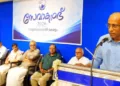
These are some of the questions that come to my mind after my two days at the Writer's Meet held in New Delhi by the Syama Prasad Mookerji Research Foundation (SPMRF). The focus of the meet was on the question of an alternative narrative, and this was discussed in several vibrant and engaging ways by the 300 participants who attended from all across India. There were journalists and novelists, poets and satirists, political figures and activists, students and professors, and most of all, several leading new media trailblazers who have been at the forefront of keeping alive news and opinions suppressed or ignored by big media companies the last few years in India.
There is an “alternative narrative” that already exists in India, unacknowledged (or often misrepresented and demonised) in mainstream media, and there it was, embodied, alive, and real. At the meet were many of the people who gave a voice to the non-violent democratic revolution that took place in 2014 against an entrenched, divisive, violent and corrupt political system.
I felt energised to be among people fighting against the odds still for the future of India, and indeed, the future of the writer’s role in a free society. Whether these bloggers, twitter giants, and others think of themselves as “writers” or not, they are all stepping up to the role that writers have been expected to play in society, as defenders of truth and explorers of new paths.
Yet, the media-feted image of the writer that has circulated in elite Indian and international circles for some time now has focused almost entirely only on a certain kind of writer, one who returns awards and signs petitions, and participates, it would seem, in a mass produced delusion about India that curses and demonises its people and aspirations. But that paradigm, it is safe to say, is passing. It is dominant still, for now, and it still holds moral appeal and influence because it does strive to speak for certain issues and communities marginalised and oppressed. However, and this is important for the new writers of India to recognise, that paradigm’s vision of justice and freedom has been deeply tainted by its co—optation by global systems of power, injustice, and indeed, violence.
India’s new writers are free of that taint. They may not yet have the influence, importance or sometimes even experience and professionalism to fulfill the huge task this moment in history has given to them, but they are being led by conscience, and for the first time, as far as I know, they have actually gathered in one space to speak with each other about the forms of expression that sort of conscience might lead them to.
Old and New Paradigms
The problem with what has been a rather domineering and dominant paradigm in the discourse on India was summed up crisply by film-maker Vivek Agnihotri in his talk: there is simply no India in the narrative on India! He shared several examples to demonstrate how alienated movies and movie-makers have become from the everyday concerns and lives of people in India, and the same concern was apparent in several other contexts as well. I spoke about the near-absurd levels to which the academic paradigms on Indian history, religion and politics have shifted to in the West, despite their stated good intentions of empowering postcolonial voices and positions, using as a case-study the recent struggle to retain the name of India in the California middle school history curriculum. Academia, and in turn much of the international news media, seems to have swallowed uncritically the claim that the civilisational, historical, cultural and political continuities of India are no more than elite and elitist constructs, and are pushing positions that in any other context would be deemed baseless, biased, and sometimes incredibly apologetic towards violence and imperialism.
The biggest challenge in confronting these problematic narratives today is the near complete absence of an alternative institutional structure. When academia, mainstream media, and even entertainment media and popular culture have seemingly bought into a highly dubious discourse that normalises and excuses violence against the people of India, arguing against all evidence that somehow well-organised forces of terror and destruction are nothing more than aspirations of the unjustly oppressed, the task of showing a mirror to the hoaxes of our time is not an easy one. There is, after all, a huge difference in professional and financial capital between the forces manufacturing the dominant discourse on India today, and the many small real and online communities of writers and readers resisting it valiantly.
And the problem is not simply that this dominant discourse is unpatriotic or anti-national. The real problem is that it is part of a much deeper malaise that has set into the major social and cultural institutions of the country since colonialism, and sadly, even after Independence too.
Intellectual Change and Democratic Change
I feel that there has been a sense of impatience, if not frustration, that somehow the mandate the people of India gave for a change in 2014 has not translated into a transformation in the spheres of education, media, and culture. There are constitutional limits to what can be done in terms of governance, no matter what the established and emerging ideals and ideologies of a new democratic moment might demand. And despite all the loose talks in certain privileged media and activist circles about India allegedly heading for some kind of dictatorial regime, the truth remains what it is, and in a constitutional democracy, the fact is there is no such thing as a forced change in the narrative. An important lesson one might draw from the Writer’s Meet is that while political representatives clearly do not intend to ignore their intellectual and literary constituents, the onus for now, especially in the absence of a concrete “alternative narrative infrastructure,” is on them to carry on with their writing indifferent to expectations about the outcome. The Writer's Meet served as a reminder of what writers for India ought to be
looking to, and looking up to. What India’s writers have now is the task of decolonising the dominant narrative as it plays out in the minds and lives of the young. Considering how young, idealistic, and liberal some of the
participants at the meet are, it gives one a sense of hope.
The gathering was a reminder to every writer that the power that the words he or she wields comes not just from his own striving, but ultimately from the struggles and sacrifices that the whole of humanity has made to give them its meanings.
(The writer is USF Professor and author of Rearming Hinduism)