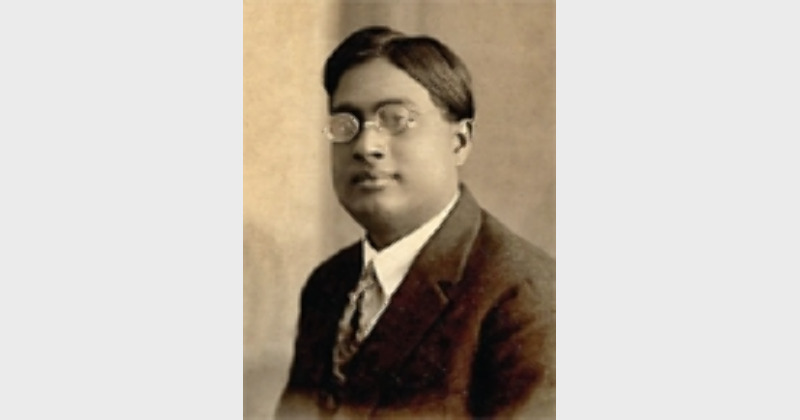
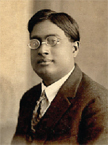
 The great scientist Satyendra Nath Basu was born on January 1, 1894 in Calcutta (now Kolkata). His father Surendra Nath Basu was employed in the Engineering department of the East India Railway and his mother Amodini Devi was a house wife. Satyendra Nath was the eldest child of his parents and he had six sisters. He started his education at an elementary school in Calcutta before he joined the Hindu School in 1907. In school days he identified himself as an extraordinary student. He was encouraged by the outstanding Mathematics teacher and the Headmaster of Hindu School. Once he established a new record by scoring 110 marks out of 100 marks in Mathematics examination. He had solved some problems in Mathematics (particularly in Geometry) by various approaches – some of them were totally new. Young Satyendra Nath also showed his skill in handling various apparatus in his school days. He constructed a telescope and other scientific instruments in collaboration with his school mates.
In 1909, Satyendra Nath was admitted to the Presidency College of Calcutta for higher studies after successful completion of the final school examination (ranked 5th). That period was the golden age of the Presidency College as there were brilliant students and extraordinary teachers. Renowned scientists – Meghnad Saha, Nikhil Ranjan Basu, JC Ghosh, JN Mukherjee and Girijapathi Bhattacharyya were his classmates, and he came across Netaji Subhas Chandra Basu in college life. Satyendranath came in contact with great teachers like Prof JC Basu, Prof Prafulla Chandra Ray, Prof SN Maitra and others. Young Satyendra Nath was impressed by the teaching of these great scientists and seed of patriotism was sown in the young mind by these great patriotic teachers. Satyendra Nath completed his BSc with Mathematics Honours in 1913 and then MSc in mixed mathematics (now Applied Mathematics) in 1915 with record marks, and ranked first in all the examinations starting from the Intermediate examination. While Satyendranath was a Post-Graduate student he married Usha Devi on 5th May 1914, at the age of twenty, the couple had five children -2 sons and 3 daughters.
Satyendra Nath started his service career as a Lecturer in Physics in Calcutta University in 1916. In fact, he was appointed to the newly opened University College of Science under Calcutta University. He served there till 1921. Then he went to Dacca University as a Reader in Physics Department. He taught there till 1945, being a professor and head of the department from 1927. In 1945, he came back to Calcutta on being appointed as Khaira Professor of Physics in Calcutta University and retained in that post till his retirement 1956. Then the university honoured him with Emeritus Professorship. He became the Vice-Chancellor of Viswabharati University in same year but resigned in 1958 after being appointed as a National Professor.
Basu started his research career immediately after he joined the service. His first research article on “Equation of State” was published jointly with his friend and colleague Meghnad Saha in the Philosophical Magazine in 1918. They incorporated Relativity Theory to explain many aspects of gases and it”s now referred as “Saha-Basu” equation. Subsequently, his work on Rydberg’s Principle was also published in the same journal.
Immediately after he joined Dacca University, he wrote a short article of just six pages relating to Planck’s Law and Light Quantum hypotheses, and sent it to Philosophical Magazine for publication. Unfortunately, the editor could not understand the subject matter and rejected the article. Basu then sent the article directly to Einstein who realised the importance of the work, translated the article into German, and sent it to Zeitschrift fir Physik for publication with his comments. Later Einstein adopted Basu’s approach in a more systematic manner, which is now known as “Basu-Einstein” Statistics and the corresponding fundamental particles are known as Bosons. In 1924 onwards, Basu visited various research institutes in Europe and discussed with renowned scientists like Madame Curie, Schrodinger, Heisenberg and others. He discussed extensively with Einstein about their joint works. He got the great honour of being an elected fellow of the Royal Society of London in 1958. He was the President of the Indian Science Congress in 1955. He had also much interest in other branches of science (Chemistry, Geology, Zoology, Anthropology and Engineering). He was fond of art and music of Bengal, and developed expertise on the musical instrument “Esraj”. He was a critic of music and composed some new ragas.
Throughout his life, he fought for science education in Mother Tongue. Visiting different foreign countries he realised the importance of education in Mother Language. He had the opinion that a layman is able to understand science if it is taught in his mother tongue. He founded a science association in Bengal named Bangiya Vijnan Parishad in 1948. All correspondence of the Parishad is carried out in Bengali and it publishes a periodical entitled Jnan o Vijnan. He succeeded in his fight for imparting Science Education in Mother Tongue, when Calcutta University got the permission of the government to impart instructions in Bengali. He taught Physics at the Post-graduate classes in Bengali. At the age of 80, Basu suffered a severe heart attack, lay ill for some time and then passed away on February 4, 1974. Though he is no longer with us, he remains in our mind and in the scientific community for his works, particularly in the name of the fundamental particle ‘Boson’, the existence of which was experimentally verified in 2012.
Prof Subenoy Chakraborty (The writer is Professor at Jadavpur University, Kolkata)