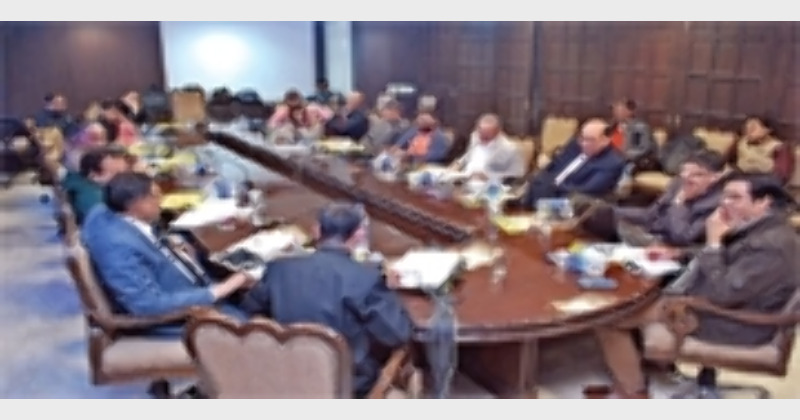
In the third chapter of annual event of Dialogue on Defence, Organiser and Panchjanya in a day-long brainstorming on the challenge of Red Terrorism, tried to address all possible dimensions of the biggest internal security threat. Here are the excerpts of that dialogue:
Power of Communication: Mobile Radio can puncture the Maoist systems—Shubhranshu Chaudhary
In my view, Red Terror is not limited to Chhattisgarh but dispersed all over the nation. The people who started this battle in 1960s are still there and they want to transform the system through violent means. From their side, the war is in dual mode. Maoists fight without weapons who are just 1-2 per cent in numbers while 99 per cent are Maoist supporters who carry weapons. Most of these supporters are with the Maoists not because of their ideological appeal but because we failed to communicate with them, be in touch with them or we pushed them. On ground, Maoist movement is losing power in Bastar at leadership level. Out of 40 polit bureau members, 20 or even less than that are there. Some are in jails or some have lost their lives. The intellectual support that they used to get in 1990s is also waning. With local support, 100-200 intellectuals are with them.
We never tried to communicate with these Vanvasis. They listen to only All India Radio but after almost 70 years there is no single news bulletin in Gondi which is a language of 12 crore Vanvasis. There is no institution studying Gondi language. We consider Maoism to be the biggest internal security threat, but we do not find journalists, police officers or administrative officers who have tried to learn their language. In such a situation, Radio can do wonders.
If nobody is talking to me, I will obviously talk to the other side. They have the option of Maoists. If we provide them mobile technology to communicate, to sing their songs, to share their problems, many issues can be solved. This can puncture the systems created by the Maoists. We need to create hope which they have lost among Vanvasis. Maoists never claim that they are going to improve the situation of Vanvasis. They want to unfurl the Red Flag on Red Fort. This area was just a hiding ground for them, now it has become headquarters for Maoists.
- Vijay Kranti : Common people have to be connected with the mainstream. If a person living in the interiors of the forests does not get the benefits of the national systems, anybody can take him along.
- Pawan Deo : The argument of neglect is baseless. The real issue is police factor. Locals are afraid of Maoists and they are not confident that police machinery can secure them 24X7.
- Ata Hasnain: We need to analyse why Maoism has been perpetuating for such a long time and who is behind this. If somebody is with them, who is he? Such movement cannot sustain them without resources or strong support. Unless grass-roots politics is strengthened, real success is not possible. What is the scenario of Panchayati Raj institutions in Chhattisgarh?
- Shubhranshu Chaudhary: I am looking at this problem from language point of view. Bastar is a part of Central Bharat with large Vanvasi population. This cannot be ruled by the north Bharat mindset. As far as local governance is concerned, there is also a language barrier. You go two kilometers in the forests and you will die with hunger if you do not know Gondi.
- Alok Bansal: I believe that ‘Maoism has perpetuated because of lack of development’ is a false argument. I disagree with Shubhranshu on this point. He said, people became Maoists in 1990s. I have stayed in Bastar when DP Mishra was charged with murder. Praverchand Bhanjdeo was killed in his own house. Till then, there was no Maoism. There was no conflict between Hindi and Gondi. Vanvasis of Bastar are most satisfied. Like Islamic fundamentalism, another fundamentalist ideology is rising there. The efforts of bringing Naxalism in 1970s failed miserably. Why they were successful in 1990s, is the real question.
- Where are the Linkages: P V Ramana : Just to place things in perspective, the People’s War Group was formed in 1980. In 1991, in an official document, declared Kondapalli Seetharamaiah that ‘Abujhmad is strategically important for us, this will be our command headquarters and let us go and occupy this place. Bastar of today is because of Lanka Papi Reddy.’
Whether some organisations declare revolution as their objective or not, intruding in such groups, establishing strategic linkages and creating influence has been part of the Maoists strategy. All of us have heard of World Economic Forum. It conducts its meetings. And wherever World Economic Forum works, the world social forum also reaches there and conducts its meetings. But the world social forum itself has been brought by the western imperialists. It took the Maoists a little late to understand this. And then for an answer to World Social Forum, they formed what is known as MR 2004, Mumbai Resistance 2004. It was formed in January 2004. 43 countries right from Latin America to Philippines in Southeast Asia were represented in the meeting. They have also conducted rallies in Mumbai and brought out documentaries. And to my surprise, one of the CDs circulated there is known as Blazing Train. It is a documentary on the Maoist revolution in Bastar.
- Coordination between Centre and States is must—Prakash Singh : The big question today is how to counter the Maoists menace? The coordination between the Centre and the States is very crucial in this regard. But unfortunately it is missing on the ground. Our reluctance to act sternly on this front is evident from the fact that there is no national policy to deal with this extremism. Why it is so, is unknown. The prime reason of poor coordination between the states and centre is that we do not have any security policy at the national level. The Chief Ministers are trying to deal with it according to their own understanding and wisdom. Every state seems to be fighting in its own manner. Some believe in police action while some call for economic development. This is the reason the problem which began in 1971, why has now spread to 180 districts. Many Chief Ministers are openly alleged to be taking the help of the Maoists during polls.
Sharing of intelligence input between states and Centre and state and state is also crucial. Sometime back West Bengal and Jharkhand blamed each other for not sharing the information. The SIB of Andhra Pradesh has done wonderful work on this front. They have supplied intelligence to Centre also. Every state seems to be fighting against this menace in its own way. Some believe in stern action, while some opt for economic development. Since there is lack of coordination between the states the problem continues to assume more gigantic form and now about 180 districts are in its grip. Even some political parties use them in the election in their favour. Many Chief Ministers have been blamed for using the Maoists in their favour during the polls. But on the other hand in Andhra Pradesh the District Magistrate and Superintendent of Police formulate plans at their own level in the districts and establish contact with the people in villages. The Superintendent of Police himself organised sports activities for children in villages. The police also provide medical aid and financial aid to the sick and also look after the family members of the misguided youth who joined the Maoists. This has produced some good results.
It has been witnessed that our continuous reluctance towards a minor problem helps it to assume a gigantic form, which later on becomes a major threat to the internal security. This is a fact that you cannot fight against any problem without putting your life in danger.
- Col Jaibans Singh : Five-six states are suffering from Maoism today. The Naxalites are fighting in different manners. Then how can the central government fight against it in a single plan? Similarly, a single department can also not deal with it. It requires multipronged strategy.
n Prakash Singh : See, a national policy can resolve the problem in all the states. The problem is that we do not have national policy to fight against terrorism also. The policies in the US and Britain are very clear in this regard but we do not have a single paper for it. It is strange that no government ever thought about it, any policy can be formulated within five-six months. - Pawan Deo : During my visit to Loss Angeles I asked some police officers how they prevented the repeat of 9/11, whereas in Bharat we see the repeated attacks. They replied that one will have to nab the culprits to prevent the repeat of the attacks.
n Prakash Singh : The problem with us in Bharat is that whenever the government initiates action against the terrorists or naxalites, the opposition parties start hue and cry even before the beginning of the action. Fact is that there should be no intervention in matters related to security. After the attack the France Government took a decision to take stern action. No one opposed it. But an uproar was created world over on the Batla House encounter in Bharat. There seems to be no commitment to security in our country. There must be a national policy on security. If the government fails to make it then who will do it? - KG Suresh : We talked about ideology, let us look at the national perspective. For the last 65 years, you had almost a one party rule in this country, because there was no counter ideology. One ideology tends to dominate, when there is no counter ideology. In the absence of that, the state cannot be a counter ideology; the police cannot be a counter ideology. An ideology has to be countered with another ideology. I think these are very critical, to resolve this.
- Transparency in policies will produce results: Pawan Deo: According to the Constitution, Law and order is the jurisdiction of the state. Now CRPF or ITBP do not know what to do. These security forces suggest to eliminate naxalism, whereas the state police have different thinking as they have to listen to their DG. If there is no coordination in operations, no problem can be resolved.
- Prakash Singh: There are problems with the state police too. We should understand that when the state police fail to take effective action against the Maoists, the central forces are to be deployed. Why are policemen in large number are not sent during the operation? If the state governments start action on their level, many problems can be resolved.
- Dhruv Katoch: We have to understand that the people who are actually working on the ground are not of officer level. They are at the lowest level of the forest guard, the lowest level of the police. There is a problem. We have to understand that problem. There is a lack of Empathy. How are we going to sort out this issue? It’s going to take time. Ultimately, the fear of gun is still there.
Ultimately you have to get a unified commanding and control system. You need to have a proper commanding structure. You need to get a grid system. You can have force from the state police. There will have to be a joint-command. You can have a system by which both the local police and CRPF officers have to live on the ground. - Shun hesitation: Prakash Singh : Today the situation is so much critical in certain areas of the country that anybody can go to Mount Everest but not to those areas. Sometime back I reached the border of Abujhmad, but the local police did not allow me to move forward citing security reasons.